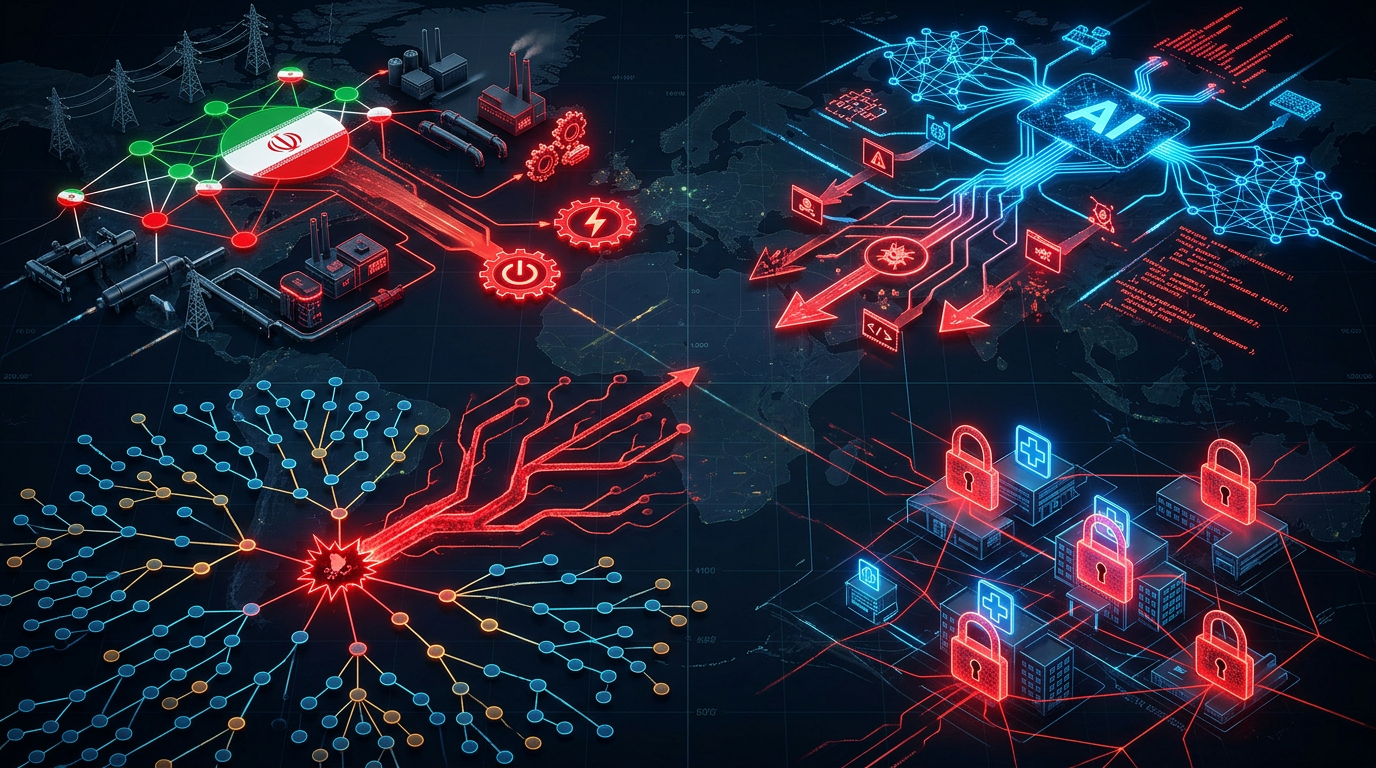
For years, the security community treated AI-assisted attacks as a looming threat — something to prepare for, not yet contend with. That window has closed. Across threat intelligence feeds, incident reports, and real-world breach investigations, the same pattern is emerging: adversaries have moved from experimenting with AI to weaponizing it at scale. The implications for defenders are profound and, in several respects, unlike anything the industry has faced before.
Understanding how AI is being exploited — and where the defensive gaps are widest — is no longer optional for security professionals. It is the central challenge of this moment.
From Script Kiddies to Scalable Adversaries
One of AI's most significant contributions to the attacker ecosystem is democratization. Tasks that once required sophisticated tradecraft — crafting convincing phishing lures, writing functional malware, identifying and chaining vulnerabilities — can now be partially or fully automated using large language models (LLMs) and purpose-built AI tools. The barrier to entry for launching capable attacks has dropped dramatically.
This isn't speculative. Security researchers have documented jailbroken and uncensored LLMs circulating in criminal marketplaces, sold under names like "WormGPT" and "FraudGPT." These tools strip away the safety guardrails built into consumer-facing AI products, leaving behind a system optimized purely for generating malicious content on demand. A relatively unsophisticated threat actor can now generate targeted spear-phishing emails, polymorphic malware variants, or convincing executive impersonations in minutes, not days.
The barrier to entry for launching capable attacks has dropped dramatically — and the ceiling on attack sophistication has risen just as fast.
Hyper-Personalized Social Engineering
Traditional phishing relied on volume to compensate for low quality. AI has inverted that calculus. By ingesting publicly available data — LinkedIn profiles, corporate websites, news articles, social media posts — AI-driven attack frameworks can now generate highly personalized messages that convincingly mimic the tone, language, and context of legitimate communication.
In several recently documented campaigns, attackers used AI to clone the writing style of senior executives by training on publicly available communications. The resulting emails, sent to finance and HR personnel, were indistinguishable from the real thing — and the business email compromise (BEC) losses that followed were significant. Deepfake audio and video are adding another layer to this threat, with voice-cloning tools now capable of replicating a person's voice from as little as a few seconds of sample audio.
The practical implication is clear: email filters, link scanners, and even human intuition are no longer sufficient detection mechanisms when the phishing content is grammatically perfect, contextually accurate, and stylistically authentic.
AI-Accelerated Vulnerability Discovery and Exploitation
The vulnerability lifecycle — from discovery to exploitation — is compressing at an alarming rate. AI models trained on large codebases, CVE databases, and exploit frameworks are capable of identifying classes of vulnerabilities faster than human researchers. For defenders, this means the window between patch release and active exploitation continues to shrink.
More concerning are reports of AI being used to automatically generate working exploits for newly disclosed vulnerabilities. In some cases, proof-of-concept code has appeared in criminal forums within hours of a CVE publication. This renders the traditional patching cadence — typically measured in days or weeks — dangerously inadequate against threat actors augmented with AI tooling.
Autonomous Attack Agents
Perhaps the most significant development on the horizon — and in early stages of deployment — is the emergence of autonomous AI agents capable of conducting multi-stage attacks with minimal human oversight. These systems can chain together reconnaissance, initial access, lateral movement, and exfiltration in a coordinated sequence, adapting in real time to defensive countermeasures.
Security researchers have demonstrated proof-of-concept "pentesting agents" that, when pointed at a target environment, can autonomously discover and exploit vulnerabilities without human direction. While these tools are currently positioned as red-team utilities, the underlying technology is dual-use, and it would be naive to assume adversaries are not investing in similar capabilities.
Defending Against an AI-Augmented Adversary
The defensive response to AI-powered threats cannot rely solely on traditional signature-based or rule-driven controls. It requires a paradigm shift toward behavioral analysis, AI-assisted detection, and significantly faster response cycles.
Organizations should prioritize deploying AI-native detection capabilities that can identify subtle behavioral deviations — lateral movement patterns, anomalous data access, unusual authentication sequences — that would evade conventional SIEM rules. Equally important is investment in human-AI collaboration workflows, where AI handles triage and correlation at scale while human analysts focus on contextualization and decision-making.
On the policy and architecture side, zero-trust principles become even more critical in an environment where identity-based attacks are increasingly convincing. Multi-factor authentication, least-privilege access, and continuous verification should be treated as non-negotiable baseline controls — not aspirational goals.
Finally, organizations must revisit their threat intelligence programs. Static, periodic reporting is insufficient when the threat landscape evolves in hours rather than months. Real-time feeds, adversary emulation exercises, and active collaboration with peers and government partners are essential inputs for staying ahead of AI-accelerated threats.
The Asymmetry Problem
The uncomfortable reality is that AI creates a structural asymmetry that favors attackers in the near term. Attackers benefit from lower costs, faster iteration, and no accountability constraints. Defenders, by contrast, must protect a much larger and more complex attack surface, operate within budget and regulatory limits, and justify every investment to stakeholders who may not yet appreciate the scale of the shift underway.
Closing that gap requires the security community to move with urgency — sharing threat intelligence openly, advocating for the resources commensurate with the risk, and building AI capabilities into defensive operations before adversaries make that gap insurmountable. The tools exist. The knowledge is accumulating. What the moment demands now is the will to act on it.
Intel Briefs: In the News This Month
Three recent stories that illustrate the threats covered above — in practice, in the wild, and across borders.
LeakNet Ransomware Pairs ClickFix Social Engineering with Deno Runtime to Evade Detection
A newly documented ransomware campaign tracked as LeakNet is combining two techniques that, together, create a particularly stealthy delivery chain. The initial access vector is ClickFix — a social engineering method in which victims are presented with a convincing fake browser or application error, then instructed to manually paste and execute a command to "fix" the problem. That command silently installs the payload.
What makes LeakNet distinctive is its choice of execution environment: rather than dropping a traditional executable, operators deliver the ransomware logic as a TypeScript script run through the Deno runtime. Because Deno is a legitimate, signed developer tool, most endpoint security products either whitelist it outright or fail to flag its activity as suspicious. The combination gives LeakNet a meaningful evasion advantage during the critical window between initial execution and encryption.
Defender Takeaway: Audit approved runtimes in your environment — Deno, Node, Python, and similar interpreters can be abused as living-off-the-land binaries. Pair application allowlisting with behavioral monitoring for unexpected script execution from browser-adjacent processes.→ Source: BleepingComputer
Handala Wiper Discovered on GitHub Disguised as a CrowdStrike Utility
Researchers at Duggan USA identified a destructive wiper malware — attributed to the pro-Palestinian hacktivist group Handala — uploaded to GitHub under the guise of a legitimate CrowdStrike tool. Handala has a history of deploying wiper payloads against Israeli organizations, and this campaign represents a calculated evolution of that playbook: rather than relying solely on phishing or credential attacks for initial access, the group used GitHub's trusted reputation and the CrowdStrike brand to encourage direct downloads.
Organizations that retrieved and executed the file in a security context would trigger immediate and irreversible data destruction. The incident is a sharp reminder that open-source platforms are not inherently trustworthy distribution channels, and that threat actors deliberately exploit brand trust at moments of heightened awareness around specific vendors.
Defender Takeaway: Validate all security tooling downloads through official vendor channels and verified checksums — even when the source appears to be a reputable platform. Establish a formal vetting process for any executable sourced outside your approved software catalogue.→ Source: Duggan USA
Europol and Partners Dismantle SocksEscort, a Residential Proxy Service Fuelling Cybercrime
In a coordinated international operation, Europol and law enforcement partners seized and disrupted SocksEscort, a long-running criminal proxy service that allowed subscribers to route malicious traffic through the internet connections of unwitting civilians. SocksEscort operated by silently compromising consumer routers, IoT devices, and endpoints and enrolling them in a residential proxy network — giving paying criminal customers IP addresses that appeared to belong to ordinary households in virtually any country.
This infrastructure was widely used to mask the origin of credential-stuffing attacks, fraud operations, and reconnaissance campaigns, making attribution extremely difficult. The takedown removes a significant anonymization layer from the criminal ecosystem and reflects the increasing willingness of international agencies to pursue the enabling infrastructure behind cybercrime, not just the end operators.
Defender Takeaway: Residential proxy traffic is notoriously difficult to block by IP reputation alone. Invest in behavioral authentication controls — velocity checks, device fingerprinting, and anomaly detection on login flows — to catch credential-stuffing even when the source addresses appear clean.→ Source: Europol