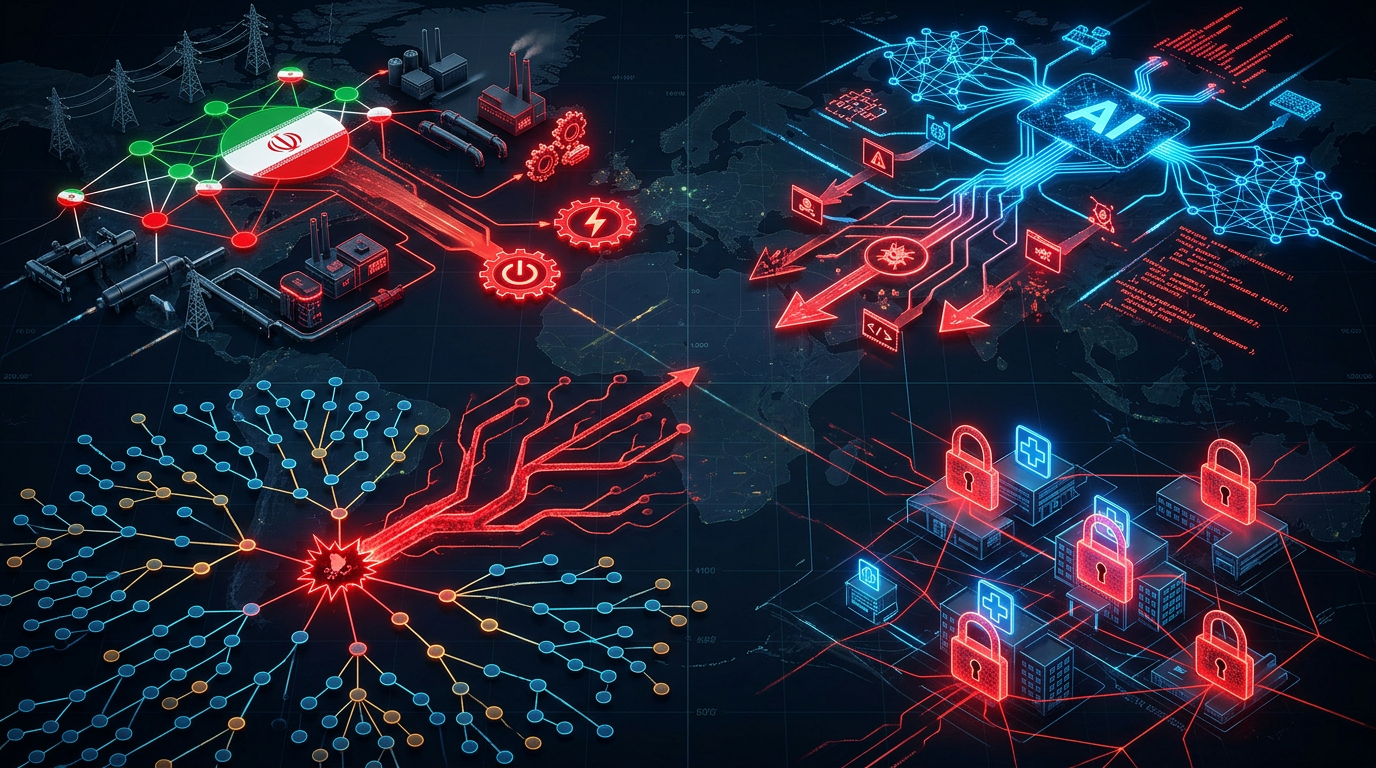
April arrived with a threat landscape operating at a pace that challenges every assumption defenders have built their programs around. Iranian state actors moved from reconnaissance to active targeting of industrial control systems at scale. Supply chain attacks evolved in technical sophistication — one campaign deployed a dropper written in the Zig programming language specifically to evade conventional detection. Healthcare ransomware crossed national borders. And the exploitation window for critical vulnerabilities collapsed from weeks to hours.
This is not a collection of isolated incidents. It is a coherent picture of adversaries who have professionalized their operations, industrialized their tooling, and studied defender playbooks closely enough to route around them. The April threat landscape demands a strategic response — not just faster patching, but a fundamental rethink of where defenders spend their time and resources.
The Exploitation Window Is Now Measured in Hours
The most operationally urgent development of April was not any single vulnerability — it was the near-total collapse of the time between public disclosure and weaponized exploitation. Two separate cases this month made the pattern undeniable.
The Marimo Python notebook platform received a critical remote code execution patch on April 11. Within hours of disclosure, active exploitation was confirmed in the wild. Attackers had reverse-engineered the patch, identified the underlying flaw, and developed functional exploit code faster than most organizations could read the security advisory — let alone test and deploy a fix.
Adobe's Acrobat Reader faced a similar dynamic. A zero-day vulnerability was confirmed under active exploitation, forcing an emergency out-of-band patch release. The urgency was significant enough to bypass Adobe's standard monthly patch cycle entirely.
The grace period for patching is gone. Organizations that treat vulnerability management as a scheduled maintenance activity are now operating with a permanent, structural exposure window.
The practical implication is significant: patch management programs built around monthly cycles or even weekly reviews are no longer fit for purpose against today's threat actors. Critical remote code execution vulnerabilities must be treated as actively exploited from the moment of public disclosure. That requires automated patch deployment pipelines, continuous asset inventory, and the organizational authority to push emergency changes outside of normal change windows.
A legacy Apache ActiveMQ Classic vulnerability — CVE-2022-41678, thirteen years old — also saw renewed exploitation activity this month. The persistence of old vulnerabilities in production environments remains one of the most consistent and exploitable patterns in the threat landscape. Attackers maintain running inventories of unpatched systems; defenders often do not.
Iranian State Actors Escalate Industrial Targeting
Iran's offensive cyber program reached a new operational tempo in April. Intelligence analysis confirmed the systematic cataloging of over 5,000 vulnerable industrial control systems across critical infrastructure networks, with the highest concentration in United States facilities. The targeting is deliberate and strategic — focused specifically on programmable logic controllers managing power generation, water treatment, and transportation systems.
This is not opportunistic scanning. The scope and focus indicate state-level coordination aimed at establishing pre-positioned access within operational technology environments for potential future activation. The targeting of PLCs specifically — devices that bridge the digital and physical worlds — signals intent beyond data theft or financial disruption. These are the systems that, if manipulated, cause physical consequences.
A parallel campaign confirmed in April targeted gas odorizer systems through a critical authentication bypass flaw in GPL750 controllers. Successful exploitation would allow unauthenticated remote manipulation of natural gas odorization levels — a safety system designed to make gas leaks detectable by smell. The implications for pipeline safety are severe.
Separately, Russian military intelligence (GRU Unit 26165, also known as Fancy Bear) was confirmed conducting DNS hijacking operations against enterprise routers to intercept Microsoft 365 credentials and authentication tokens. The technique targets the network infrastructure layer rather than endpoints or applications — a deliberate choice to operate below the visibility threshold of most endpoint security deployments.
Supply Chain Attacks Reach New Technical Sophistication
April produced multiple supply chain compromises that, taken together, represent a maturation of attacker technique that should concern any organization with complex software dependencies.
The GlassWorm campaign deployed a dropper written in Zig — a relatively new systems programming language with a small but growing adoption in the security community. The choice is tactically significant: most malware detection tooling is trained on established languages. Zig-based binaries lack the telltale signatures that behavioral engines associate with malicious code, giving the dropper meaningful evasion capability against conventional defenses.
A separate campaign compromised the CPUID website — a widely trusted hardware monitoring tool used across enterprise and enthusiast environments — to distribute the STX RAT via trojanized installers. Users downloading what appeared to be a legitimate utility were instead deploying a remote access trojan with full system control capabilities. The trust relationship with a known, reputable software source was the attack vector.
A WordPress plugin supply chain attack compromised over 800,000 sites through a backdoored plugin that passed routine repository review. The attack exploited the implicit trust that site administrators place in the official plugin ecosystem.
Supply chain attackers are not breaking through the front door. They are walking in through the vendors, tools, and ecosystems that defenders have explicitly trusted.
The consistent theme across these campaigns is the exploitation of trust relationships. Defenders cannot assume that software from known sources is clean. Verification must extend to the build process, the distribution channel, and the runtime behavior of every dependency.
Healthcare Ransomware Goes Cross-Border
The ransomware attack on ChipSoft — a major electronic health records provider serving hospitals across the Netherlands and Belgium — demonstrated a level of operational planning that goes beyond typical financially motivated ransomware campaigns. Attackers timed deployment to maximize patient care disruption, hitting systems that manage scheduling, medication dispensing, and clinical workflows simultaneously across multiple national health systems.
The cross-border nature of the impact is significant. Healthcare providers in different countries share vendor dependencies but rarely share incident response plans or mutual aid agreements. The attack exploited that gap — a single compromise producing cascading failures across jurisdictions with different regulatory frameworks, different crisis communication requirements, and different backup infrastructure.
Separately, law enforcement this month identified the Russian individual behind the GandCrab and REvil ransomware operations — two of the most destructive ransomware-as-a-service programs in history. The identification, while an important attribution milestone, came years after the peak operational damage. The criminal ecosystem that GandCrab and REvil helped create remains active under different names and affiliates.
AI Security: Both Sides of the Equation
April's AI security developments cut in two directions simultaneously — new capabilities for defenders, and an expanding attack surface that security teams are only beginning to map.
OpenAI's introduction of a $100 enterprise ChatGPT Pro tier signals the mainstreaming of AI-assisted security work. AI tools are becoming standard components of analyst workflows for log analysis, threat hunting, and report generation. The productivity gains are real. So are the data exposure risks: enterprise deployments of AI assistants create new questions about what organizational data flows through third-party model infrastructure.
AI browser extensions represent an emerging and largely unmanaged attack surface. Extensions with broad DOM access and permission to read page content can exfiltrate credentials, session tokens, and sensitive data with minimal user awareness. Most enterprise browser management policies were written before AI extensions existed; most have not been updated to account for them.
A separate development with longer-term implications: an AI system demonstrated the ability to autonomously discover zero-day vulnerabilities in production software. The research capability exists. The question of who deploys it offensively — and how quickly — is not academic.
What Security Teams Should Prioritize in May
The April threat landscape points to five operational priorities for the month ahead:
Compress the patch response window. Critical RCE vulnerabilities must be treated as actively exploited from disclosure. Build automated deployment pipelines for critical patches and establish the organizational authority to push emergency changes outside normal change windows. Review your process for the Apache ActiveMQ class of problem — old vulnerabilities in production systems that were never properly remediated.
Audit OT/ICS network exposure. Iranian targeting of industrial control systems is systematic and ongoing. Conduct an immediate inventory of internet-facing OT devices. Implement network segmentation between operational technology and corporate IT networks. Verify that PLCs and industrial controllers are not directly reachable from the internet or from untrusted network segments.
Extend supply chain verification. Treat vendor software as untrusted until verified. Implement runtime behavioral monitoring for all third-party tools and dependencies, particularly developer utilities and security software. Review browser extension policies to account for AI-enabled extensions with broad permissions.
Test healthcare and OT incident response offline. The ChipSoft attack demonstrated that healthcare organizations need tested plans for operating without electronic health records. If your incident response plan assumes system availability, it is not an incident response plan — it is a recovery plan. Practice the offline scenarios.
Map AI data flows. Inventory every AI tool in use across the organization. Understand what data each tool can access and where that data goes. Establish clear policies for what information may be processed by third-party AI systems, and verify that enterprise AI deployments are configured to prevent training on organizational data.
Exploitation Velocity: The New Benchmark for Patch SLAs
The Marimo RCE and Adobe zero-day cases this month establish a new empirical baseline: functional exploits can exist within hours of public disclosure. This is no longer an edge case — it is the operating assumption defenders must build around.
The technical mechanism is increasingly well-understood. Attackers use automated patch diffing tools to identify the specific code change introduced by a security fix, then reverse-engineer the underlying vulnerability from the delta. For memory corruption and logic flaws, this process can be largely automated. For some vulnerability classes, exploit code generation can follow within the same pipeline.
Organizations should audit their current patch SLAs against this reality. A 30-day SLA for critical vulnerabilities means operating with a confirmed exposure window for a month after public disclosure. That is not risk management — it is risk acceptance without a formal decision.
View Vulnerability Alerts →Zig as an Evasion Language: What GlassWorm Signals About Tooling Evolution
The GlassWorm campaign's use of Zig for dropper development is a leading indicator of a broader trend: threat actors actively selecting programming languages based on their evasion properties against deployed security tooling.
This follows earlier waves of Go-based and Rust-based malware, both of which gained initial evasion advantages from the relative novelty of their binary formats and runtime characteristics. Detection capabilities caught up — which is why attackers moved to Zig. The pattern will continue as new languages gain traction.
The defensive implication is behavioral rather than signature-based: organizations relying on signature detection for novel malware will consistently trail the attacker tooling cycle by one generation. Runtime behavioral analysis — what the code does, not what language it is written in — is the durable detection investment.
View Malware & Exploits →FINRA's Intelligence Fusion Center: A Model for Sector-Wide Threat Sharing
FINRA's establishment of an intelligence fusion center this month deserves attention beyond the financial services sector. The model — centralizing threat intelligence collection, analysis, and dissemination across a regulated industry — addresses one of the most persistent structural weaknesses in enterprise security: the fragmentation of threat intelligence across organizations that face the same adversaries.
Individual firms see slices of attacker activity. A sector-wide fusion center sees patterns. The financial sector has a structural advantage here — a single regulatory body with the authority and relationships to mandate sharing. Other critical sectors lack that centralization, which is part of why coordinated responses to campaigns like the Iranian ICS targeting have been slower.
For security leaders, the FINRA model is worth studying regardless of sector. The core question it answers — how do you turn fragmented intelligence into coordinated defense — is universal.
View Cybersecurity News →