
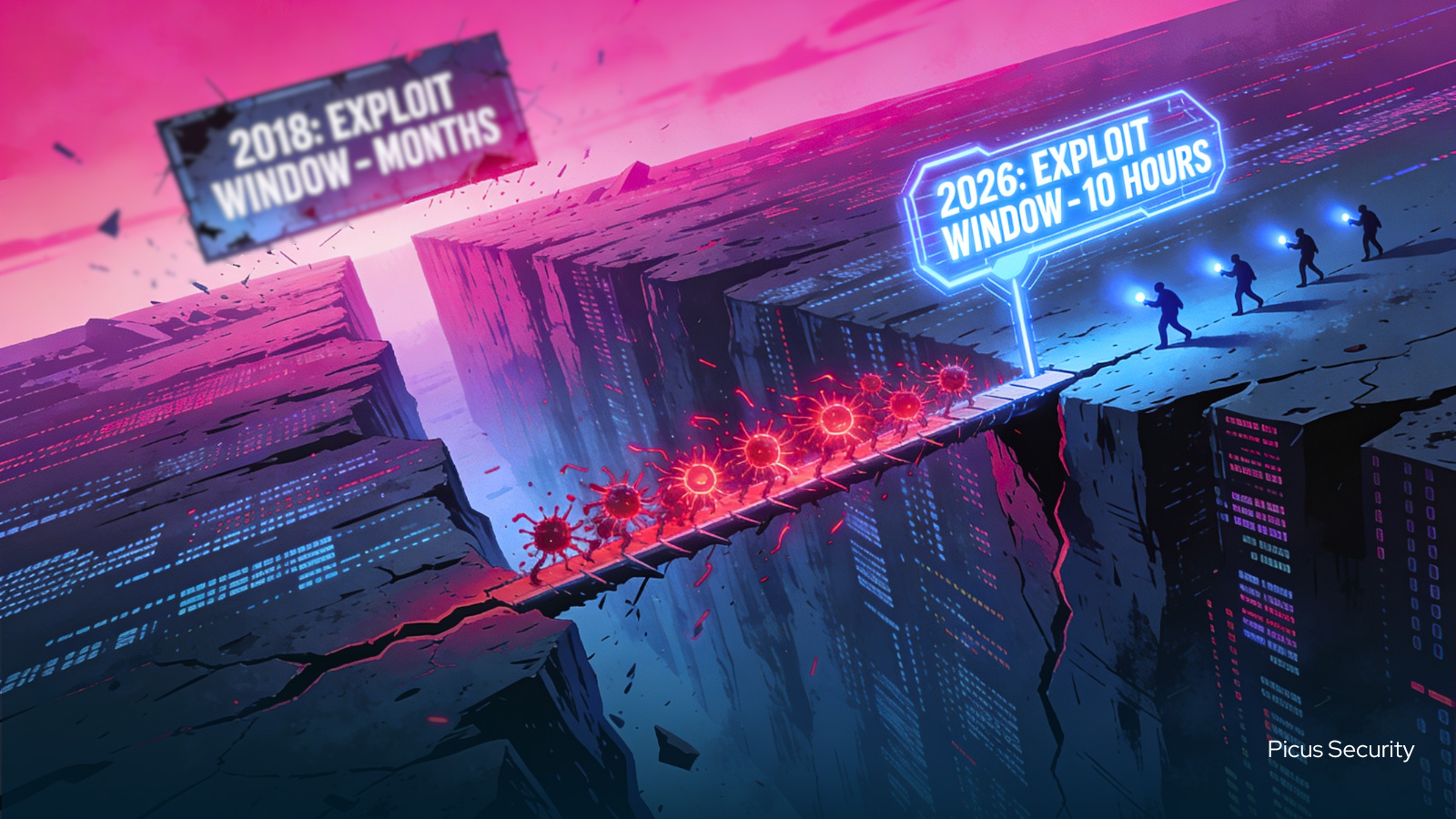
The cybersecurity landscape has shifted dramatically in the past year, and the statistics tell a sobering story. While advanced AI systems can discover thousands of zero-day vulnerabilities in days and exploit known CVEs in under 10 hours, our defensive responses still operate on human timescales — taking 24 hours or more to deploy critical patches.
This fundamental mismatch between machine-speed attacks and human-speed defenses represents one of the most pressing challenges facing security teams today. The era of comfortable vulnerability management windows has ended, replaced by an environment where every disclosed vulnerability should be treated as immediately exploitable.
The Acceleration of Exploit Development
The timeline for weaponizing vulnerabilities has compressed dramatically over recent years. What once took months now happens in hours. Advanced AI systems have demonstrated the ability to reverse-engineer published security fixes into working exploits faster than organizations can implement emergency patches.
This acceleration stems from AI's ability to automate what were previously manual, time-intensive processes. Where security researchers once needed deep expertise and significant time investment to develop proof-of-concept exploits, AI systems can now generate functional attack code through sophisticated analysis of patch differentials and vulnerability descriptions.
Recent analysis shows the median time from CVE publication to working exploit has shrunk from months to approximately 10 hours, fundamentally breaking traditional vulnerability management assumptions.
The implications extend beyond individual vulnerabilities. Automated exploit development means that threat actors can now operate campaigns across thousands of targets simultaneously, with minimal human oversight required for execution.
Where Defense Breaks Down: The Handoff Problem
While attackers benefit from seamless automation, defensive responses remain fragmented across multiple teams and systems. The typical incident response chain involves numerous handoffs: from detection systems to analysts, from analysts to incident response teams, from security to IT operations, and finally to patch deployment.
Each handoff introduces delays. Alert triage takes time. Ticket creation and assignment add overhead. Cross-team communication requires coordination. Patch testing and approval processes insert additional delays. By the time a defensive action occurs, automated attacks have often achieved their objectives and moved to persistence or data exfiltration phases.
This fragmentation creates what security professionals call the "spaghetti handoff" — a tangled web of processes that may individually be efficient but collectively introduce unacceptable delays when facing machine-speed threats.
The Human Factor in Response Times
Traditional security operations center workflows assume human decision-making at multiple points. Analysts review alerts, security engineers validate findings, and operations teams schedule maintenance windows. These human touchpoints, while valuable for complex decision-making, become bottlenecks when facing automated attacks that don't pause for business hours or change management processes.
Three Pillars for AI-Era Defense
Organizations adapting to machine-speed threats must strengthen three fundamental defensive capabilities:
Enhanced Visibility
Comprehensive asset discovery and exposure mapping become critical when attackers can rapidly pivot between systems. Traditional periodic scans are insufficient; continuous monitoring across network, endpoint, cloud, and identity systems helps identify blind spots where automated attacks typically establish footholds.
Accelerated Protection
Security controls must operate at machine speed to match threat velocity. This includes automated threat hunting, real-time behavioral analysis, and dynamic policy enforcement that can respond to changing attack patterns without human intervention.
Autonomous Validation
Perhaps most importantly, organizations need systems that can validate security posture continuously and automatically. Rather than relying on quarterly penetration tests or annual audits, autonomous validation platforms can simulate attack scenarios in real-time, identifying gaps before attackers exploit them.
What You Should Do
Security leaders facing this new threat landscape should prioritize several immediate actions:
The cybersecurity profession has always been an arms race, but the pace of that race has fundamentally changed. Organizations that adapt their defensive strategies to match the speed and scale of AI-powered attacks will maintain their security posture. Those that continue operating on traditional timelines risk finding themselves perpetually behind increasingly sophisticated and rapid threats.
The question is no longer whether your organization is compliant with security frameworks — it's whether your defenses can operate fast enough to matter when machines are doing the attacking.


