
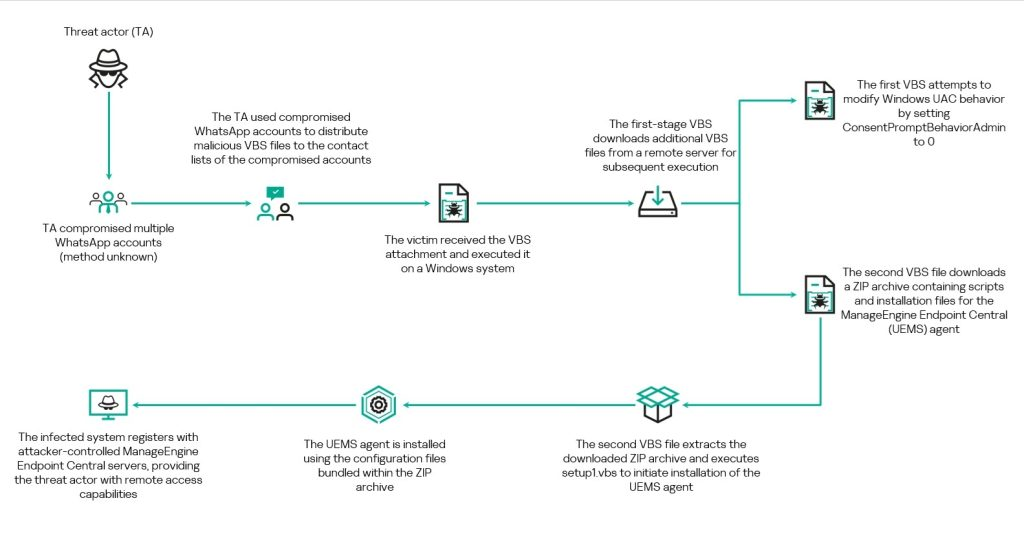
There is something particularly insidious about a cyberattack that weaponizes your own contact list against you. A currently active malware campaign does exactly that — turning trusted WhatsApp conversations into delivery vehicles for remote access software that hands attackers complete control over a victim's machine. The operation is technically layered, geographically targeted, and disturbingly polished in its social engineering.
A Campaign Built on Borrowed Trust
The attack begins with a WhatsApp message — not from a stranger, but from someone already in your contacts. The account sending the message has been compromised, and the attacker is exploiting that established trust relationship to bypass the skepticism most people would normally apply to unsolicited files.
The attachment arrives with names designed to trigger urgency: think debt settlement notices, outstanding payment lists, or overdue invoice summaries. These filenames are localized into at least six languages — Portuguese, French, German, and Malay among them — signaling that whoever built this operation invested real resources in regional targeting. This is not opportunistic spray-and-pray activity. It is a coordinated campaign with deliberate geographic reach.
Confirmed victims span Malaysia, Brazil, India, Mexico, Singapore, the United Kingdom, Spain, Taiwan, Australia, Russia, and Vietnam. Roughly 80 percent of identified victims are concentrated in Malaysia, suggesting either a primary target demographic or the origin point of initial propagation. How the WhatsApp accounts were originally compromised remains under investigation.
The Three-Stage Infection Chain
Once a victim opens the attached VBScript file, a structured, multi-phase infection sequence begins:
C:\Users\Public\Documents\ and reaches out to attacker-controlled servers to retrieve two additional scripts. The code is heavily obfuscated — variable names are randomized, strings are assembled character by character, and junk content is interspersed throughout. Embedded comments written in simplified Chinese mimic the formatting of legitimate Microsoft components, a deliberate attempt to confuse anyone who might inspect the code.The Calculated Abuse of Legitimate Tools
The choice to deploy a recognized RMM platform rather than custom malware is deliberate and strategically sound. Legitimate remote management software is trusted by corporate security tools, less likely to trigger endpoint detection alerts, and familiar enough to system administrators that its presence might not immediately raise flags. This technique — sometimes called "living off the land with commercial tools" — is an increasingly common evasion strategy among sophisticated threat actors.
When attackers install software that your IT department might legitimately use, traditional signature-based defenses often fall silent. The malicious intent is in the configuration, not the binary.
One of the command-and-control server IP addresses identified in this campaign has previously appeared in infrastructure associated with other known remote access trojan activity, raising the possibility of operational overlap with established threat groups. However, attribution remains inconclusive. The simplified Chinese-language comments embedded in the scripts suggest a Chinese-speaking operator, but that assessment carries low confidence — embedded language artifacts are easily planted as deliberate misdirection.
What You Should Do
For Individual Users
- Never open script files received via messaging apps — regardless of who sent them. File types including VBS, VBE, BAT, CMD, JS, and PS1 have no legitimate use in a WhatsApp conversation. No accountant, creditor, or business contact will send you a Visual Basic Script as a financial document.
- Treat attachment-only messages with immediate suspicion. This campaign's messages contained no accompanying text — just the file. That absence of context is a red flag, even from a known contact.
- Verify out-of-band before acting. If a contact sends you an unexpected financial document, call or text them through a different channel to confirm they actually sent it before touching the file.
- Enable two-factor authentication on WhatsApp to reduce the risk of your own account being hijacked and used to target others.
For Security Teams and CISOs
- Audit authorized RMM deployments and alert on any unrecognized instances of tools like ManageEngine Endpoint Central, AnyDesk, or similar platforms appearing on endpoints.
- Monitor registry modifications to UAC settings as a high-confidence indicator of compromise — legitimate software rarely needs to silently disable administrative prompts.
- Block execution of script file types (VBS, JS, PS1) for standard user accounts through application control policies.
- Brief employees on messaging-app-based phishing — most security awareness training focuses on email. Consumer messaging platforms are an increasingly active threat vector.
The Broader Signal
This campaign illustrates a maturation in social engineering tactics. Attackers are no longer relying solely on convincing strangers to click malicious links — they are compromising accounts to exploit pre-existing trust networks. Your contacts have already done the hard work of building credibility with you. Once an attacker controls those accounts, that credibility becomes the weapon.
The sophistication of the obfuscation, the multilingual localization, the use of a commercially legitimate RMM platform, and the targeting of over a dozen countries point to a threat actor with patience, resources, and a clear operational objective. Until attribution is established, organizations and individuals alike should treat the tactics themselves as the defining threat — and adjust their defenses accordingly.


