
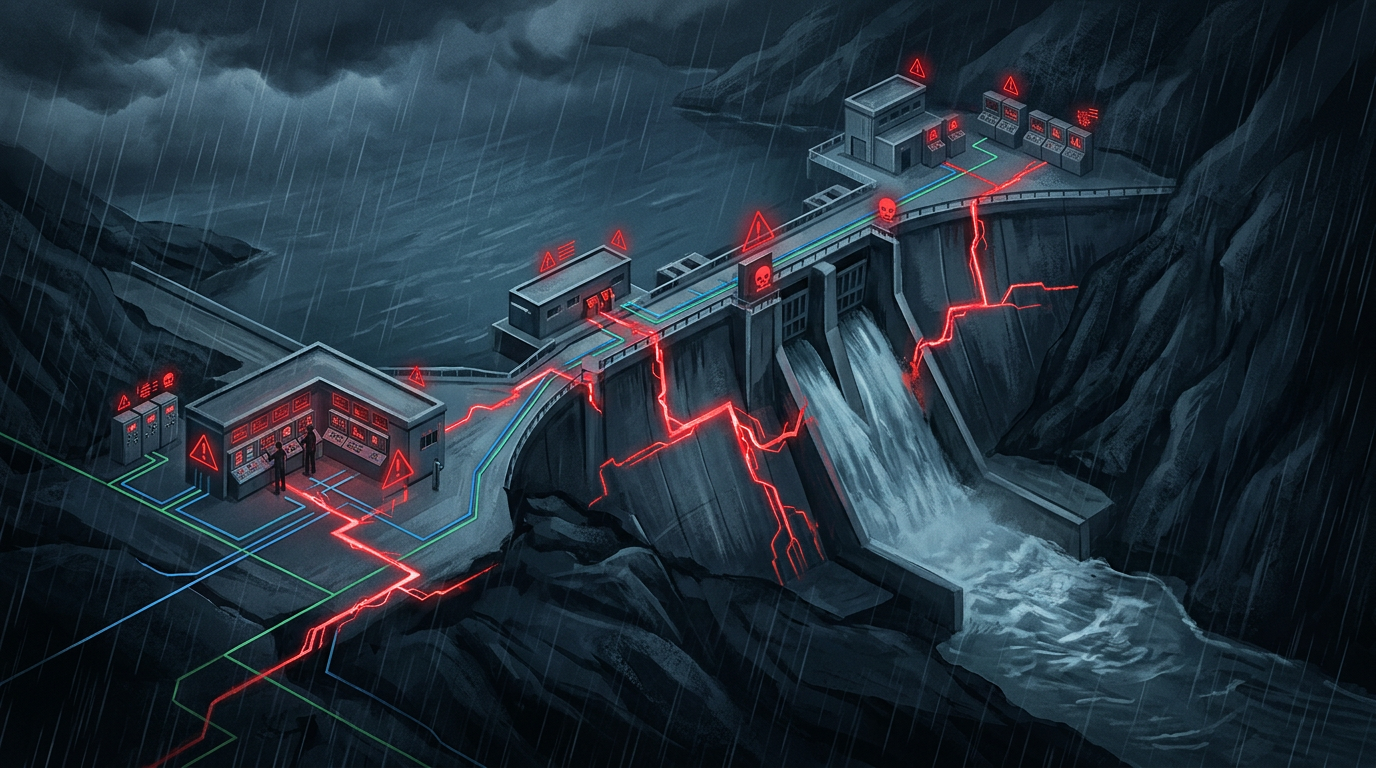
The unthinkable has become routine: cybercriminals now hold the keys to the systems that protect our cities from natural disasters. What happened in Venice this spring should serve as a wake-up call for every organization responsible for critical infrastructure worldwide.
A sophisticated threat group calling itself the "Infrastructure Destruction Squad" successfully penetrated the hydraulic pump network designed to protect Venice's historic Piazza San Marco from flooding. Their brazen announcement—posted in Chinese on Telegram channels—revealed not just the technical sophistication of the attack, but the chilling casualness with which they offered to sell complete system access for a mere $600.
The New Battlefield: Where Digital Meets Physical
This incident represents far more than a cybersecurity breach; it's a glimpse into the future of warfare where the distinction between digital and physical attacks has completely dissolved. Unlike traditional IT compromises that typically result in data theft or service disruption, operational technology (OT) breaches can trigger real-world catastrophes.
The attackers demonstrated their capabilities by sharing screenshots of control panels, system configurations, and valve states—essentially proving they could manipulate the very infrastructure designed to prevent flooding of one of the world's most iconic cultural sites. Their message was clear: we're not just in your networks, we own them.
"We have been here for months and will remain here for months to come. No tests conducted by your security teams can drive us away. No system updates can expel us."
This level of persistence and confidence suggests an adversary with deep resources and advanced capabilities—characteristics typically associated with nation-state actors or highly organized criminal enterprises.
The Perfect Storm of Vulnerability
The Venice breach illuminates three converging factors that have created unprecedented risk in our critical infrastructure:
What makes this particularly alarming is the timing. Just days after the Venice disclosure, U.S. intelligence agencies issued warnings about Iran-linked advanced persistent threat (APT) groups systematically targeting internet-exposed operational technology across multiple sectors, including water systems and energy infrastructure.
Beyond Technical Fixes: A Strategic Imperative
The threat actors in Venice explicitly stated their political objectives: to expose infrastructure vulnerabilities and enable "political blackmail" of government entities. This represents a fundamental shift in the threat landscape, where critical infrastructure has become both a target and a weapon.
Traditional cybersecurity approaches—firewalls, endpoint protection, incident response—are necessary but insufficient for this new reality. Organizations must adopt a comprehensive operational resilience framework that assumes breach and focuses on maintaining critical functions under attack.
The economic implications are staggering. A successful attack on flood defenses could result in billions of dollars in damage, displacement of populations, and irreversible harm to cultural heritage sites. Yet the barrier to entry for causing such damage has dropped to hundreds of dollars—a troubling asymmetry that favors attackers.
What You Should Do
Organizations responsible for critical infrastructure must take immediate action:
- Conduct OT-focused risk assessments: Traditional IT security audits miss operational technology vulnerabilities. Engage specialists who understand industrial control systems.
- Implement network segmentation: Isolate critical OT systems from corporate networks and the internet. Assume that some level of compromise is inevitable.
- Develop incident response playbooks: Create specific procedures for OT incidents that account for safety implications and coordination with physical security teams.
- Establish continuous monitoring: Deploy specialized OT security tools that can detect anomalous behavior in industrial protocols.
- Train operational staff: Ensure personnel can recognize and respond to potential cyber incidents affecting physical systems.
The Venice incident should serve as a catalyst for urgent action. As threat actors continue to demonstrate their ability to reach into our most critical systems, the question is no longer whether such attacks will occur, but when—and whether we'll be prepared to respond effectively when they do.
The infrastructure that protects our cities, powers our economies, and sustains our way of life has become the new frontier in cyberwarfare. The time for treating this as a distant possibility has passed. The war for our critical infrastructure is already underway.


