
When a vulnerability lives in software, vendors patch it. When it lives in firmware, the window for remediation is narrow but possible. When it lives in the silicon itself — etched permanently into the chip at the moment of manufacture — the calculus changes entirely. That is precisely the situation Apple and tens of millions of device owners now face following the public release of usbliter8, a newly demonstrated BootROM exploit targeting A12 and A13 chips.
What Is usbliter8 and Why Does It Matter?
Released by security research group Paradigm Shift on June 18, 2026, usbliter8 is a working exploit that achieves arbitrary code execution inside Apple's SecureROM — the very first code a device executes at power-on. Because SecureROM is hardwired into the chip during fabrication, it cannot be updated, overwritten, or patched. Every affected device will carry this vulnerability for the duration of its operational life, regardless of iOS version or security update history.
The scope of affected hardware is substantial. Chip families A12, A13, S4, and S5 are all confirmed vulnerable. In consumer terms, that translates to:
Researchers also indicate that A12X and A12Z support — covering 2018 and 2020 iPad Pro models — is theoretically achievable, though not yet implemented. The true blast radius of this vulnerability may still be expanding.
The Root Cause: A Hardware Flaw in USB Controller Logic
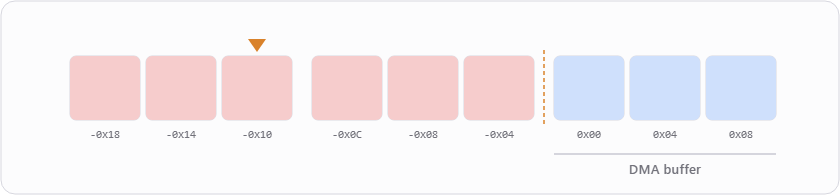
At the heart of usbliter8 is a subtle but devastating flaw in the Synopsys DWC2 USB controller Apple used in these chips. The controller is designed to store incoming USB Setup packets via direct memory access (DMA), buffering up to three consecutive packets before resetting its internal write pointer on the fourth — decrementing it by a fixed 24 bytes. The problem arises because the controller also accepts undersized packets and increments its pointer only by the actual bytes received, not by a fixed standard size.
Over successive interactions, this mismatch causes the write pointer to step backwards through memory in 12-byte increments — a textbook buffer underflow condition that is entirely repeatable and reliable.
"The core issue arises because the controller also accepts smaller packets (though always stores in 4-byte chunks)," the researchers noted, explaining how the accumulated mismatch becomes a controllable primitive for memory corruption.
What transforms a hardware quirk into a full exploit on A12 and A13 specifically is Apple's configuration of the USB DART — the chip's internal memory mapping unit — within SecureROM. On affected devices, DART runs in bypass mode, which means the drifting DMA pointer can reach and overwrite arbitrary SRAM rather than being confined to a safe memory region. The A11 chip is spared because its USB driver manually resets the DMA address after each packet, preventing accumulation. A14 and later configure DART correctly, making the same underlying bug unexploitable on newer silicon.
How Code Execution Is Achieved
The exploitation path differs meaningfully between chip generations, and the A13 variant is notably more sophisticated.
On A12 devices, the DMA buffer sits adjacent to the USB task stack in memory. By corrupting that stack data, attackers can redirect execution during a normal task switch — a relatively direct route to privileged code execution.
On A13, Pointer Authentication (PAC) protects stack-stored return addresses, requiring a multi-stage bypass. Paradigm Shift's technique involves corrupting DART-related heap structures to establish limited write primitives, overwriting a panic depth counter to force the chip into an error loop rather than rebooting, and finally overwriting the USB interrupt handler pointer in BSS memory so the next USB interrupt redirects execution to attacker-controlled code. Both paths ultimately land at EL1 — the chip's fully privileged execution level — inside SecureROM itself.
Once control is established, usbliter8 injects a custom USB request handler and writes the signature string PWND:[usbliter8] into the device's USB serial identifier. From this position, an attacker can demote the SoC's production fuse state or load a completely unsigned iBoot image — stepping entirely outside Apple's hardware-enforced chain of trust.
Parallels to checkm8 — and Where the Differences Lie
Security professionals will immediately recognize the structural similarities to checkm8, the landmark 2019 BootROM exploit that permanently affected A5 through A11 devices. checkm8 redefined how the industry understood unpatchable hardware vulnerabilities, enabling jailbreaks, forensic tools, and — in adversarial hands — persistent implants that survived factory resets. usbliter8 picks up almost exactly where checkm8's chip coverage ended, extending that class of risk to the next two chip generations.
Critically, Paradigm Shift has confirmed that the Secure Enclave — Apple's dedicated security coprocessor responsible for biometric data, encryption keys, and payment credentials — has not been demonstrated as compromised. However, researchers explicitly warn that BootROM-level control may open new attack surfaces toward the Secure Enclave. That research has not been published, but it would be premature to treat the current boundary as permanent.
Attack Requirements and Realistic Threat Modeling
usbliter8 is emphatically not a remote exploit. Successful execution requires physical access to the target device, placement in Device Firmware Update (DFU) mode, a USB connection, and a dedicated RP2350-based microcontroller board. These constraints dramatically narrow the realistic threat population in everyday consumer scenarios.
However, threat modeling for law enforcement forensic tools, nation-state border seizure scenarios, targeted corporate espionage, and high-value individual targeting looks considerably more concerning. The attack leaves no persistent software artifact on the device — once rebooted normally, the exploit's effects dissolve — but the window of access it provides is extensive.
What You Should Do
- Understand your exposure: If your organization manages fleets of iPhones or iPads from the 2018–2020 era, audit which devices carry A12 or A13 chips. These devices cannot be patched against this class of attack.
- Enforce physical security policies: Because the attack requires hands-on access and DFU mode, robust physical security controls — device custody policies, locked storage, and chain-of-custody protocols — are your primary mitigation.
- Accelerate hardware refresh cycles: For personnel handling sensitive data, consider prioritizing migration to A14 or later devices, which are confirmed unaffected.
- Treat DFU access as a privileged operation: Any legitimate use of DFU mode in managed environments should be logged, authorized, and audited. Unauthorized DFU access on a device should be treated as a potential compromise indicator.
- Monitor for forensic tool updates: Commercial mobile forensic platforms may quietly integrate usbliter8 capabilities. Security teams should track updates to tools used in adversarial contexts.
- Do not rely on iOS version as a control: No iOS update can address a flaw in read-only silicon. Software-layer security remains valuable for other threats, but offers zero protection here.
As of the time of publication, Apple had not issued a security advisory or CVE designation for usbliter8. The absence of an official response does not diminish the severity — it reflects the uncomfortable reality that Apple has no software lever to pull. For the affected devices, this is a permanent condition of the hardware, and the security community will need to manage it accordingly for years to come.


