
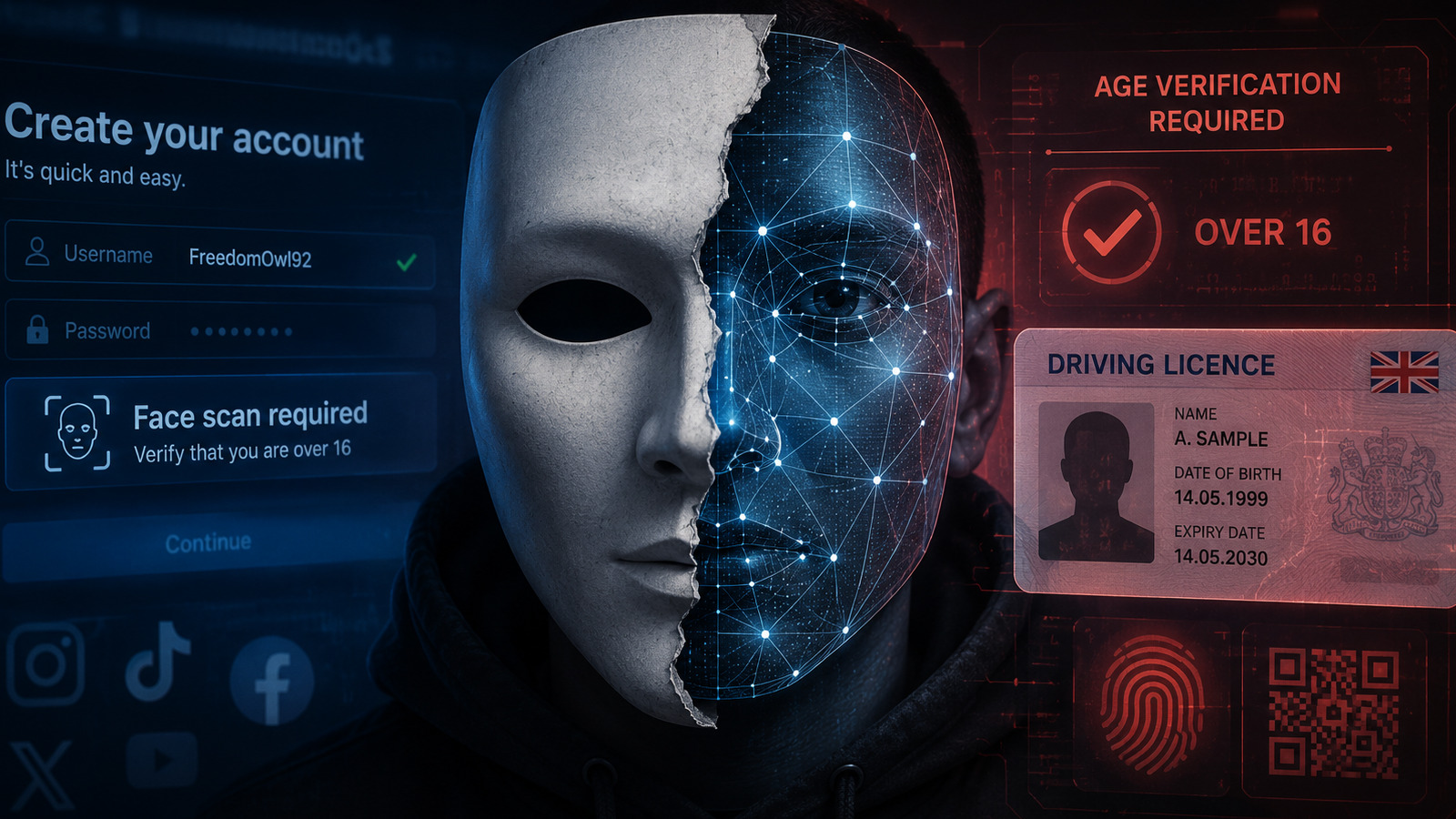
Britain is about to become one of the most aggressive regulators of social media access in the democratic world. By spring 2027, anyone opening a new social media account in the United Kingdom will be required to prove their age — either by uploading government-issued identification or submitting to a facial age scan. The stated goal is straightforward: keep children under 16 off platforms like Instagram, TikTok, Snapchat, and YouTube. The unintended consequences, however, are anything but simple.
The Architecture of the Ban
The policy, announced by Prime Minister Keir Starmer following a national consultation that drew over 116,000 responses, draws heavily from Australia's pioneering legislation, which took effect in December 2025. But the UK version stretches further. Beyond simply restricting access for minors, it targets high-risk platform features — livestreaming, algorithmic feeds that enable stranger contact — and applies default restrictions to 16- and 17-year-olds as well, in an attempt to avoid what officials describe as a "cliff-edge" at age 16.
The scope is broad. Platforms defined as enabling social interaction through algorithmic feeds are covered. Messaging services such as WhatsApp and Signal are explicitly excluded, as is YouTube Kids. Notably, gaming platforms like Roblox are not banned outright, but their interactive features — such as in-app chat — will be locked down for minors. The government is also consulting on overnight curfews and mandatory breaks in infinite scrolling for users under 18.
Separately, AI "romantic companion" chatbots — applications that simulate intimate or roleplay relationships — will be required to enforce an 18-plus minimum, with intimate functionality broadly restricted for under-18s across AI chatbot services.
The Adult Privacy Trap Hidden in the Fine Print
The government has been at pains to reassure adults that most of them won't be affected. Existing accounts are largely grandfathered in: if an account is more than 16 years old, has a credit card attached, or is linked to an already-verified email address, no new check is required. Anyone previously verified under the existing Online Safety Act is similarly exempt.
"What's marketed as a child protection measure quietly becomes a rule that no adult can open a new account without proving their identity."
But that grandfather clause does nothing for new accounts. A journalist wanting a pseudonymous handle, a citizen seeking privacy from their employer, a domestic abuse survivor starting fresh — all face the same requirement: biometric scan or ID upload. The policy effectively ends anonymous account creation in the UK, a civil liberties shift that received remarkably little political scrutiny during its passage.
This new regime sits alongside an already aggressive enforcement environment. Since mid-2025, the Online Safety Act has required adult content sites to run highly effective age verification for every user. By early 2026, the UK's communications regulator Ofcom had opened investigations into more than 90 platforms and issued six fines, with its jurisdiction extended to platforms including Reddit, Discord, Bluesky, and AI services.
The Security Community's Core Concerns
Cybersecurity professionals are raising two interlocking alarms about this framework.
1. A Massive New Attack Surface
Centralised or platform-held databases of identity documents and facial biometrics represent extraordinarily attractive targets for threat actors. Age verification providers — typically third-party intermediaries — become single points of failure for the personal data of millions of users. History offers little comfort here: identity verification vendors have suffered significant breaches, and the aggregation of national ID scans creates a honeypot that did not previously exist at this scale.
2. The VPN Bypass Problem
Perhaps the most technically damaging critique is the simplest: a VPN defeats the entire system. The Online Safety Act's enforcement model targets platforms, not users. Anyone connecting through a server located outside the UK sidesteps the age-check requirement entirely. When adult content enforcement launched in mid-2025, some VPN providers reported subscription spikes of up to 1,800 percent. Australia's experience reinforces the concern — research conducted months after its ban found more than 60 percent of children were still accessing restricted social media platforms.
The UK government has publicly ruled out a blanket VPN ban, acknowledging their legitimate uses in business and privacy contexts. However, it has signalled intent to explore age-restricting children's access to VPN services specifically — a measure that would itself require VPN providers to verify user ages, creating yet another layer of the same data-collection problem.
What You Should Do
A Line in the Sand — or a Line in the Water?
There is genuine and widespread concern about the impact of algorithmic social media on adolescent mental health, and the policy reflects real public demand for action. But good intentions do not neutralise structural security risk. A regime that requires the mass collection of biometric data and government IDs, enforced by third-party intermediaries with imperfect security track records, and easily circumvented by a ten-dollar VPN subscription, deserves more rigorous technical scrutiny than it has so far received.
The UK is not simply drawing a line in the sand for Big Tech. It is also drawing a new map of surveillance infrastructure — one that will outlast any single government's intentions, and one whose security architecture should be stress-tested before it is built at national scale.


