
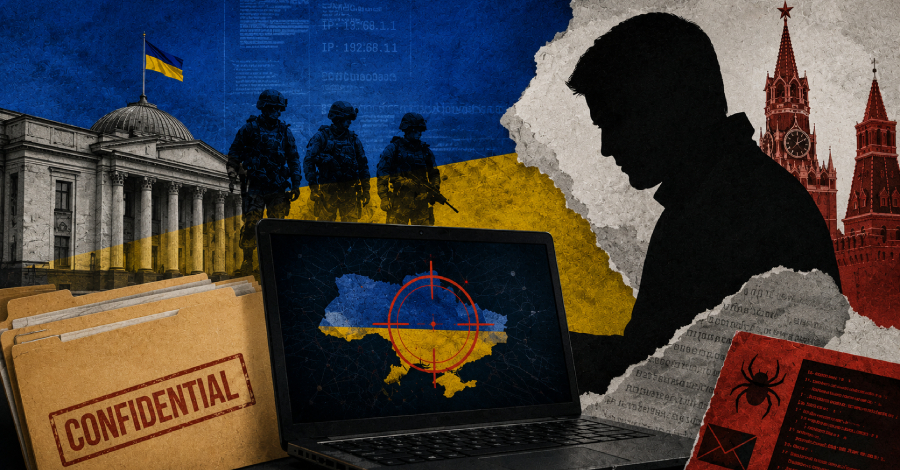
Russia's most persistent cyber espionage apparatus has once again demonstrated its capacity for technical evolution. Turla, the Kremlin-linked threat group with a decades-long history of high-value intelligence operations, has introduced a previously unknown .NET backdoor into its growing arsenal — and the targets speak volumes about Moscow's current strategic priorities.
A New Tool in a Well-Worn Playbook
Designated STOCKSTAY by researchers, the Windows-based backdoor has been actively deployed against government institutions and military organizations operating within Ukraine, as well as entities with a stake in Italian foreign policy. The dual targeting profile is not incidental — it reflects Turla's characteristic approach of pursuing both front-line intelligence on the active conflict in Eastern Europe and broader geopolitical positioning across NATO-aligned nations.
What distinguishes STOCKSTAY from commodity malware is its development trajectory. Rather than a one-time capability, the backdoor appears to be under continuous refinement — a hallmark of state-sponsored tooling designed for longevity and adaptability. This iterative development model allows Turla's operators to respond to detection signatures, modify behavior in response to defender activity, and expand the malware's capability set without requiring full redeployment of their infrastructure.
Understanding Turla's Operational Profile
Turla — also tracked under designations including Snake, Venomous Bear, and Waterbug — is widely attributed to Russia's Federal Security Service (FSB). The group has been active since at least the late 1990s and has a documented history of compromising foreign ministries, defense contractors, intelligence agencies, and critical infrastructure across Europe, the Middle East, and Central Asia.
Their tradecraft is sophisticated by any measure. Turla operations typically favor long-dwell intrusions — campaigns designed not to cause immediate disruption but to silently exfiltrate intelligence over extended periods. The introduction of STOCKSTAY fits this operational philosophy precisely: a quietly persistent backdoor, built on the ubiquitous .NET framework to blend into legitimate Windows environments, capable of maintaining access while evading conventional detection.
"The continuous development of STOCKSTAY signals that Turla is not deploying a temporary capability — this is infrastructure investment designed to sustain intelligence collection through an extended operational window."
Why Ukraine and Italy?
The targeting pattern reveals clear strategic logic. Ukraine remains the primary theater of Russia's ongoing hybrid warfare campaign, and cyber espionage against Ukrainian military and governmental targets provides actionable battlefield intelligence, insight into Western weapons transfers, and visibility into diplomatic communications.
Italy's inclusion is equally deliberate. As a G7 member, NATO ally, and country with historically complex relationships in its foreign policy toward Russia and the Mediterranean region, Italian institutions represent high-value intelligence targets for Moscow. Turla has previously targeted Italian and broader European diplomatic entities, and this latest campaign suggests that priority has not diminished.
Technical Implications of a .NET Backdoor
The choice of .NET as the development framework carries specific implications for defenders. The runtime environment is deeply embedded in enterprise Windows deployments, meaning STOCKSTAY-related processes may appear superficially legitimate to endpoint monitoring tools that rely on process naming or basic behavioral heuristics. Detection requires memory analysis, behavioral baselining, and network traffic inspection tuned for the specific command-and-control patterns associated with the malware.
The continually developed nature of the backdoor also complicates static signature-based defenses. Hash-based IOCs shared following initial discovery will have a diminished shelf life as operators modify the binary. Organizations relying solely on traditional AV or outdated threat intelligence feeds may find themselves operating with blind spots.
What You Should Do
The Broader Strategic Picture
STOCKSTAY is not an isolated development — it is the latest chapter in a sustained Russian cyber espionage campaign that has intensified in both scope and sophistication since the full-scale invasion of Ukraine began. The convergence of active conflict and traditional intelligence collection is reshaping the threat landscape for European governments and their international partners.
For security leaders operating in sectors with any exposure to Ukrainian affairs, NATO policy, or European foreign relations, Turla's continued capability development is a concrete reminder: the adversary is not standing still. Neither can the defense.


