
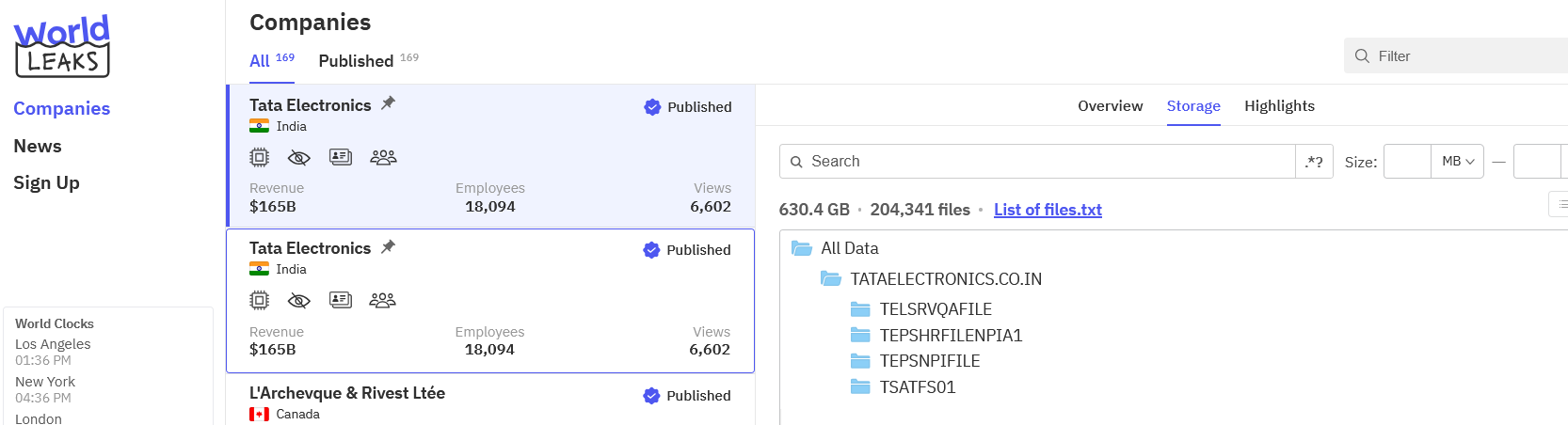
When a threat actor advertises 630 gigabytes of stolen corporate data on an underground forum — data allegedly containing supplier specifications tied to two of the world's most recognizable technology brands — the cybersecurity community takes notice. That is precisely the situation unfolding around Tata Electronics, the Indian manufacturing giant that has now confirmed a cyberattack penetrated portions of its IT infrastructure.
The incident is more than a single corporate breach. It is a stark reminder that the electronics supply chain serving Silicon Valley and global automakers has become one of the most attractive targets for sophisticated extortion groups — and that the downstream consequences of such attacks can ripple far beyond the company initially compromised.
What We Know About the Breach
Tata Electronics acknowledged the intrusion after weeks of silence following the emergence of stolen data on a hacker forum. In a carefully worded statement, the company confirmed that a cybersecurity incident had affected certain systems while insisting that operations and manufacturing remained uninterrupted. Notably absent from the company's disclosure: any detail about what specific data was accessed, how many individuals or business partners were affected, or how the attackers gained initial entry.
The threat group behind the claim — known as WorldLeaks — asserts it holds more than 630GB of material spanning over 200,000 files. Samples that have circulated reportedly include Apple supplier specifications and Tesla manufacturing documentation. While the full authenticity and completeness of this data have not been independently confirmed, the nature of the claims is credible given Tata Electronics' role in global technology manufacturing.
"The incident has had no impact on our operations across businesses, which remain unaffected." — Tata Electronics spokesperson
Reports also indicate that Tata notified employees at its iPhone assembly operations of the breach, and that a ransom demand was issued. Apple has separately confirmed it is investigating the matter. Tata Electronics currently assembles approximately one-third of Apple's iPhones produced in India — a figure that underscores the company's strategic importance to one of the world's most valuable supply chains.
WorldLeaks: A Ransomware Gang That Dropped the Ransomware
Understanding WorldLeaks requires a brief look at its evolution. The group emerged in 2025 as a rebranding of Hunters International, a ransomware operation active since 2023. Facing intensified law enforcement pressure and the operational complexity of managing encryption-based attacks, the group made a calculated pivot: it abandoned file encryption entirely and repositioned itself as a pure data extortion operation.
This model — often called "exfiltration-only" extortion — is increasingly common among financially motivated threat actors. By removing encryption from the equation, these groups eliminate the technical complexity of ransomware deployment, reduce their exposure to disruption by defenders, and still maintain powerful leverage: the threat of publicly releasing sensitive corporate, customer, or partner data.
WorldLeaks has claimed hundreds of victims since its rebranding, and its willingness to target a company deeply embedded in the Apple and Tesla supply chains signals an ambition to maximize reputational and financial pressure on victims.
The Supply Chain Security Imperative
This incident crystallizes a challenge that security leaders have been wrestling with for years: third-party and supply chain risk is not a hypothetical threat vector — it is an active one. A breach at a Tier 1 supplier can expose proprietary designs, component specifications, contractual terms, and manufacturing processes that represent years of competitive investment by the end customers.
For organizations like Apple and Tesla, the exposure is not limited to operational disruption. The leaked data, if authentic, could theoretically provide competitors or nation-state actors with valuable insights into product roadmaps, supply chain dependencies, and manufacturing tolerances.
Several dynamics make supply chain targets particularly attractive to extortion groups:
What You Should Do
Whether you lead security for an enterprise, a manufacturer, or a technology firm with a complex supplier ecosystem, this incident offers concrete lessons worth acting on now.
- Audit supplier security posture: Formal contractual security requirements mean little without verification. Conduct or commission third-party security assessments of your highest-risk suppliers, particularly those handling proprietary technical documentation.
- Classify and minimize data sharing: Apply strict data minimization principles to what you share with external partners. If a supplier does not need full engineering specifications to perform their function, do not provide them.
- Establish breach notification SLAs with suppliers: Your supplier contracts should define explicit timelines for breach notification. Weeks of silence — as seen here — is unacceptable when your own customers and partners may be affected.
- Prepare for exfiltration-only extortion scenarios: Incident response playbooks that focus primarily on ransomware decryption are incomplete. Develop specific procedures for data theft extortion, including legal, communications, and law enforcement engagement protocols.
- Monitor threat intelligence feeds: Early detection of your organization's data appearing on underground forums can materially reduce response time and limit downstream harm.
The Broader Picture
The Tata Electronics breach is not an isolated event — it is a data point in a clear trend. As ransomware groups evolve their tactics and supply chains grow more interconnected, the attack surface for extortion campaigns continues to expand. The companies most at risk are not always the household names whose logos appear on finished products, but the critical suppliers operating in their shadow.
Security leadership at every level of the technology supply chain should treat this incident as a live exercise in what happens when supplier resilience is insufficient. The cost of proactive investment in third-party risk management is measurably lower than the cost of the alternative.


