
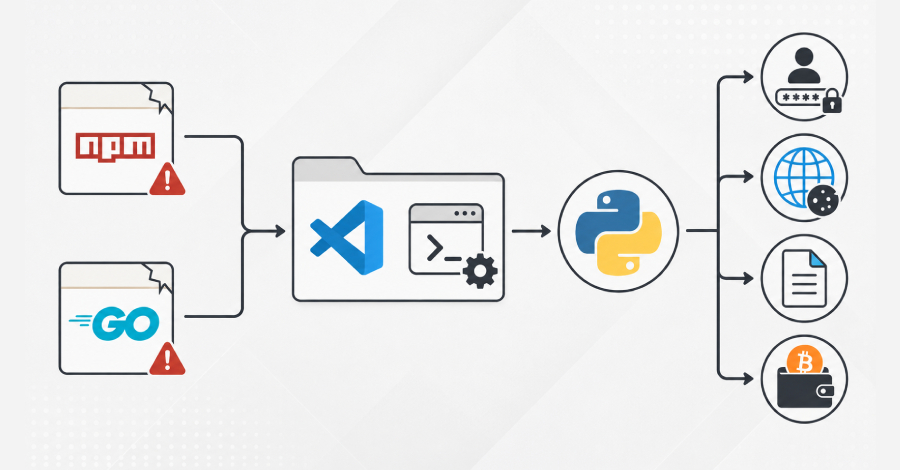
A sophisticated software supply chain attack is actively targeting developers across all major operating systems, exploiting the implicit trust engineers place in open-source package ecosystems. Security researchers have identified a coordinated campaign involving at least two hijacked npm packages and a cluster of malicious Go modules — all engineered to deliver a Python-based information stealer to unsuspecting victims.
The Anatomy of a Supply Chain Hijack
What makes this campaign particularly alarming is not just its cross-platform reach, but the deliberate architectural choices attackers made to avoid detection. Rather than relying on npm lifecycle scripts — the standard mechanism most security tooling monitors — the threat actors routed their malicious payload delivery through Visual Studio Code task configurations. This single design decision allowed the malware to sidestep security hardening introduced in recent versions of npm, effectively rendering conventional defenses blind to the intrusion.
This isn't opportunistic malware. The decision to target VS Code tasks reflects a deep understanding of developer workflows and modern security tooling gaps. Attackers knew exactly where the blind spots were — and built their campaign around them.
How the Attack Chain Unfolds
Once a developer installs a compromised package, the malicious code establishes persistence through VS Code's task runner infrastructure — a mechanism routinely used by legitimate development tools for automation. From there, a Python-based infostealer payload is fetched and executed, capable of operating natively on Windows, Linux, and macOS environments.
The use of Python as the final payload stage is tactically shrewd. Python is nearly ubiquitous in developer environments, minimizing the likelihood of its execution triggering endpoint alerts. The interpreter is trusted, the language is familiar, and defenders rarely scrutinize Python processes in developer machines with the same rigor applied to other execution environments.
What the Infostealer Targets
.env) commonly containing cloud and service credentialsFor organizations whose developers work with cloud infrastructure, CI/CD pipelines, or proprietary codebases, the downstream risk from a single compromised machine can be catastrophic — extending far beyond the individual endpoint to production systems, customer data, and source code repositories.
The Go Package Cluster: Expanding the Attack Surface
Beyond the npm ecosystem, researchers identified a coordinated cluster of malicious Go packages participating in the same campaign. Go has grown rapidly as a preferred language for backend services, CLI tooling, and infrastructure software. Its package ecosystem, while generally well-regarded, lacks some of the centralized security controls that have slowly been introduced into npm. This makes it an attractive target for attackers looking to plant malicious dependencies where scrutiny is lower and developer trust is high.
Attackers are no longer just targeting end users — they are going upstream, poisoning the tools that developers rely on to build the software that everyone else depends on.
The convergence of npm and Go packages in a single campaign suggests a well-resourced threat actor with the capability and patience to maintain presence across multiple ecosystems simultaneously — and the operational sophistication to tailor evasion techniques for each environment.
Why Traditional Defenses Fall Short
Security teams have historically focused supply chain monitoring efforts on lifecycle script execution, binary analysis, and known malicious package signatures. This campaign demonstrates that adversaries are evolving faster than defensive playbooks can adapt. By operating through legitimate IDE infrastructure and avoiding conventional execution triggers, the attackers achieved a level of stealth that should concern every organization with a software development function.
Static analysis tools that evaluate packages at install time may flag suspicious lifecycle scripts — but they are not designed to evaluate how a package might interact with VS Code's task runner post-installation. This gap is now being actively exploited.
What You Should Do
- Audit your dependency trees immediately. Use software composition analysis (SCA) tools to identify recently updated or newly introduced packages across npm and Go modules in all active projects.
- Review VS Code task configurations. Inspect
.vscode/tasks.jsonfiles in your repositories for unexpected commands, external script calls, or references to unfamiliar executables or URLs. - Enforce package integrity verification. Implement lockfiles (
package-lock.json,go.sum) and verify checksums before allowing packages into build pipelines. - Restrict outbound network access from developer machines. Network segmentation can limit an infostealer's ability to exfiltrate credentials even after initial execution.
- Deploy endpoint detection on developer endpoints. Developer machines are high-value targets and deserve the same EDR coverage applied to servers and user workstations.
- Educate engineering teams. Developers should be trained to treat unfamiliar package updates and unexpected IDE behavior with the same skepticism applied to phishing emails.
The Bigger Picture
This campaign is a reminder that the software supply chain remains one of the most consequential and underdefended attack surfaces in enterprise security. As package ecosystems mature and security controls improve, adversaries will continue probing for the next architectural seam to exploit. Organizations that treat developer tooling as outside the security perimeter are operating on borrowed time.
The question is no longer whether your organization's software supply chain will be targeted — it is whether your defenses will be mature enough to detect and contain the intrusion before the damage is done.


