
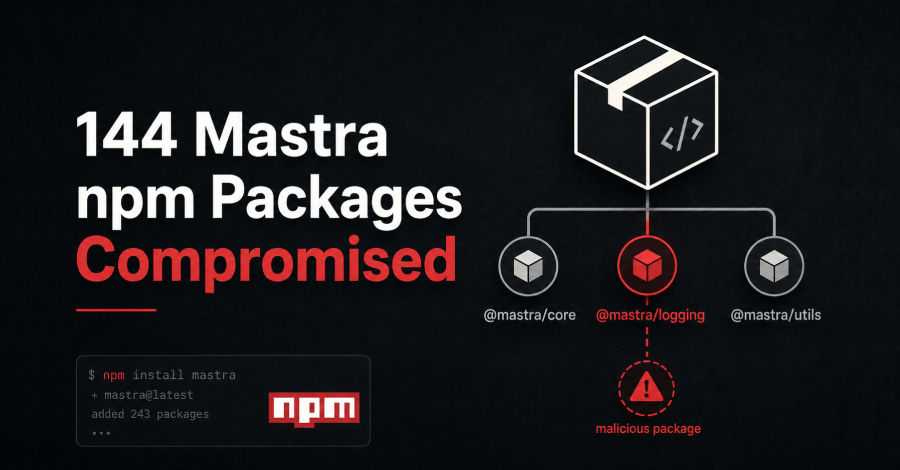
Software supply chain security has become one of the most pressing battlegrounds in modern cybersecurity — and a recently disclosed attack on the Mastra npm namespace serves as yet another sobering reminder of just how fragile the open-source ecosystem can be. Researchers from multiple security firms have confirmed that as many as 144 packages bearing the @mastra/* namespace were systematically compromised through a single hijacked developer account, exposing potentially thousands of downstream applications to malicious code.
One Account, Massive Blast Radius
The attack, tracked under the campaign name easy-day-js, exploited a fundamental weakness in how open-source package registries operate: trust is often inherited from individual contributor identities rather than enforced through organizational controls. In this case, threat actors gained control of a legitimate npm account — identified as belonging to a Mastra contributor — and leveraged that access to mass-publish trojanized versions of packages across the entire framework's namespace.
Mastra is a widely adopted open-source framework built in JavaScript and TypeScript, purpose-designed for developing artificial intelligence applications. Its growing popularity in the AI development space made it a high-value target. Developers integrating Mastra into AI pipelines would have had little reason to suspect that pulling a routine package update could introduce malicious payloads into their build environments.
When a single compromised identity can trigger mass-publication across an entire namespace, the attack surface isn't just one package — it's the entire trust graph of every project that depends on it.
Why This Attack Pattern Is So Dangerous
What makes the easy-day-js campaign particularly insidious is its exploitation of organizational namespace trust. Developers and CI/CD pipelines that automatically resolve the latest versions of @mastra/* packages would have unknowingly pulled compromised builds without any visible warning signs. The malicious packages bore all the hallmarks of legitimacy — correct namespace, familiar versioning conventions, and the implicit endorsement of the Mastra project.
This technique — often called a namespace hijack or account takeover supply chain attack — is becoming increasingly common. Unlike typosquatting, where attackers register deceptively named packages, account takeovers allow adversaries to publish directly into the authentic namespace, making detection far more difficult for automated scanning tools that rely on name-matching heuristics.
The Broader Supply Chain Threat Landscape
The Mastra incident does not exist in isolation. It reflects a sustained and growing trend of threat actors targeting the npm registry and other package ecosystems as a force multiplier. By compromising one upstream package, attackers can cascade malicious code into hundreds or thousands of dependent projects simultaneously — a significantly more efficient attack vector than targeting individual organizations.
AI and machine learning application development has become a particularly attractive attack surface. Projects in this space frequently integrate dozens of third-party packages at speed, with developer velocity often prioritized over rigorous dependency vetting. The intersection of fast-moving AI tooling and loosely enforced supply chain security creates exploitable gaps that sophisticated threat actors are actively mapping and targeting.
What Security Teams Need to Know
The technical details of the injected payloads are still being fully analyzed by the research community, but the structural lesson is already clear: organizations cannot rely on implicit trust in package namespaces, even those associated with well-known frameworks. Defense must operate at multiple layers.
What You Should Do
@mastra/* packages, run a full dependency audit and verify package integrity against known-good checksums or lockfile hashes.^ or ~ in production environments. Pinning to exact versions reduces the risk of silently pulling updated, compromised packages.A Wake-Up Call for AI Development Teams
The timing of this attack is not coincidental. As organizations race to embed AI capabilities into their products and services, the tooling ecosystem supporting that work — frameworks like Mastra, LangChain, and their dependencies — represents an expanding and under-secured attack surface. Security teams must engage directly with AI development workflows rather than treating them as a separate domain.
The easy-day-js campaign illustrates that sophisticated attackers understand developer behavior, trust hierarchies, and the operational realities of modern software delivery. Defending against these threats requires an equally sophisticated, proactive approach — one that treats supply chain integrity not as a compliance checkbox, but as a core component of application security strategy.


