
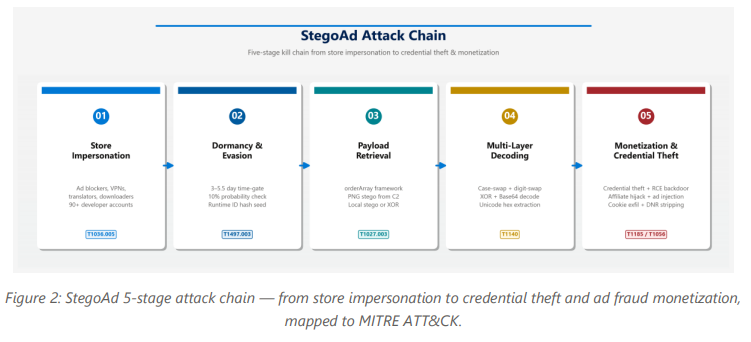
For at least two years, a sophisticated threat actor ran one of the most technically refined malicious browser extension campaigns ever documented on a major platform. The operation — now dismantled by Microsoft's Edge Extensions Security team — infiltrated the official Edge Add-ons store with 119 seemingly legitimate extensions, accumulating approximately 2.6 million installs. The actor behind it had been active since at least 2021, quietly perfecting a multi-layered evasion architecture that repeatedly outpaced detection tooling.
Researchers have dubbed the campaign StegoAd, a portmanteau of the two techniques at its core: steganography and ad injection. The name is precise. This was not a crude credential-harvesting script bundled into a free download. It was an engineered deception that evolved its concealment methods each time defenders closed in.
A Payload No Scanner Could See
The extensions themselves were functional. Ad blockers blocked ads. VPN tools routed traffic. Translators translated. Positive user reviews accumulated organically. Nothing about the surface experience raised suspicion — which was by design. The malicious payload did not activate until three to five and a half days after installation, a deliberate dormancy window calibrated to outlast most behavioral sandboxing environments used during app store review.
The concealment technique evolved across three distinct generations:
A March 2026 variant added one more layer of misdirection: the payload container was renamed setting.conf — disguised as a routine configuration file. The extension fetched it, searched for a specific marker string, and decoded a Base64 payload segmented by a delimiter sequence. Calling it a settings file was an elegant piece of social engineering aimed squarely at analysts rather than users.
Built to Evade Analysts, Not Just Scanners
The campaign's anti-analysis architecture went well beyond passive concealment. If a user opened browser developer tools to inspect the extension, a flag was set internally, and the dormancy period extended indefinitely — the payload would never fire under observation. Some variants further reduced their activation rate to just 10 percent of sessions, making behavioral detection statistically improbable during any short-window review.
The command-and-control infrastructure only served live payloads to requests that passed a fingerprint check derived from the extension's own runtime ID and a correctly formatted User-Agent string. Security researchers probing the C2 server directly received an empty decoy response. The full payload was only recoverable from controlled infected instances.
A polymorphic JavaScript framework — internally labeled orderArray — was identified across 66 extensions in more than 15 naming variants. Despite the surface-level variation, every instance shared an identical four-component structure: an encoded payload object, a seed generator using the extension's runtime ID, a regex-based decoder, and a double-Base64 extractor. Variable and function names rotated completely across each variant, defeating fixed-pattern detection signatures.
The Full Attack Surface: Ad Fraud Was Just the Cover Story
Ad fraud was the campaign's visible revenue layer. Extensions injected the actor's own advertisements, replaced existing Google AdSense and Amazon ad units — capped at six substitutions per page to avoid triggering anomaly detection — and hijacked affiliate commissions across more than 20 Amazon regional storefronts, plus eBay, AliExpress, Taobao, and JD.com.
But the ad fraud component obscured something considerably more dangerous. The C2 server maintained a full remote code execution backdoor capable of pushing arbitrary JavaScript to any victim's browser and executing it within 10 milliseconds. Critically, every extension across the entire campaign received the same payload modules. All 2.6 million users were exposed to the complete attack surface — not a subset, not a targeted cohort.
The credential theft module was purpose-built for Google account takeover. It captured passwords on Google sign-in pages, waited for two-factor authentication prompts, harvested those codes as well, and exfiltrated both via double-Base64 encoding to an attacker-controlled domain. The attack sequence was timed to intercept the full authentication chain before session establishment.
What You Should Do
- Audit your installed extensions immediately. Review every browser extension across your organization — Edge, Chrome, and Firefox alike. Remove anything not actively needed and verify provenance for everything that remains.
- Do not treat positive reviews as a trust signal. StegoAd extensions accumulated genuine positive reviews because they functioned as advertised. Review scores are not a security indicator.
- Enforce extension allowlisting in enterprise environments. Browser extension policies should permit only explicitly approved tools. Group Policy and MDM solutions support this for managed device fleets.
- Treat dormant activation as a known evasion tactic. Security teams should extend sandbox observation windows and avoid drawing conclusions from short-window behavioral analysis alone.
- Assume credential exposure if any affected extension was installed. Users who had StegoAd extensions installed should rotate Google credentials and any account where those credentials were used, treating 2FA codes as potentially compromised for the installation period.
- Reassess browser security in your threat model. Browser extensions operate with significant privilege inside authenticated sessions. They warrant the same scrutiny applied to endpoint software.
StegoAd is a case study in the gap between functional legitimacy and security integrity. The extensions did exactly what they claimed. They simply did considerably more. That the campaign ran undetected for two years across an official, curated platform underscores a difficult reality: the browser extension ecosystem remains a largely under-policed attack surface with direct access to credentials, sessions, and real-time user behavior. Defenders who treat extensions as low-risk utilities are operating on an assumption this campaign has decisively invalidated.


