
In the annals of state-sponsored cyberespionage, persistence is often the defining measure of success. A threat actor recently attributed to Chinese intelligence interests demonstrated precisely that, operating undetected inside North American medical and military research networks for more than two years — a duration that speaks less to extraordinary tradecraft and more to the chronic gaps in defensive visibility that continue to plague research institutions worldwide.
A Target List That Tells a Story
The organizations compromised by this campaign — internally tracked as UNC6508 — were not selected at random. Victims include elite academic medical centers, prominent clinical research providers, military health institutions, professional health advocacy bodies, and federal regulatory organizations. Their collective work covers molecular biology, pharmaceutical clinical trials, public health policy, and military medical readiness.
The breadth of that targeting reflects a sophisticated collection mandate: building a comprehensive, real-time intelligence picture of Western biomedical and defense science. The intrusions are assessed with high confidence as espionage-motivated, with priorities consistent with the established intelligence collection requirements of the Chinese state.
The targeting pattern suggests not opportunistic access, but deliberate, tasked collection — someone in Beijing wanted a sustained window into the leading edge of Western medical and military research.
The Entry Point: A Trusted Research Platform
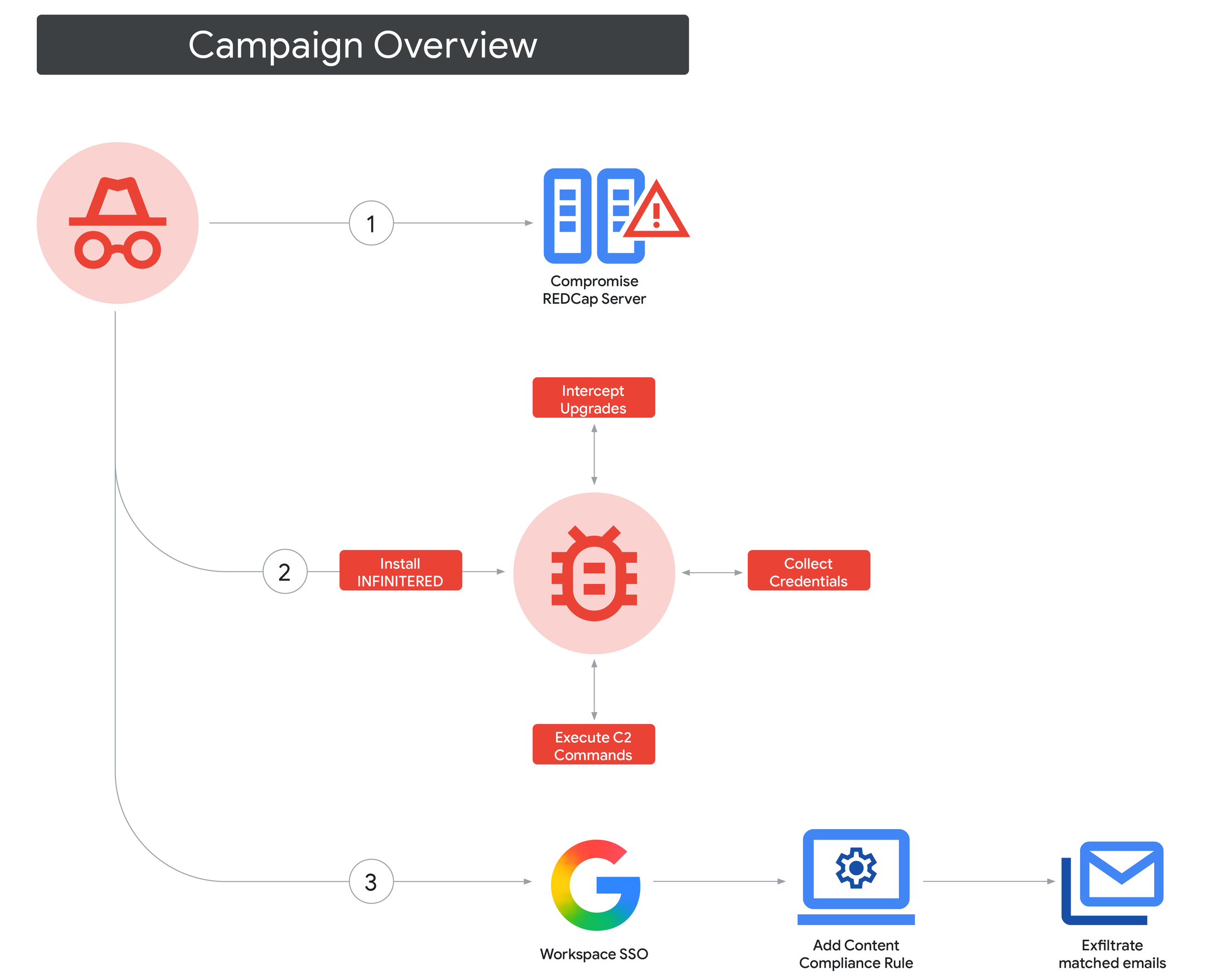
Every confirmed intrusion in this campaign shared a common entry vector: REDCap, the widely adopted web-based platform used by hospitals and universities to build and manage clinical research databases and surveys. Its prevalence across North American academic medicine made it an ideal chokepoint for an adversary with access to unpatched legacy deployments.
While no specific vulnerability has been publicly identified, behavioral evidence suggests the group focused on older, unpatched versions of the software — a reminder that legacy systems in research environments frequently receive less rigorous patch management attention than enterprise IT infrastructure.
Custom Malware Built to Survive Patching
Approximately three months after gaining initial access, the threat actors deployed a purpose-built malware implant designed specifically for REDCap environments. The payload, dubbed INFINITERED, represents a technically deliberate engineering choice — not a commodity tool repurposed for the task, but a bespoke weapon designed for longevity and stealth within the target platform.
INFINITERED operates across three functional layers:
From Database Access to Email Exfiltration
The harvested credentials unlocked the campaign's second phase. Armed with administrator-level access, the attackers pivoted to the victim organizations' cloud email environments, exploiting a legitimate administrative feature — content compliance rules — to silently forward matching emails to attacker-controlled accounts.
The keyword triggers embedded in those rules offer a revealing window into the collection priorities driving the operation. Among them: search terms correlating directly with a Chikungunya virus outbreak in China's Guangdong province during July 2025. That detail is significant. It indicates the collection tasking was not static or pre-programmed — it responded dynamically to real-time domestic intelligence needs, suggesting active human direction of the campaign.
Operational Security Designed to Blend In
Throughout the campaign, the threat actors maintained careful operational security. Traffic was routed through obfuscation networks, infrastructure was operation-specific rather than reused, bulk-sourced accounts supplemented the stolen credentials, and every element was calibrated to blend with legitimate network activity.
Researchers eventually disrupted portions of the known infrastructure — including disabling an exfiltration account — and worked with affected organizations on remediation before public disclosure. Multiple additional suspected intrusions remain under active investigation.
What You Should Do
For security teams at research institutions, healthcare organizations, and any entity running REDCap or similar web-based research platforms, this campaign demands immediate action across several fronts:
- Audit and patch all REDCap deployments immediately. Legacy and older versions are the confirmed attack surface. Inventory every instance across your environment and prioritize updates — but recognize that patching alone will not remove an active INFINITERED infection.
- Hunt for unauthorized email forwarding rules. Review all content compliance and mail forwarding configurations in your cloud productivity platforms. Any rule you cannot directly attribute to a known, authorized administrative action should be treated as suspect and removed pending investigation.
- Enforce phishing-resistant MFA on all administrator accounts. This campaign succeeded in part because stolen passwords provided uncontested access. Hardware security keys or passkey-based authentication eliminate that vector.
- Expand logging and anomaly detection coverage. A backdoor running undetected for over two years is a monitoring failure as much as a detection failure. Ensure your logging captures REDCap application-layer activity, authentication events, and outbound email rule changes.
- Treat research platforms as high-value targets. REDCap and similar tools often fall outside the primary security perimeter, managed by researchers rather than security teams. That needs to change — the data they host and the access they provide make them tier-one assets from an adversary's perspective.
The Broader Lesson
What makes this campaign instructive is not the novelty of the techniques deployed. Credential harvesting, email exfiltration, and persistence through application-layer backdoors are well-documented tradecraft. What is striking is the duration — over two years of undetected access — and the implications for how research organizations assess their own defensive posture.
State-sponsored actors operating against high-value research targets are patient, methodical, and increasingly focused on sector-specific platforms that security teams may not monitor with the same rigor as enterprise infrastructure. The institutions best positioned to defend against this threat are those willing to apply enterprise-grade security thinking to every system that touches sensitive research data — not just the ones that appear on a traditional IT asset register.


