
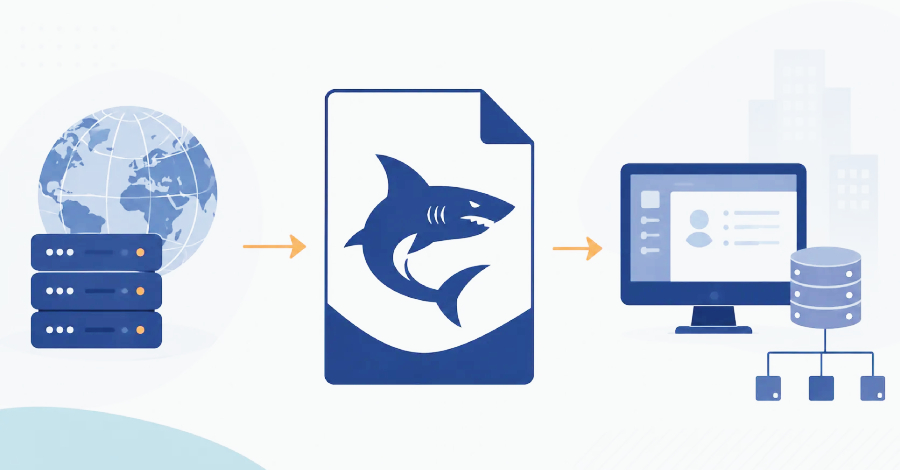
A newly identified threat campaign is quietly burrowing into the networks of government institutions and diplomatic missions across Asia, leveraging a custom-built malware loader that security researchers have never seen before. The operation, now being tracked under the name StrikeShark, represents a calculated, multi-stage intrusion effort with the hallmarks of a disciplined and well-resourced threat actor.
A New Loader Enters the Arena
At the heart of this campaign is SharkLoader, a previously undocumented malware family whose sole operational purpose is to serve as a delivery vehicle for more destructive payloads. In this case, that payload is Cobalt Strike Beacon — the commercial penetration testing framework that has become one of the most widely abused tools in the advanced threat actor playbook.
SharkLoader's emergence is significant not simply because it is new, but because it signals that the operators behind StrikeShark have invested meaningfully in custom tooling. Purpose-built loaders are harder to detect than off-the-shelf alternatives, and they allow threat actors to bypass signature-based defenses that would otherwise flag known malware families at the point of entry.
When a threat actor develops proprietary loader infrastructure, it tells us they are thinking in terms of sustained access, not smash-and-grab. They are optimizing for stealth, persistence, and operational longevity.
High-Value Targets in the Crosshairs
The campaign has zeroed in on geopolitically sensitive targets — a diplomatic organization in Indonesia and multiple government entities in Taiwan. The selection of these targets is not coincidental. Both Indonesia and Taiwan occupy strategically important positions in the Indo-Pacific, and both are of considerable intelligence interest to a range of state-aligned and state-sponsored threat actors operating in the region.
The targeting pattern strongly suggests that the primary motivation here is espionage rather than financial gain. Cobalt Strike Beacon, once deployed, provides operators with a robust remote access capability: it supports command-and-control communication, lateral movement, credential harvesting, and data exfiltration — precisely the toolkit needed for a sustained intelligence-gathering operation.
How the Attack Chain Works
While full technical details of SharkLoader's delivery mechanism continue to be analyzed, the general framework of this style of attack follows a familiar but effective sequence:
Why Cobalt Strike Remains a Persistent Threat
It is worth emphasizing why Cobalt Strike continues to appear in advanced threat campaigns years after its abuse by criminal and nation-state actors became widely documented. The tool is functionally excellent — it was designed by security professionals for red team operations, which means it is highly capable, actively maintained, and built to evade defensive countermeasures. Cracked and leaked versions have proliferated across underground markets, and even sophisticated actors with custom tooling often layer Cobalt Strike into their operations for its reliability and extensibility.
The combination of a novel, custom loader paired with a proven post-exploitation framework is a strategy that balances operational security with effectiveness — a pairing that defenders must be prepared to detect at both layers simultaneously.
What You Should Do
Organizations — particularly those operating in sectors or geographies that carry elevated geopolitical risk — should treat campaigns like StrikeShark as a direct threat signal and act accordingly. Here are the priority actions to take:
- Hunt for Beacon indicators proactively. Do not wait for alerts. Conduct regular threat hunts specifically targeting Cobalt Strike Beacon communication patterns, including malleable C2 profiles and unusual HTTPS beaconing behavior.
- Enforce memory-based detection. Since loaders like SharkLoader are engineered to minimize disk presence, ensure your endpoint detection tools include behavioral and in-memory scanning capabilities, not just file-based signatures.
- Audit external-facing infrastructure. Reduce your attack surface by identifying and hardening or decommissioning exposed services, particularly those accessible from the internet without strong authentication controls.
- Segment your network aggressively. Lateral movement is what turns an initial compromise into a catastrophic breach. Micro-segmentation and least-privilege access policies dramatically raise the cost of post-exploitation activity.
- Train for phishing at the executive and diplomatic level. High-value targets require high-investment social engineering. Ensure that senior officials and their support staff receive targeted phishing simulation and awareness training.
- Monitor DNS and C2 traffic patterns. Beacon relies on consistent, periodic callbacks. Behavioral baselines and anomaly detection on outbound traffic can surface these patterns before significant damage is done.
The Broader Picture
StrikeShark is a reminder that the threat landscape in the Asia-Pacific region remains intensely active. Diplomatic and government organizations are consistently among the highest-priority targets for advanced intrusion campaigns, and the emergence of new, custom malware families suggests that capable actors continue to invest in their offensive capabilities. Defenders cannot afford to stand still. Visibility, behavioral detection, and proactive threat hunting are not optional enhancements — they are the baseline requirements for operating in this environment.


