
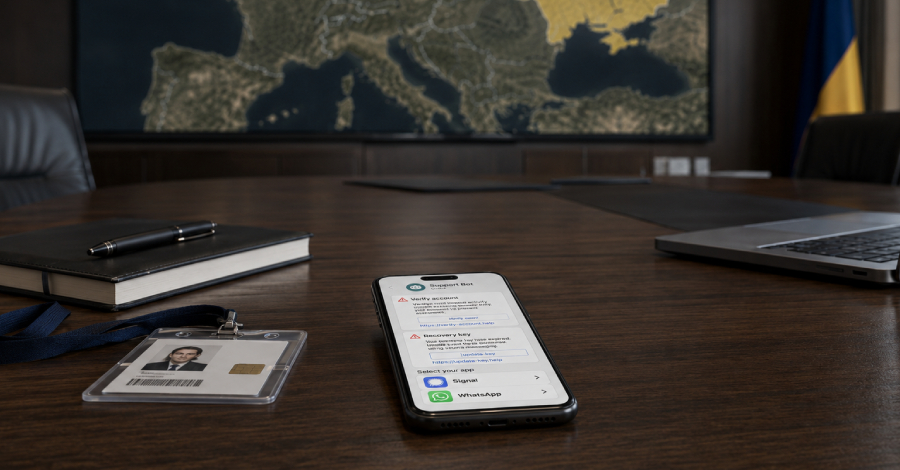
In an era where encrypted messaging apps have become the backbone of sensitive communications for governments, militaries, and civil society, a sophisticated Russian intelligence operation has demonstrated that the weakest link isn't the encryption itself — it's the humans relying on it. A joint investigation by Ukraine's Security Service (SSU) and the U.S. Federal Bureau of Investigation has exposed a sustained, methodical campaign to infiltrate the messaging accounts of high-value targets across Ukraine, Europe, and the United States.
The Architecture of Deception
The operation hinged on a deceptively simple but devastatingly effective technique: impersonation. Operatives linked to Russian intelligence services crafted fraudulent text messages designed to mimic legitimate technical support communications from popular encrypted messaging platforms. Recipients — ranging from Ukrainian government officials and active military personnel to politicians and civil society activists — were manipulated into surrendering their account credentials or granting unauthorized access under the guise of routine account verification or security alerts.
This is social engineering at its most dangerous. Rather than attempting to crack military-grade encryption, the adversary bypassed it entirely by targeting the authentication layer — the login credentials and session tokens that grant access to accounts from the outside. Once inside, operators could silently monitor communications, extract contact networks, and potentially manipulate or delete sensitive exchanges without triggering obvious alarms.
"The most fortified vault in the world becomes worthless if someone tricks you into handing over the keys. That's precisely what this campaign exploited."
Who Was in the Crosshairs
The targeting profile reveals a clear strategic intent. This was not opportunistic cybercrime — it was precision intelligence collection. The campaign specifically prioritized:
The geographic breadth of the campaign — spanning Ukraine, broader Europe, and the United States — signals that Russian intelligence sought not only tactical military intelligence but also strategic political insights into Western decision-making and solidarity around the ongoing conflict.
Why Messaging Platforms Are Prime Targets
Encrypted messaging applications have earned trust among sensitive communicators precisely because their cryptographic protocols are robust. End-to-end encryption, when properly implemented, renders intercepted messages virtually unreadable. This is exactly why adversaries have pivoted away from attempting to break the encryption and instead focus on account takeover — gaining legitimate access through stolen credentials or session hijacking.
Once an attacker controls an account, encryption becomes irrelevant. Messages are decrypted on the device and visible to anyone with account access. Furthermore, messaging accounts often serve as identity hubs, linked to other services, containing years of communication history, and providing insight into an individual's entire professional and personal network.
The Broader Context: A Pattern of Russian Cyber Operations
This campaign does not exist in isolation. It represents a continuation of Russia's well-documented strategy of combining cyber operations with information warfare to support its geopolitical objectives. Previous operations attributed to Russian intelligence services have targeted election infrastructure, energy grids, and government networks across NATO member states. The shift toward targeting individual messaging accounts reflects an evolution in tradecraft — moving toward quieter, harder-to-attribute intrusions that can yield intelligence without triggering the visible disruption that draws immediate international response.
The involvement of both the SSU and FBI in uncovering this campaign also underscores the growing importance of allied intelligence sharing in countering state-sponsored cyber threats. Threats that operate across borders require coordinated defenses that transcend national jurisdictions.
What You Should Do
Whether you're a government official, corporate executive, journalist, or anyone handling sensitive communications, this campaign offers critical lessons that demand immediate action:
- Enable Registration Lock / Two-Factor Authentication: Most secure messaging platforms offer a PIN or passphrase-based registration lock. Enable it immediately. This prevents attackers from re-registering your number on a new device even if they intercept an SMS verification code.
- Never respond to unsolicited support messages: Legitimate messaging platforms do not reach out via SMS to request credential verification. Any such message should be treated as a potential phishing attempt and reported directly to the platform through official channels.
- Audit linked devices regularly: Most messaging apps display all active sessions and linked devices. Review this list frequently and immediately revoke access to any session you don't recognize.
- Use hardware security keys where available: For high-risk individuals, FIDO2-compatible hardware keys provide the strongest available authentication factor and are highly resistant to phishing attacks.
- Verify through independent channels: If you receive any communication claiming to be from a platform's support team, verify its legitimacy by contacting the company directly through their official website — never through links or numbers provided in the suspicious message.
- Conduct regular security awareness training: Organizations handling sensitive communications must ensure that all personnel — not just IT staff — understand social engineering tactics and know how to respond to suspicious outreach.
Key Takeaways
The Russian intelligence operation uncovered by Ukrainian and American investigators is a masterclass in asymmetric cyber tradecraft. By targeting the human element rather than the technical infrastructure, operatives achieved access that no amount of brute-force cryptographic attack could have provided. The message for organizations and individuals alike is sobering: technical security measures are only as strong as the awareness of the people using them.
In an environment where state-sponsored actors are actively hunting credentials through deception, complacency is a vulnerability. Treat every unsolicited account-related communication as adversarial until proven otherwise — because in today's threat landscape, it very well may be.


