
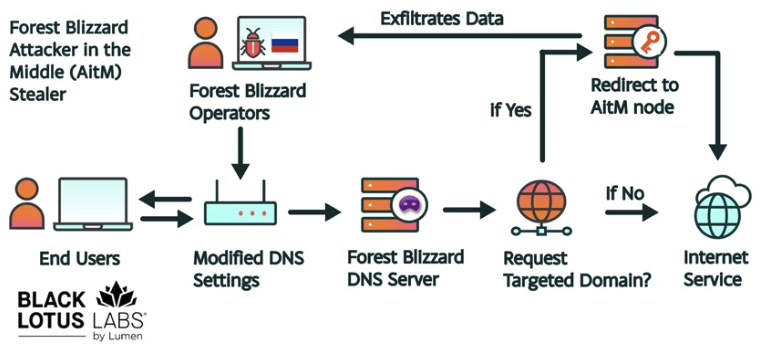
A sophisticated espionage campaign attributed to Russia's military intelligence apparatus has exposed critical vulnerabilities in how organizations secure their network perimeters. The operation, which compromised over 18,000 internet routers across multiple countries, demonstrates how state-sponsored actors are exploiting aging infrastructure to bypass traditional security controls.
The Anatomy of a DNS Hijacking Campaign
Security researchers have uncovered an extensive surveillance network operated by Forest Blizzard, a threat group linked to Russia's GRU military intelligence unit. The campaign targeted primarily legacy routers from manufacturers including Mikrotik and TP-Link, devices commonly deployed in small office and home office environments that often lack robust security maintenance.
Rather than deploying complex malware, the attackers leveraged a surprisingly straightforward approach: exploiting known vulnerabilities to modify the Domain Name System configurations of compromised routers. This technique allowed them to redirect network traffic through attacker-controlled DNS servers without installing persistent malicious code on the devices themselves.
Intercepting Authentication at Scale
The true sophistication of this operation lies in its ability to harvest OAuth authentication tokens from Microsoft Office users. When organizations authenticate to cloud services, these tokens serve as digital keys that grant access to corporate resources. By positioning themselves as intermediaries in the authentication process, the attackers could capture these credentials even after users had successfully completed multi-factor authentication.
The implications are significant: traditional security measures like strong passwords and two-factor authentication become ineffective when the underlying network infrastructure has been compromised at the router level. Users believed they were securely accessing legitimate Microsoft services, while their authentication credentials were being silently intercepted by foreign intelligence operatives.
Scale and Impact Assessment
At the campaign's peak in late 2024, the surveillance network encompassed over 18,000 compromised routers spanning government agencies, law enforcement organizations, and third-party email providers. The targeting pattern suggests a strategic focus on entities with access to sensitive government communications and intelligence.
The operation affected more than 200 organizations and approximately 5,000 consumer devices. The broad scope indicates this was not a targeted intrusion against specific high-value targets, but rather a dragnet approach designed to capture authentication credentials from any accessible network infrastructure.
The attackers demonstrated remarkable operational adaptability, quickly shifting from malware-based router compromise to DNS manipulation techniques when their previous methods were publicly exposed.
Evolving Tactics and Countermeasures
Security researchers note that Forest Blizzard has shown significant tactical flexibility in response to public disclosure of their operations. Following earlier security advisories about their activities, the group rapidly pivoted from using malware to control smaller numbers of routers to implementing large-scale DNS hijacking across thousands of vulnerable devices.
This adaptive capability suggests a well-resourced operation with dedicated technical personnel capable of developing and deploying new attack methodologies on short notice. The shift to DNS manipulation represents a more scalable approach that requires less sophisticated technical infrastructure while potentially yielding greater intelligence collection opportunities.
Regulatory and Industry Response
The campaign has prompted significant policy discussions about the security implications of foreign-manufactured networking equipment. Recent regulatory proposals have focused on restricting the certification of consumer-grade routers produced outside the United States, citing national security concerns about the integrity of critical communications infrastructure.
However, industry experts have raised questions about the practical implementation of such policies, noting that domestic router manufacturing capacity may be insufficient to meet market demand. The tension between security requirements and supply chain realities illustrates the complex challenges facing policymakers as they attempt to secure critical infrastructure.
Key Takeaways for Security Leaders
This campaign underscores a fundamental security principle: the weakest link in any security architecture often lies not in sophisticated endpoint protection or advanced threat detection, but in the mundane network infrastructure that organizations take for granted. As state-sponsored actors continue to demonstrate creativity in exploiting these overlooked attack surfaces, security leaders must expand their defensive focus beyond traditional enterprise security controls to encompass the entire digital ecosystem that supports their operations.


