
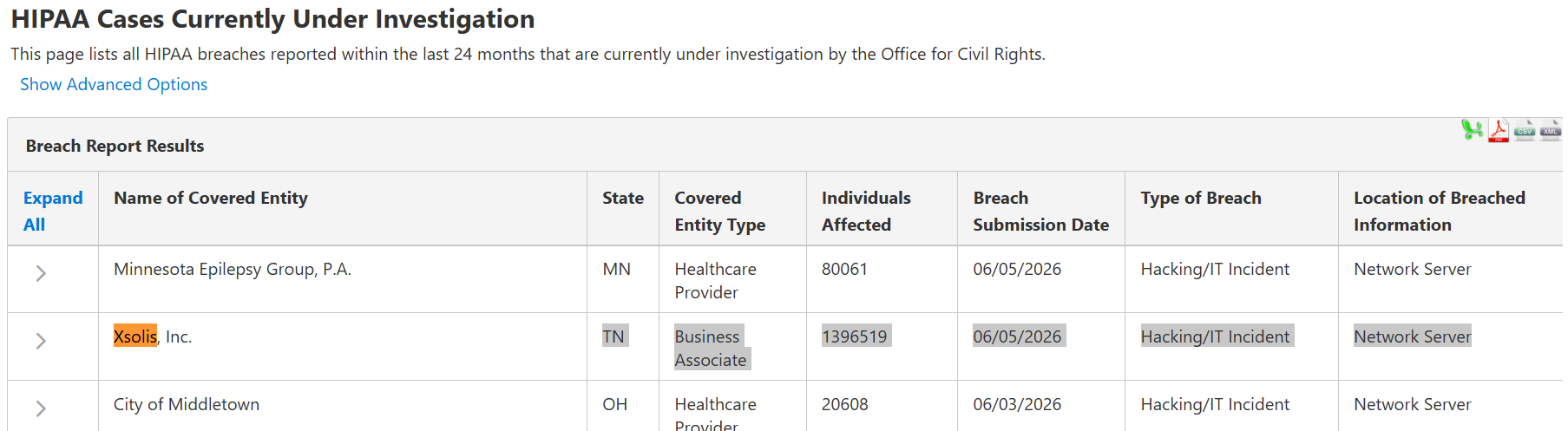
A single phishing email. That is frequently all it takes to bring a healthcare organization's data security posture to its knees — and the latest incident involving Tennessee-based healthcare technology company Xsolis offers a sobering reminder of just how devastating that reality can be. The firm, which provides utilization management and revenue cycle solutions to hospitals and health insurance payers, has confirmed that a targeted phishing attack in January 2026 resulted in the unauthorized exposure of sensitive personal and protected health information belonging to nearly 1.4 million individuals.
How the Breach Unfolded
According to the company's official disclosure, the intrusion originated on January 20, 2026, when a threat actor successfully executed a phishing attack against Xsolis systems. Two days later, on January 22, internal teams detected the unauthorized activity and moved quickly to contain it. External cybersecurity specialists were brought in to assist with forensic investigation, and law enforcement was notified.
The investigation ultimately confirmed that the attacker had exfiltrated files containing sensitive data aggregated from Xsolis's hospital and payer client base. Depending on the individual, the compromised information may include:
The U.S. Department of Health and Human Services has formally logged the total number of affected individuals at 1,396,519 — placing this squarely among the more significant healthcare data breaches reported in 2026.
Why Healthcare Vendors Remain High-Value Targets
What makes this incident particularly instructive is not just its scale, but its entry point. Xsolis is not a hospital — it is a third-party technology vendor that aggregates and processes patient data on behalf of multiple healthcare institutions. This is the classic supply-chain exposure: attackers who cannot pierce a hospital's defenses directly may find that the vendor ecosystem surrounding it presents a far softer target.
Healthcare data is uniquely valuable on criminal markets. A complete record combining a Social Security number, insurance credentials, and medical history commands a premium that credit card data simply cannot match — and the damage to victims can persist for years.
Utilization management firms like Xsolis sit at a sensitive intersection: they receive detailed clinical and administrative data from multiple provider organizations, centralizing risk in a single platform. A successful breach at this layer can simultaneously affect patients across dozens of affiliated hospitals or health systems — a force multiplier that sophisticated threat actors increasingly understand and exploit.
Ransomware Connection? Not Confirmed
As of the time of writing, no ransomware group has claimed responsibility for the Xsolis intrusion, and the company has stated it is not aware of any confirmed misuse of the compromised data. However, the absence of a ransomware claim does not rule out data brokering, identity fraud operations, or future targeted attacks leveraging the stolen records. Healthcare data theft frequently precedes downstream fraud by months or even years, making early consumer notification and protective action especially critical.
Xsolis's Response Measures
The company has undertaken several remediation steps in the wake of the incident:
- Immediate containment of the unauthorized access vector
- Engagement of external cybersecurity forensic experts
- Notification to federal law enforcement
- Implementation of additional technical security controls
- Direct mail notification to all identified affected individuals
- Establishment of a dedicated toll-free support hotline
- Provision of complimentary credit monitoring and identity protection services
While these are appropriate post-breach responses, cybersecurity professionals will note that the two-day detection gap between the phishing attack and its discovery underscores the need for real-time behavioral monitoring and email security controls capable of catching credential-harvesting attempts before lateral movement occurs.
What You Should Do
If you believe you may have received care at a hospital that partners with Xsolis, or if you receive a notification letter, take the following protective steps immediately:
- Enroll in the free credit monitoring and identity protection services offered through the breach notification — do not delay, as enrollment windows typically expire.
- Place a fraud alert with any one of the three major credit bureaus (Equifax, Experian, or TransUnion). The alert is automatically shared across all three and lasts 90 days, with extended seven-year alerts available for confirmed identity theft victims.
- Consider a credit freeze, which is the strongest available protection. It restricts new creditors from accessing your credit file entirely and is available at no cost under federal law.
- Review your Explanation of Benefits (EOB) statements from your health insurer carefully for any services you did not receive — a hallmark sign of medical identity fraud.
- Monitor financial accounts and credit reports regularly. You are entitled to a free annual credit report from each major bureau, and free weekly reports remain available through AnnualCreditReport.com.
- Be alert for phishing attempts targeting you. Threat actors who acquire breach data frequently use it to craft highly convincing follow-on phishing or vishing attacks against the same victims.
The Broader Lesson for Healthcare Organizations
For healthcare CISOs and security leaders, the Xsolis breach reinforces a critical imperative: vendor risk management cannot be an afterthought. Every third-party platform that touches protected health information must be subject to rigorous security assessments, contractual security obligations, and continuous monitoring. The regulatory exposure under HIPAA for covered entities whose business associates suffer breaches is substantial — and reputational damage to affiliated hospitals can far outlast any financial penalty.
Phishing remains the dominant initial access vector across virtually every sector, yet it continues to succeed at alarming rates. Organizations processing sensitive health data at scale must invest in advanced email security, mandatory phishing simulation training, and zero-trust access architectures that limit the blast radius when credentials are inevitably compromised. The question is no longer whether a phishing attempt will succeed — it is whether the controls surrounding that moment of failure are sufficient to prevent a 1.4-million-record catastrophe.


