
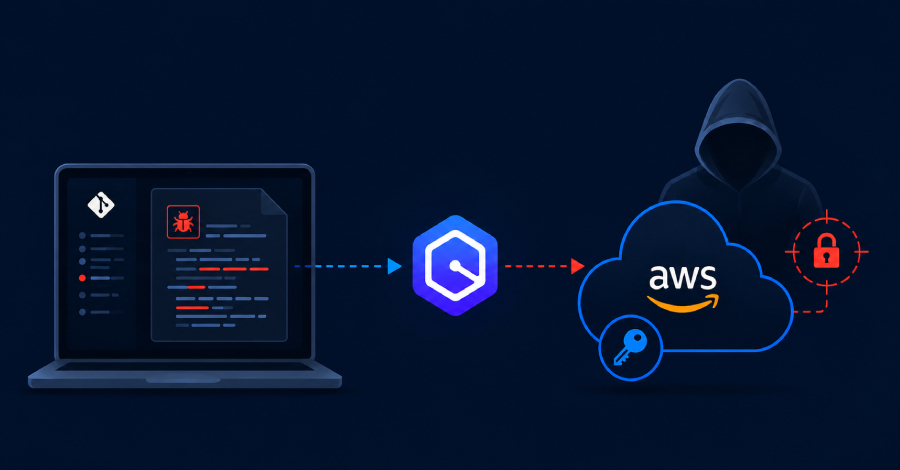
The promise of AI-powered development tools is speed, intelligence, and seamless integration with a developer's existing workflow. But that seamless integration is precisely what made a recently patched vulnerability in Amazon Q Developer so dangerous — and so instructive about the security risks hiding inside the AI coding assistant revolution.
A Short Path to Credential Theft
Tracked as CVE-2026-12957 and assigned a CVSS score of 8.5, the flaw resided in how Amazon Q Developer processed configuration data associated with Model Context Protocol (MCP) servers. MCP is an emerging standard that allows AI assistants to interact with external tools, services, and data sources — expanding what an AI agent can do far beyond simple code completion.
The attack chain required remarkably little friction. A developer opens a malicious or compromised repository, grants workspace trust — a routine step many developers perform without a second thought — and Amazon Q Developer takes over from there. The assistant, faithfully processing the repository's MCP configuration, would execute attacker-supplied commands with the privileges of the authenticated developer. Those privileges, in the context of an AWS environment, can include access to cloud credentials that unlock storage buckets, databases, compute instances, and more.
"The most dangerous vulnerabilities are those that weaponize trust. A developer trusting a workspace is a normal, expected behavior — and that's exactly what this exploit leveraged."
The implications are significant. Cloud credentials, once harvested, rarely expire quickly. An attacker with valid AWS tokens can pivot laterally across services, exfiltrate sensitive data, provision infrastructure for further attacks, or quietly establish persistent access long before any incident response team detects unusual activity.
Why MCP Deserves Serious Security Scrutiny
Model Context Protocol is still maturing as a standard, and its adoption is accelerating as AI coding tools race to offer richer, more capable developer experiences. But with expanded capability comes expanded attack surface. MCP configurations embedded in repositories are essentially executable instructions handed directly to an AI agent with ambient credentials — a setup that demands careful sandboxing, strict privilege separation, and rigorous input validation.
This vulnerability illustrates a category of risk that security teams should now treat as a first-class concern: AI agent prompt and configuration injection. When an AI assistant automatically processes configuration files from untrusted sources, any weakness in how those configurations are validated or sandboxed becomes a potential code execution vector.
The threat model here is not hypothetical. Open-source repositories are trivially easy to seed with malicious configurations. Developers routinely clone unfamiliar codebases for evaluation, debugging, or contribution. The combination of routine developer behavior and a vulnerable AI assistant creates an attack surface that scales with adoption.
Amazon's Response
Amazon has patched the vulnerability in Amazon Q Developer. Organizations and individual developers using the tool should verify they are running the latest version and treat any period prior to patching as a potential exposure window, particularly if developers were actively working with external or community repositories during that time.
The patch addresses the flaw in how MCP server configurations were handled, though the broader architectural question — how AI coding tools should safely manage agentic capabilities without becoming vectors for credential theft — remains an industry-wide challenge that no single patch fully resolves.
What This Means for Your Security Posture
This incident is a leading indicator, not an isolated anomaly. As AI development tools become standard infrastructure in engineering teams, security organizations must adapt their threat models accordingly. Every AI assistant that reads files, executes tools, or connects to external services represents a new category of attack surface that traditional endpoint and code scanning controls were not designed to address.
What You Should Do
Key Takeaways
CVE-2026-12957 is a high-severity reminder that AI coding assistants are not passive tools — they are active agents operating with real credentials in sensitive environments. A malicious repository configuration is now a viable initial access vector. The attack chain is short, the required developer interaction is minimal, and the potential impact reaches directly into cloud infrastructure.
Security teams that have not yet included AI development tools in their threat modeling, vulnerability management, and detection programs should treat this patch cycle as their prompt to begin. The intersection of agentic AI and cloud-privileged developer environments will continue to attract adversary attention — and the next CVE in this category may not arrive with a patch already in hand.


