
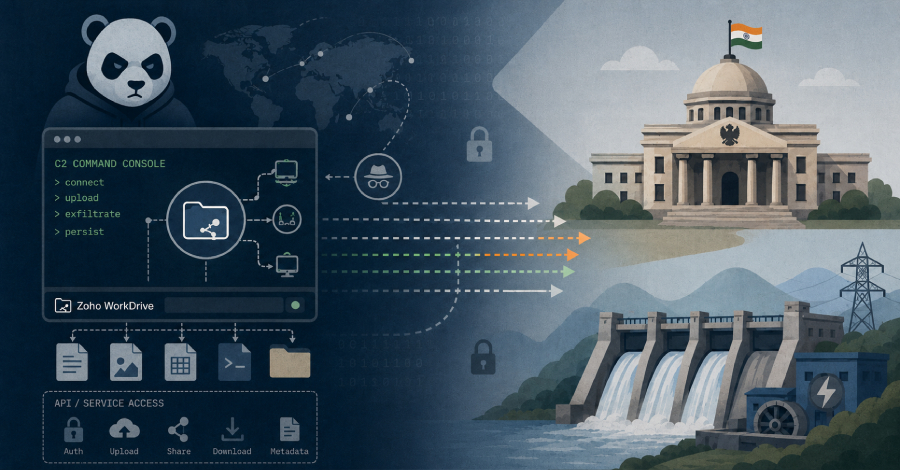
A sophisticated Chinese state-aligned espionage operation is actively burrowing into the heart of Indian government infrastructure — and it is doing so with the help of a tool that organizations trust every day. Security researchers have uncovered evidence that Mustang Panda, one of the most persistent and technically capable threat actors tied to Beijing's intelligence apparatus, is running not one but two concurrent campaigns targeting Indian government institutions and critical infrastructure, including hydropower facilities.
A Trusted Platform Turned Against Its Users
What distinguishes this campaign from run-of-the-mill state-sponsored intrusions is the adversary's deliberate abuse of Zoho WorkDrive, a legitimate cloud productivity and file-sharing platform widely used across enterprise and government environments. By routing command-and-control communications through a trusted SaaS platform, Mustang Panda effectively neutralizes one of the most common defensive mechanisms organizations rely on: domain reputation filtering.
When malicious traffic is indistinguishable from normal business communication with a recognized cloud vendor, perimeter defenses and network monitoring tools face a fundamental blind spot. Security teams trained to block known-malicious infrastructure find themselves powerless against a command channel that looks, by every standard measure, completely legitimate.
"Living-off-trusted-sites" is rapidly becoming the preferred evasion architecture for nation-state actors — embedding espionage operations inside the digital workflows organizations depend on most.
High-Value Targets Inside Government Networks
Confirmed compromises extend to machines operated by senior administrative staff within Indian government networks — a detail that underscores both the ambition and the precision of this operation. Mustang Panda is not casting a wide net hoping to catch commodity data. Targeting senior officials suggests the group is pursuing high-value intelligence: policy documents, diplomatic correspondence, infrastructure planning data, or personnel records that could provide strategic advantage.
The simultaneous targeting of hydropower infrastructure alongside government administrative networks points to a dual mandate. On one hand, the group appears to be gathering political and bureaucratic intelligence. On the other, probing energy infrastructure aligns with a broader pattern of pre-positioning within critical systems — a hallmark of state-sponsored operations that blend espionage with potential disruptive capability.
New Malware Signals Continued Investment
Beyond the novel use of Zoho WorkDrive, researchers identified previously undocumented malware strains deployed as part of the intrusion chain. This is significant for several reasons. First, it demonstrates that Mustang Panda continues to invest in custom tooling, reducing reliance on commodity malware that detection systems are tuned to catch. Second, new malware variants reset the detection clock — security vendors must analyze, profile, and update signatures before defensive coverage catches up.
This combination — novel malware paired with legitimate infrastructure as a command channel — represents a maturation in the group's operational security posture. It reflects a calculated effort to extend dwell time inside compromised networks, allowing for deeper reconnaissance and more thorough data exfiltration before detection occurs.
Understanding Mustang Panda's Strategic Context
Mustang Panda, also tracked under designations including TA416 and Bronze President, has a documented history of targeting governments across Southeast Asia, Europe, and South Asia. The group's operations consistently align with Chinese geopolitical interests, focusing on countries involved in territorial disputes, infrastructure partnerships, or diplomatic friction with Beijing.
India's relationship with China across several of these dimensions makes it a high-priority intelligence target. Border tensions, competing infrastructure investments across South Asia, and India's growing strategic partnerships with Western nations all provide ample motivation for sustained espionage activity. This campaign should be understood not as an isolated incident but as part of a long-running, continuously evolving intelligence collection effort.
The Broader Threat of Cloud Platform Abuse
The exploitation of Zoho WorkDrive as a command-and-control channel is part of a wider and deeply concerning trend. Threat actors across the spectrum — from nation-states to ransomware groups — are increasingly routing malicious operations through platforms such as Google Drive, Microsoft OneDrive, Dropbox, Slack, and Telegram. This approach, sometimes called "living-off-trusted-sites," exploits the implicit trust organizations extend to major cloud providers.
Traditional network security architectures were not designed to inspect or restrict traffic to these platforms granularly. Blocking them entirely is operationally untenable for most organizations. This gap creates a structural advantage for adversaries willing to invest in this technique.
What You Should Do
The Mustang Panda campaign against Indian government targets is a reminder that sophisticated adversaries are no longer relying on technical brute force alone. They are exploiting trust — in platforms, in workflows, and in the assumptions that underpin how organizations build their defenses. Closing that gap requires moving beyond perimeter-centric thinking toward behavioral monitoring, zero-trust architecture, and a realistic understanding of who is targeting your organization and why.


