
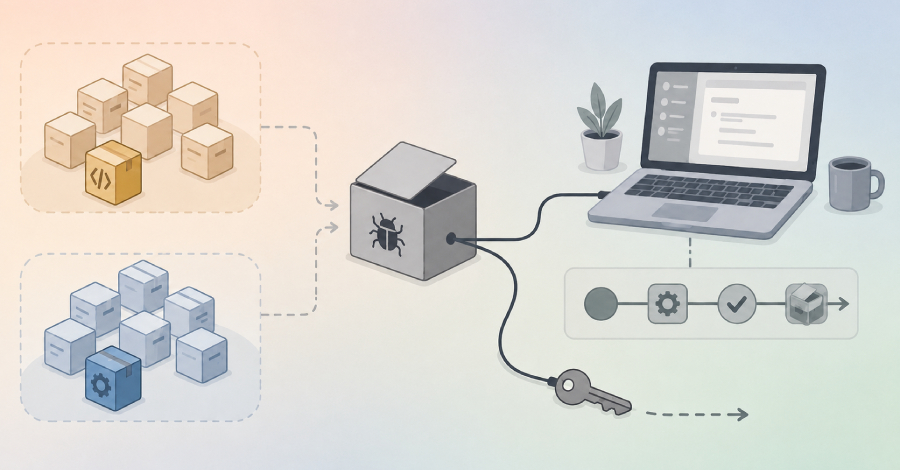
Software supply chain attacks have evolved from an occasional headline into a persistent, escalating crisis — and the latest campaign tied to the Miasma malware family illustrates exactly why development pipelines have become one of the most coveted attack surfaces in modern cybersecurity. What began as a focused operation has grown into a multi-vector offensive spanning npm packages, GitHub Actions, and now the broader Go ecosystem.
A Malware Family Growing in Sophistication
Security researchers have been tracking a cluster of malicious activity associated with three related malware strains — Mini Shai-Hulud, Miasma, and Hades — that share common code lineage and tactical objectives. The family's defining characteristic is its aggressive focus on developer tooling: rather than targeting end-users directly, these threats embed themselves into the infrastructure developers trust implicitly.
The newest wave of activity reveals a deliberate expansion strategy. Threat actors have successfully poisoned packages associated with LeoPlatform and RStreams — two npm-hosted libraries with genuine developer adoption — by publishing malicious releases that blend seamlessly with legitimate version histories. For organizations that rely on automated dependency resolution, the risk of silently ingesting a compromised package is not hypothetical; it is a continuous operational reality.
GitHub Actions: Weaponizing the CI/CD Pipeline
Perhaps the most alarming dimension of this campaign is its exploitation of GitHub Actions workflows. Continuous integration and delivery pipelines are by design automated, trusted, and often minimally scrutinized once established. Attackers behind Miasma have recognized this blind spot and are actively abusing workflow configurations to trigger malicious code execution at build time — meaning an organization's own CI/CD infrastructure can become the delivery mechanism.
When your build pipeline becomes the attack vector, traditional perimeter defenses become largely irrelevant. The threat is already inside the trusted zone before a single line of production code ships.
This technique is particularly insidious because it can evade endpoint detection tools that focus on runtime behavior. Malicious instructions embedded in a workflow file execute with the same permissions as legitimate build steps, making forensic attribution difficult and immediate impact broad.
Crossing Into the Go Ecosystem
The campaign's lateral movement into Go module infrastructure signals a deliberate effort to maximize the blast radius. The Go ecosystem, while generally considered more structured than npm in its dependency handling, is not immune to typosquatting, dependency confusion, or malicious package injection. As Go adoption continues accelerating in cloud-native and backend development, it represents an increasingly high-value target for supply chain operators.
This cross-ecosystem propagation reflects a maturation in attacker tradecraft. Rather than betting everything on a single package registry, the operators behind Miasma are deliberately distributing their exposure — ensuring that takedowns on one platform do not neutralize the entire campaign.
The Broader Supply Chain Threat Landscape
This campaign does not exist in isolation. It is part of a documented trend in which criminal and state-adjacent threat actors increasingly focus their resources on the software development lifecycle itself. The economics are compelling from an attacker's perspective: a single compromised package can propagate malicious code to thousands of downstream applications, organizations, and ultimately end-users — all through channels those victims actively trust.
Organizations that have not yet formalized their approach to software composition analysis (SCA) and supply chain integrity verification are particularly exposed. Relying on package maintainers alone for security assurance is no longer a defensible posture.
What You Should Do
The Takeaway for Security Leaders
The Miasma campaign is a reminder that supply chain security is not a one-time project — it is a continuous discipline. As this malware family demonstrates an appetite for cross-ecosystem expansion and workflow-level compromise, security teams must evolve their monitoring and validation capabilities at the same pace. The developers writing your software are not the adversaries; but the infrastructure they depend on is now firmly in the crosshairs.


