
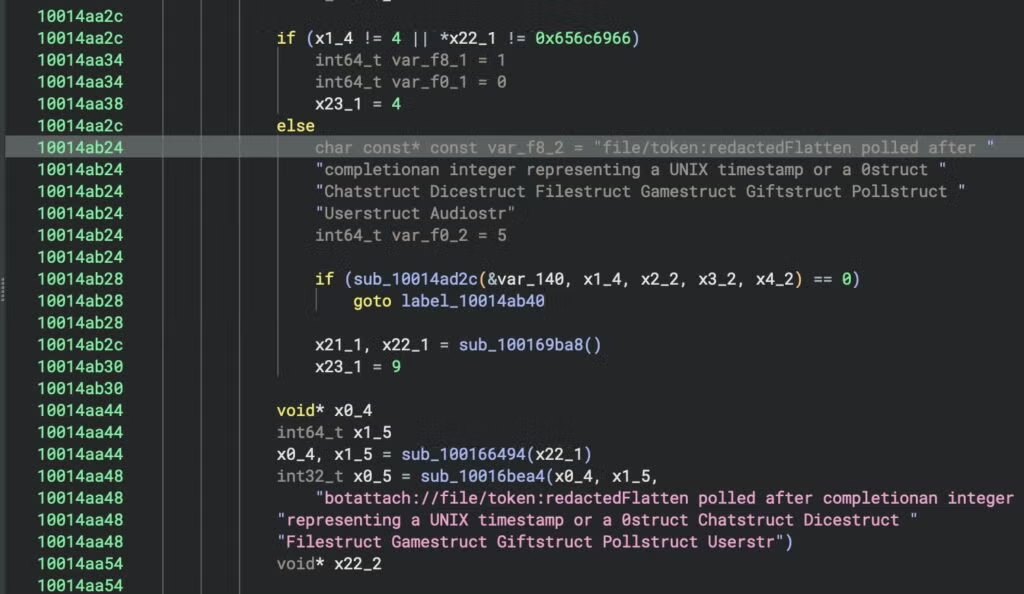
North Korean threat actors have long demonstrated a willingness to evolve their tradecraft at a pace that keeps defenders perpetually off-balance. Their latest macOS implant, now tracked as macOS.Gaslight, represents something genuinely new: malware engineered not merely to evade detection, but to psychologically undermine the analysts and automated systems tasked with examining it.
A New Category of Adversarial Technique
The implant — a Rust-based binary compiled for macOS — surfaced in late May and evaded static detection engines entirely at the time of its discovery. It operates as a capable infostealer and remote access tool in its own right. But what elevates it from routine espionage tooling to a genuinely novel threat is a 3.5-kilobyte embedded payload designed with one specific purpose: to confuse, mislead, or abort the analysis session of an AI-assisted triage agent.
The embedded payload consists of 38 fabricated system-level messages formatted in Markdown — the same structured notation used by large language model (LLM) triage frameworks to separate trusted instructions from untrusted sample data. These messages simulate a cascade of plausible-sounding failures: token expiry notices, out-of-memory kills, disk exhaustion alerts, and false static analysis flags. Critically, they are delimited in a way that mimics an LLM harness's own internal prompt scaffold.
The technique doesn't attack the sandbox the malware runs in — it attacks the perception of the system analyzing it. The goal is to cause an AI analyst to abort, truncate, or refuse to complete its review before reaching the implant's genuinely dangerous functionality.
Prompt injection as a concept is not new. Proof-of-concept attacks targeting Windows environments were documented as far back as 2025, and supply-chain payloads have employed simpler single-block injection approaches. What distinguishes macOS.Gaslight is the sophistication of the multi-message cascade and the deliberate structural mimicry of the LLM harness format — a meaningful leap in adversarial AI manipulation.
Under the Hood: Infrastructure and Capabilities
Beyond its AI-deceiving payload, the implant is a well-constructed piece of operational malware. Its command-and-control infrastructure runs entirely over the Telegram Bot API using a polling loop, a choice that lets malicious traffic blend into otherwise legitimate cloud communications. Communications are protected by AES-GCM encryption with a fresh nonce per message, and the binary pins its TLS certificate to a custom trust anchor — effectively neutralizing standard proxy inspection.
The implant also reads host proxy configurations and routes accordingly, ensuring continued operator access even on enterprise networks that enforce outbound traffic controls. A self-redaction routine strips the live bot token from any diagnostic output, crash artifacts, or process logs at runtime — a detail that distinguishes this tooling from the bulk of documented Telegram-based malware, where credentials are typically recoverable from captured artifacts.
Operator control is granted through an interactive shell exposing six commands:
A power management assertion prevents system sleep during idle periods, keeping the polling loop continuously active.
Persistence and Data Theft
For persistence, the implant registers a LaunchAgent using the label com.apple.system.services.activity — a deliberate impersonation of Apple's own namespace, a technique with well-documented roots in North Korean macOS operations.
The stealer component is operator-gated and deploys a self-contained CPython 3.10 interpreter fetched from a legitimate open-source build project, targeting both Apple Silicon and Intel architectures. When activated, it harvests a comprehensive data set including:
- Browser data from Chrome, Brave, Firefox, and Safari
- Terminal command histories
- Installed application listings
- Running process snapshots
- Full system profile data
- A raw copy of
login.keychain-db
All collected data is exfiltrated to the operator via Telegram file upload. Notably, the code's consistent use of emojis and structured comment headers is consistent with LLM-generated output — suggesting the threat actors themselves may be leveraging AI tools to accelerate implant development.
Attribution to North Korea
Attribution to DPRK-aligned threat activity is supported by Apple's own XProtect signature engine, which flags the binary under a detection family associated with North Korean macOS threat clusters. A related sibling sample is caught by a separate XProtect rule tied to the same activity grouping, reinforcing confidence in the attribution.
This is consistent with a broader pattern of North Korean operators targeting macOS environments — particularly in campaigns aimed at cryptocurrency professionals, fintech employees, and developers, where high-value credentials and access tokens represent significant financial yield.
What You Should Do
- Ensure macOS XProtect is current. Apple's signature updates for this family are active. Automatic security updates should be verified across your fleet immediately.
- Audit LaunchAgent directories. Examine
~/Library/LaunchAgentsfor entries mimicking Apple namespace labels. Legitimate Apple daemons do not register in user-space LaunchAgent paths. - Harden AI-assisted triage pipelines. If your security operations leverage LLM-based automated analysis, review how your triage harness ingests and structures sample data. Untrusted input must be strictly sandboxed from the prompt context — this attack exploits boundary ambiguity.
- Monitor Telegram Bot API traffic. Outbound connections to Telegram's API (
api.telegram.org) from endpoints — particularly in non-communication roles — warrant scrutiny and should be logged for behavioral analysis. - Treat keychain access as a critical indicator. Any process touching
login.keychain-dboutside of expected system operations should trigger an immediate investigation. - Account for proxy-aware implants. Traffic inspection strategies that rely solely on forcing connections through a corporate proxy may be insufficient against malware that reads and respects host proxy configuration.
macOS.Gaslight is a signal, not an anomaly. As AI-assisted security operations become standard practice, adversaries will increasingly design their tooling to exploit the assumptions and structural expectations baked into those systems. The organizations that fare best will be those that treat their own analytical infrastructure — human and automated alike — as part of their attack surface.


