
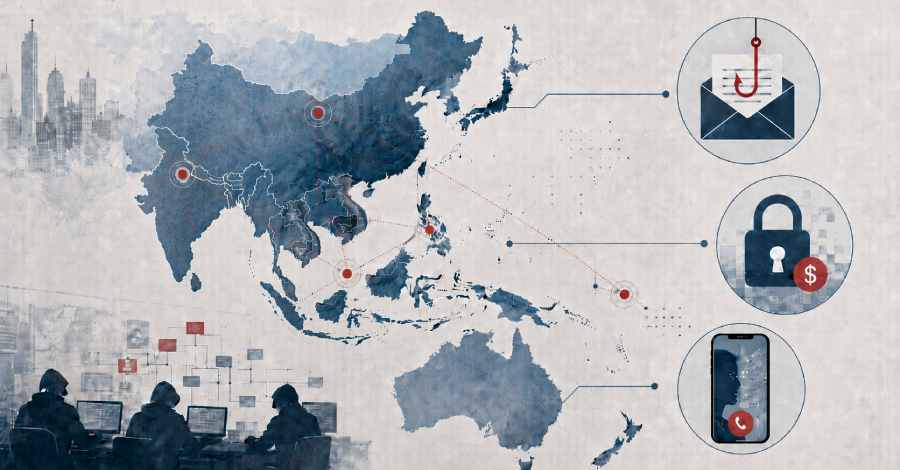
Cybercrime across the Asia-Pacific region is no longer a slow-burning problem — it has become a five-alarm emergency. A sweeping new threat assessment from INTERPOL paints a stark portrait of a region under digital siege, where phishing campaigns, ransomware operations, and AI-powered fraud schemes are metastasizing at a pace that is outstripping the defensive capabilities of many nations in the area.
A Region at a Crossroads
The Asia-Pacific region is home to some of the world's fastest-growing digital economies. Rapid internet penetration, explosive mobile adoption, and the aggressive digitalization of financial services have unlocked enormous economic opportunity — but they have also created an expansive and unevenly defended attack surface. INTERPOL's 2025/2026 assessment identifies this disparity in cybersecurity maturity as a critical vulnerability. While major technology hubs like Singapore, Japan, and South Korea maintain relatively sophisticated defenses, many neighboring nations are still building foundational capabilities, creating pockets of exposure that organized criminal networks are actively exploiting.
The same digital transformation driving regional economic growth is simultaneously lowering the barrier to entry for cybercriminals targeting millions of newly connected users.
Phishing: The Threat That Refuses to Fade
Among the threat vectors documented in the report, phishing has emerged as the most pervasive. This should not be surprising — phishing remains effective precisely because it targets the human element rather than technical infrastructure. What has changed is the sophistication and scale at which these campaigns now operate.
Artificial intelligence is fundamentally reshaping the phishing landscape. Threat actors are leveraging large language models to generate highly convincing lure content in local languages, eliminating the grammatical errors and awkward phrasing that once served as red flags for even moderately trained users. Deepfake audio and video technologies are being deployed in business email compromise (BEC) variants, enabling criminals to impersonate executives with alarming authenticity. For organizations operating across the Asia-Pacific region — particularly those with multinational workforces and cross-border financial transactions — this represents a materially elevated risk.
Ransomware Operations Grow More Targeted
Ransomware actors have not merely maintained their foothold in the region — they have sharpened their targeting. Critical infrastructure sectors including healthcare, logistics, and public utilities have drawn disproportionate attention from ransomware groups, who recognize that operational disruption in these verticals creates maximum leverage for extortion demands.
The report highlights the role of organized transnational criminal networks in coordinating these attacks. Unlike the lone-wolf hacker of popular imagination, today's ransomware ecosystem is a professionalized industry with distinct roles: initial access brokers who sell network footholds, ransomware-as-a-service platforms that provide the malicious tooling, and negotiation specialists who manage victim communications. This industrialization means that even mid-tier criminal groups can execute devastatingly effective campaigns against targets that would previously have been beyond their technical reach.
AI Scams: A New Threat Category
Beyond its role in enhancing phishing, artificial intelligence is enabling entirely new categories of fraud that are proliferating rapidly across the region. Investment scams leveraging AI-generated personas, romance fraud operations conducted at scale using chatbot technology, and synthetic identity schemes are all documented in the assessment. Notably, many of these operations are being run out of cyber scam compounds — a disturbing phenomenon where trafficked individuals are coerced into operating fraud schemes — which have become a significant and deeply troubling feature of the regional threat landscape.
What Organizations Operating in Asia-Pacific Need to Understand
The uneven cybersecurity maturity across the region means that supply chain risk is amplified. A well-secured enterprise can still be compromised through a less-defended regional partner, vendor, or subsidiary. Third-party risk management programs must account for the full geographic spread of an organization's digital ecosystem.
What You Should Do
The Bigger Picture
INTERPOL's assessment is a reminder that cybercrime does not observe borders, and that the security posture of the region's least-protected nodes affects everyone operating within it. For security leaders with Asia-Pacific exposure, the report should function not as background reading but as an active planning document. The threat environment is evolving faster than many defensive programs — and the window to close that gap is narrowing.


