
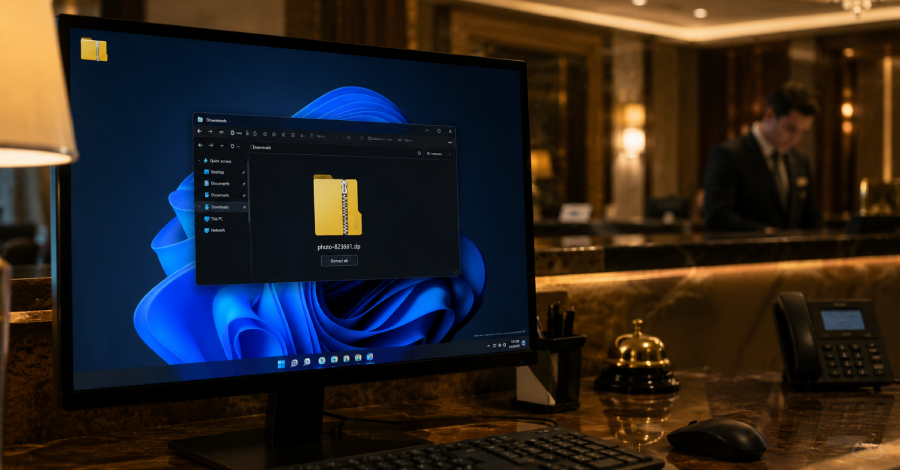
The hospitality industry has long been a lucrative target for cybercriminals — guest payment data, loyalty program credentials, and real-time access to reservation systems make hotel front desks a particularly attractive beachhead. A newly identified phishing campaign, flagged by Microsoft, is exploiting exactly that operational reality, deploying a sophisticated Node.js-based implant against hotels across Europe and Asia in a campaign that has been active since at least April 2026.
A Lure Engineered for the Hotel Industry
What makes this campaign notable isn't just its technical sophistication — it's the deliberate targeting logic baked into the attack design. Hotels routinely receive emails containing photo attachments: guest complaints about room conditions, event coordinators sharing venue images, travel agencies sending property documentation. Threat actors behind this campaign have clearly done their homework, crafting ZIP archives with photo-themed naming conventions that blend seamlessly into the normal operational noise of a hotel inbox.
When a front-desk employee or operations staffer opens the malicious archive and executes the contained payload, the attack chain delivers a Node.js implant onto the compromised machine. Front-desk terminals are particularly valuable compromise targets — they often hold keys to property management systems, payment processing interfaces, guest databases, and internal communication tools.
Why Node.js Is a Strategic Choice
The selection of Node.js as the implant runtime is a telling technical decision. JavaScript-based malware running through a legitimate runtime environment offers several distinct advantages to attackers:
This technique reflects a broader trend in the threat landscape — adversaries increasingly favor living-off-the-land approaches and legitimate runtime abuse over traditional compiled malware, precisely because it complicates detection and attribution.
Attribution and Intent Remain Unclear
Microsoft has not linked this activity to any previously catalogued threat actor, and the campaign's ultimate objectives have not yet been established. That ambiguity itself is worth noting. Campaigns of this operational maturity — regionally targeted, industry-specific, using custom implants with evasion-conscious design — rarely exist without a clear endgame, whether that's financial theft, espionage, ransomware staging, or some combination.
The absence of attribution should not be mistaken for the absence of sophistication. The targeting precision and implant design suggest a threat actor with deliberate strategic intent, even if that intent has not yet fully materialized in observed post-compromise activity.
The geographic scope — spanning both European and Asian hospitality markets — suggests either a threat actor with broad operational reach or one specifically targeting multinational hotel chains and international travel infrastructure.
The Hospitality Sector's Persistent Security Challenges
Hotels face a structural security disadvantage. High staff turnover means security awareness training is perpetually incomplete. Front-desk workers operate under significant time pressure, making careful scrutiny of incoming emails a practical challenge. And the industry's dependence on operational continuity — a hotel cannot simply take its reservation system offline — limits the aggressiveness with which security teams can respond to potential threats.
These factors combine to create environments where phishing campaigns, particularly those tailored to industry-specific communication patterns, can achieve higher success rates than in more security-mature verticals.
What You Should Do
- Audit ZIP file handling policies: Establish strict controls around the automatic execution of content extracted from email attachments, particularly archives containing executables or script files.
- Restrict Node.js execution on front-desk terminals: Unless operationally required, Node.js runtimes should not be present or executable on guest-facing workstations. Application whitelisting can enforce this.
- Deploy behavioral endpoint detection: Signature-based tools alone will not catch novel Node.js implants. Behavioral detection that flags anomalous JavaScript runtime activity or unexpected outbound connections is essential.
- Conduct targeted phishing awareness training: Hotel staff should receive specific guidance on scrutinizing photo and media attachment requests, particularly from unfamiliar senders.
- Segment front-desk systems: Network segmentation can limit the lateral movement potential of any implant that does successfully execute, containing the blast radius of a compromise.
- Monitor for Node.js process anomalies: Security operations teams should establish baselines for legitimate Node.js usage and alert on deviations, including unexpected child processes or network connections.
The hospitality sector cannot afford to treat this campaign as a peripheral concern. The operational access available from a compromised front-desk terminal represents a significant threat to guest safety, financial integrity, and regulatory compliance. Security investments that match the sophistication of the adversary are no longer optional — they are a baseline requirement for operating responsibly in an industry that sits squarely in the crosshairs.


