
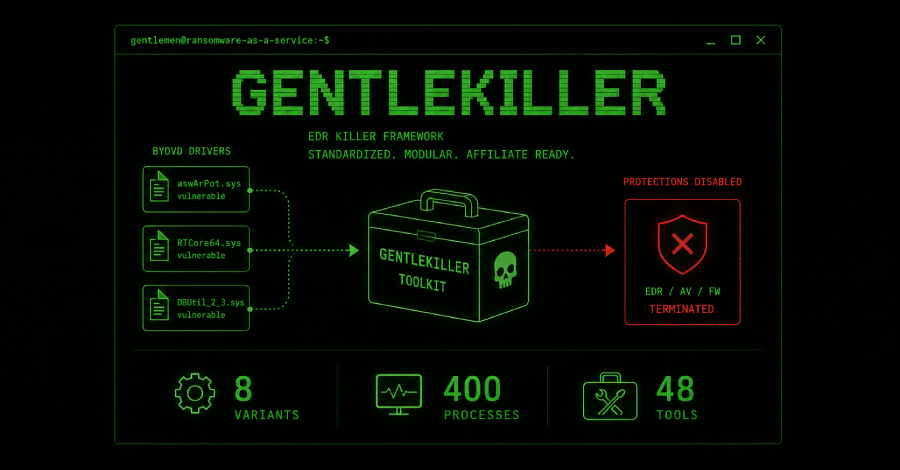
A sophisticated ransomware-as-a-service operation known as The Gentlemen has quietly assembled one of the more methodical approaches to defeating modern endpoint defenses seen in today's threat landscape. At the core of their operational toolkit sits a custom-built framework called GentleKiller — a structured, actively maintained platform engineered with a singular purpose: dismantling the security controls organizations spend significant resources deploying.
This isn't a rogue actor wielding a single blunt instrument. What's emerging from analysis of this group's activity is something closer to an organized software development operation, one that treats EDR evasion as a discipline worthy of its own dedicated engineering effort.
The Business of Killing Security Tools
Ransomware-as-a-service operations have matured considerably over the past several years. Where early groups relied on opportunistic access and brute-force tactics, today's RaaS platforms function more like franchise businesses — complete with affiliate programs, technical support, and increasingly, curated toolkits handed to partners before an attack is ever launched.
The Gentlemen operation exemplifies this evolution. Rather than leaving affiliates to source their own evasion capabilities, the group actively develops and distributes EDR-termination tools through the GentleKiller framework. This lowers the technical bar for affiliates while simultaneously standardizing the pre-encryption kill chain across campaigns.
When a RaaS group invests in maintaining a dedicated EDR-killing framework, it signals a strategic recognition that endpoint detection has become the primary obstacle between initial access and a successful encryption event.
The framework reportedly targets upward of 400 distinct security processes — a figure that encompasses a broad spectrum of commercial EDR platforms, antivirus engines, endpoint agents, and security monitoring tools. The breadth of that target list alone speaks to the operational ambition behind this capability.
Third-Party Integration and Framework Modularity
What distinguishes GentleKiller from simpler, single-purpose termination scripts is its apparent modularity. The framework incorporates third-party tools and components alongside its proprietary capabilities, suggesting the group is actively curating external resources — whether sourced from underground markets, open-source abuse, or purpose-built partnerships — and integrating them into a coherent operational pipeline.
This hybrid approach is tactically sound. By blending custom tooling with externally sourced components, the group can rapidly expand their process-kill coverage while making attribution and defensive detection more complicated. Security vendors tracking indicators of compromise face a moving target when the underlying tools are in continuous development and augmented with external modules.
Why EDR Killers Are Now Table Stakes
The proliferation of EDR platforms over the past decade has genuinely disrupted ransomware operations — or at least raised their operational costs. Threat actors have responded not by retreating, but by systematically investing in tools that neutralize these defenses before the encryptor ever touches a file system.
Several techniques dominate this space:
A framework like GentleKiller likely incorporates several of these techniques, with the specific approach selected or adapted based on the target environment's security stack.
Implications for Defenders
The existence of a mature, maintained EDR-killing framework distributed to affiliates at scale should recalibrate how security teams think about their defensive posture. It is no longer sufficient to deploy an EDR platform and consider endpoint protection solved. The adversary has adapted — and the defensive posture must adapt accordingly.
Detection needs to extend beyond malware signatures to encompass the behavior of security tools themselves. Unexpected termination of endpoint agents, modification of security service configurations, or unusual driver loads should be treated as high-priority alert conditions, not background noise.
What You Should Do
- Enable tamper protection on all endpoint agents. Most enterprise EDR platforms offer settings that prevent unauthorized modification or termination — ensure these are enforced, not just available.
- Monitor for process termination targeting security tooling. Alert on any process kill events directed at known security agents, particularly when originating from unexpected parent processes.
- Audit kernel driver loads. BYOVD attacks depend on loading vulnerable drivers. Maintain an approved driver allowlist and alert on deviations, particularly for drivers with known vulnerabilities.
- Restrict Safe Mode access. Configure systems to require additional authentication credentials before a Safe Mode reboot can be initiated, limiting a common encryptor deployment technique.
- Layer your defenses beyond the endpoint. Network-level detection, deception technologies, and identity-based controls provide visibility even when endpoint agents are compromised or killed.
- Assume affiliate involvement means scale. RaaS affiliates operate across multiple targets simultaneously. Indicators from one incident should be rapidly operationalized into detection rules across the broader environment.
The Gentlemen's investment in a dedicated, evolving EDR-killing framework is a reminder that the ransomware ecosystem continues to professionalize. For defenders, the response cannot be static. Security controls require the same iterative maintenance and adversarial testing that threat actors are apparently applying to the tools designed to defeat them.


