
Most ransomware operators hand their affiliates a playbook and a payload — and leave the messy work of disabling endpoint defenses entirely to them. The Gentlemen took a fundamentally different approach, and the results are difficult to ignore: more than 500 confirmed victims since late 2025, a ranking among the five most active ransomware operations in the first quarter of 2026, and a technical infrastructure built around one unsettling premise — that neutering your security stack before the ransomware ever runs is too important to leave to chance.
A Centralized Weapon, Not a Patchwork
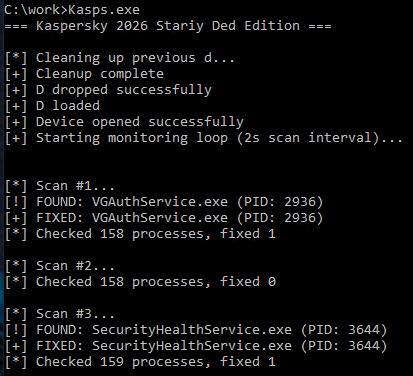
At the core of The Gentlemen's affiliate offering is GentleKiller, a proprietary EDR-killing framework with at least eight known variants. Each variant impersonates a different legitimate software product while abusing a different vulnerable or malicious kernel driver through a technique known as Bring Your Own Vulnerable Driver, or BYOVD. The attack surface this covers is staggering.
Across all variants, GentleKiller hunts for processes belonging to more than 48 distinct security products — a target list exceeding 400 individual process names. Familiar names populate that list: CrowdStrike Falcon, SentinelOne, Microsoft Defender, Sophos, VMware Carbon Black, and others that form the backbone of enterprise endpoint protection programs worldwide.
What makes GentleKiller particularly concerning from a defensive standpoint is not its breadth, but its architecture. Security researchers who examined the variants found extensive structural and behavioral commonalities beneath the surface-level disguises — clear evidence of a shared development template that operators can repurpose with minimal effort. Change the impersonated product, swap the vulnerable driver, and you have a new variant ready for deployment.
The group's approach centralizes EDR killing as an operator-managed function — a ready-to-use, standardized suite that materially lowers the entry barrier for affiliates and makes their job considerably easier.
Speed as a Competitive Advantage
The modular template design serves another critical purpose: it enables The Gentlemen to weaponize newly disclosed BYOVD proof-of-concepts in days rather than weeks. When public exploit code for vulnerable drivers surfaces on researcher blogs or GitHub repositories, the group's operators can integrate those drivers into GentleKiller almost immediately. Two variants — designated by researchers as UnknownKiller and PoisonKiller — were absorbed into the group's active toolkit within days of their respective public disclosures.
This responsiveness transforms the public vulnerability research ecosystem into an inadvertent supply chain for criminal infrastructure. Every BYOVD proof-of-concept release carries an implicit countdown timer for defenders to patch or block the relevant driver before adversaries operationalize it.
Third-Party Tools, First-Class Integration
GentleKiller is not the only instrument in the suite. The Gentlemen have supplemented their proprietary framework with three externally sourced EDR killers, each apparently acquired and then standardized with a consistent defense-evasion layer.
All three tools received the same cosmetic treatment applied to GentleKiller variants: binary protection through commercial packers, filenames mimicking legitimate security vendor software, fabricated version metadata, copied digital signatures, and matching icons. The goal is consistent — make malicious tools look innocuous long enough to survive initial inspection.
Victim Selection and Geographic Spread
The Gentlemen's victimology departs from the pattern established by most major ransomware operations, which tend to cluster heavily around US-based targets. Instead, the group's confirmed victims skew toward Southeast Asia, South America, and Western Europe — a distribution that appears deliberate rather than coincidental.
Leaked internal data suggests the group selects targets centrally, primarily based on FortiGate misconfiguration exposure, and then distributes those targets to affiliates. This structured selection process eliminates the geographic bias that emerges when individual affiliates choose their own prey, and it means that any organization running an improperly secured FortiGate device is a potential candidate regardless of where it operates.
Researchers also identified a Rust-based credential stealer called OxideHarvest active within the group's intrusion chain, indicating that data exfiltration precedes encryption — consistent with the double-extortion model that has become industry standard among ransomware operators.
What You Should Do
The Gentlemen's model represents a maturation of the ransomware-as-a-service ecosystem that demands a corresponding maturation in defensive posture. Organizations should act on the following priorities:
- Audit and restrict kernel driver loading. Implement Windows Defender Application Control or equivalent policies to block known vulnerable drivers. Microsoft's recommended driver blocklist should be treated as a baseline, not a ceiling.
- Patch FortiGate and perimeter devices immediately. The group's target selection methodology centers on misconfigured and unpatched edge devices. Exposure here translates directly into operator-assigned targeting.
- Monitor for EDR process termination events. Legitimate administrative activity rarely involves bulk security process kills. Alert on any attempt to enumerate or terminate processes associated with endpoint protection software.
- Treat BYOVD disclosures as active threats. When a new vulnerable driver proof-of-concept is published publicly, the operational window before criminal adoption is measured in days. Treat these disclosures with the same urgency as active CVE exploitation.
- Review endpoint protection tamper resistance settings. Most enterprise EDR platforms offer tamper protection modes that raise the bar for driver-based attacks. Confirm these features are enabled and monitored.
- Implement network segmentation to limit lateral movement. Even when endpoint defenses are compromised, robust segmentation can prevent ransomware from propagating to the full environment before detection.
The Gentlemen have demonstrated that the industrialization of EDR evasion is no longer theoretical. The group has built, packaged, and distributed that capability as a managed service — and they are updating it faster than most organizations update their defenses. Closing that gap requires deliberate, sustained attention to the attack surface these tools exploit.


