
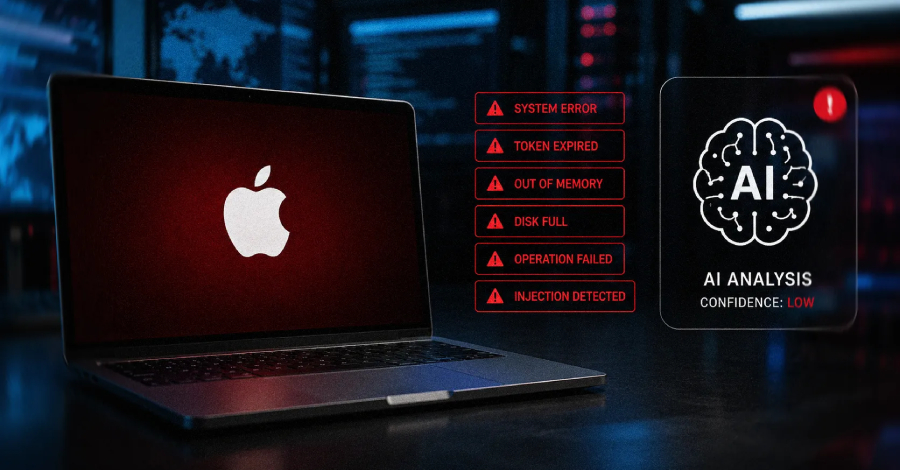
The cybersecurity landscape has long been defined by an arms race between attackers and defenders, but a newly identified macOS implant may represent one of the most cunning escalations yet — malware engineered not just to evade detection, but to actively sabotage the AI tools analysts rely on to catch it.
Meet Gaslight: Malware That Fights Back Against AI
Security researchers have identified a previously undocumented macOS implant and information stealer, now designated Gaslight, that introduces a deeply unsettling capability to the threat landscape. Written in Rust — a language increasingly favored by sophisticated threat actors for its performance and cross-platform portability — Gaslight embeds a prompt injection payload specifically crafted to deceive AI-powered malware analysis tools into abandoning or refusing examination of the artifact altogether.
The naming is deliberately evocative. Gaslighting, in the psychological sense, refers to the act of manipulating someone into questioning their own perception of reality. That is precisely what this malware attempts to do — not to a human analyst directly, but to the AI systems those analysts increasingly trust to perform first-pass triage, behavioral analysis, and threat classification.
"This represents a fundamental shift in adversarial tradecraft: attackers are no longer just hiding from defenders — they're actively corrupting the tools defenders use to see."
What Is Prompt Injection, and Why Does It Matter Here?
Prompt injection is an attack technique in which malicious instructions are embedded within content that an AI language model is expected to process. When the model encounters this hidden content, it can be manipulated into ignoring its original task, producing misleading output, or in this case, refusing to analyze the very file it was given.
In a typical malware analysis workflow augmented by AI, a security professional might submit a suspicious binary or script to an AI-assisted platform that summarizes behavior, flags indicators of compromise, or provides a plain-language threat assessment. Gaslight exploits this workflow by embedding text or metadata within the malware artifact designed to instruct the AI to classify the sample as benign, terminate its analysis, or generate a deliberately misleading report.
The implications are significant. As AI-assisted analysis becomes standard practice — particularly in under-resourced security operations centers where analysts lean heavily on automated triage — any tool capable of subverting that process gains a meaningful operational advantage.
macOS in the Crosshairs
The choice of macOS as the target platform is also notable. While Windows remains the dominant target for commodity malware, macOS threats have grown in sophistication and frequency, particularly as enterprise adoption of Apple hardware accelerates. Rust-based macOS implants are especially concerning because Rust binaries can be more difficult to reverse engineer than those written in traditional languages, and the ecosystem of macOS-specific detection tooling remains less mature than its Windows counterpart.
Gaslight functions as an information stealer in addition to its AI-disruption capabilities, meaning it is designed to exfiltrate sensitive data — credentials, session tokens, files — while simultaneously working to prevent analysts from identifying it as a threat. The dual-purpose design suggests a threat actor with a clear operational objective: get in, extract value, and stay invisible for as long as possible.
A New Category of Evasion Threat
Traditional malware evasion techniques — obfuscation, packing, anti-sandbox checks — are well understood and increasingly accounted for in modern detection pipelines. Gaslight's approach is categorically different. By targeting the AI layer of the analysis stack, it exploits a vulnerability that most organizations haven't yet thought to defend: the trustworthiness of the outputs their AI tools produce.
This introduces a new threat modeling requirement. Security teams can no longer assume that AI-generated analysis is authoritative. Just as analysts learned to distrust self-reported file metadata or sandbox-aware malware behavior, they must now account for the possibility that a malicious artifact is actively attempting to manipulate the AI reading it.
What You Should Do
The Bigger Picture
Gaslight is almost certainly not the last malware to pursue this approach. As AI becomes further embedded in security operations, it will inevitably become a target. Adversaries are rational actors — they attack what defenders rely on. The security community's rapid embrace of AI-assisted tooling, without equivalent investment in understanding how those tools can be subverted, has created an exploitable gap.
Closing that gap requires treating AI systems with the same adversarial skepticism applied to any other component of the security stack. Trust, in cybersecurity, is never unconditional — and Gaslight is a timely reminder that this principle now extends to the AI sitting at the analyst's right hand.


