
When security researchers stumbled upon an unprotected server in mid-June 2026, what they found wasn't a simple data dump. It was the inner machinery of a running criminal enterprise — complete with brute-force infrastructure, credential catalogs, annotated target spreadsheets, and AI-assisted attack tooling. The operation, now widely referred to as FortiBleed, had quietly accumulated valid remote-access credentials for 73,932 Fortinet firewall devices spanning 21,632 organizations across 194 countries. By some estimates, that represents roughly half of every internet-facing FortiGate appliance on the planet.
This wasn't a breach in the conventional sense. No single vulnerability was exploited. No sophisticated zero-day changed hands. This was industrialized credential theft — automated, tiered, and explicitly built for resale.
A Vendor, Not a Hacker
Investigators traced the operation to a single seller operating under the handle "SantaAd" on a Russian-language cybercrime forum. Active since early 2025, the account had cultivated a credible vendor reputation with a remarkably narrow product focus: Fortinet network access. Auction listings included remote administrative credentials to named U.S. manufacturers, bulk lots of FortiGate management panel access, and standing purchase requests for fresh corporate footholds — particularly targeting American companies above a specified annual revenue threshold.
The most revealing artifact wasn't a password file. It was a spreadsheet.
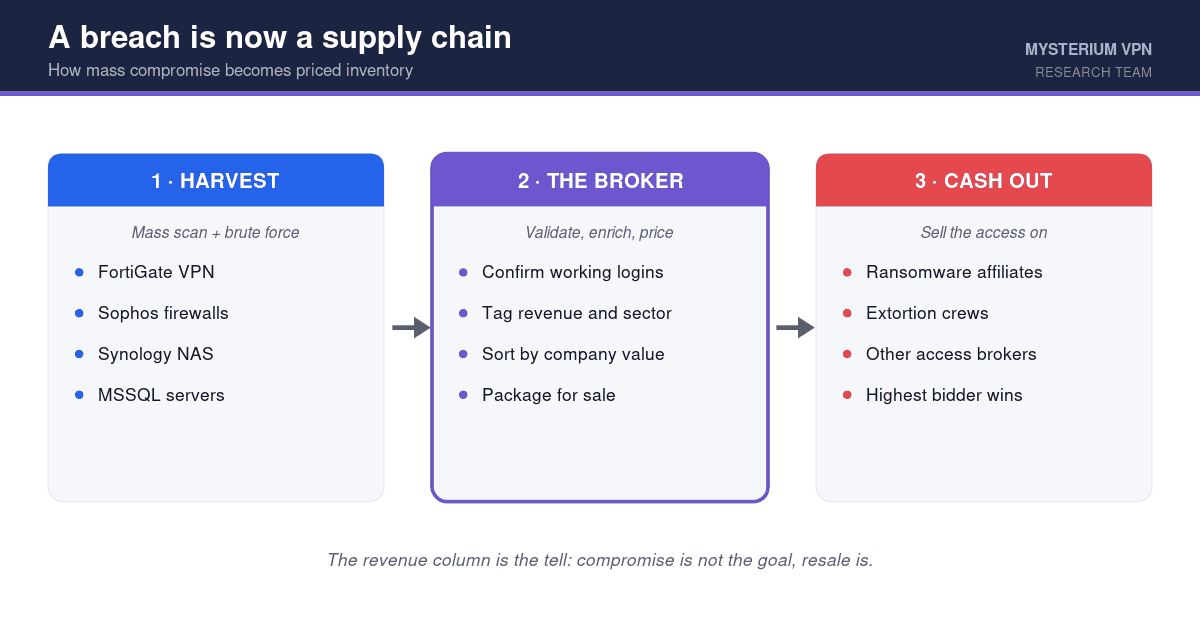
The leaked data was annotated organization by organization — company name, industry sector, annual revenue, employee count — and sorted into pricing tiers based on estimated worth. This wasn't intelligence collection. It was inventory management.
That revenue column is the defining feature of the operation. Espionage actors classify targets by strategic value. This actor classified them by resale price. The likely buyers: ransomware crews for whom a pre-validated administrative foothold inside a high-revenue enterprise represents exactly the kind of asset worth paying for.
The Infrastructure Behind the Catalog
FortiBleed ran on largely commoditized components assembled with enough sophistication to operate at scale. The attack chain involved three distinct systems working in concert:
The custom tooling bore unmistakable hallmarks of AI-assisted development: emoji-laden status messages, rigidly formatted step-by-step logic, and verbose inline comments characteristic of code generated through large language model interactions. Metadata tied the codebase to an AI development environment session created just days before the campaign launched.
AI as a Force Multiplier
Perhaps the most significant operational detail is the deployment of an AI-driven penetration-testing framework — software that allows an operator to describe a network objective in plain language and have the tool execute the corresponding attack sequence autonomously. The barrier to conducting sophisticated network intrusions has dropped dramatically. Actions that previously required experienced, technically skilled attackers can now be delegated to software by anyone capable of renting server time and writing a coherent prompt.
This is not a theoretical concern. FortiBleed demonstrates the capability deployed in a live, revenue-generating criminal operation.
Candor From the Inside
What makes this case unusually instructive is the seller's own transparency. In forum threads, SantaAd acknowledged that the credential acquisition method was "mostly brute," that the in-house brute-forcing tool was proprietary, and — crucially — that only a fraction of listed credentials had been confirmed valid at the time of sale. At one point, an entire auction was retracted because the dataset contained errors. A subsequent auction had its starting price raised after the story received press coverage, with the vendor explicitly citing news articles as third-party authentication of the data's legitimacy.
This is access brokering from the inside: not a clean, surgical heist but a noisy, imperfect assembly line — volume over precision, with quality control managed post-sale by buyers.
What Organizations Must Do Now
The structural lesson of FortiBleed is architectural. The network security appliances organizations deploy to keep unauthorized users out became the front door through which this operation walked — and then cataloged for resale. Several immediate actions follow from this reality:
- Remove management interfaces from the public internet. Firewall and VPN administration panels have no legitimate reason to be internet-accessible. Place them behind dedicated management networks or jump hosts.
- Enforce multi-factor authentication universally. Some of the compromised credentials in this dataset were lengthy and complex. Password strength alone provides no protection against brute-force operations running at sufficient scale and duration.
- Rotate all stored credentials immediately. Any credential embedded in device configurations, scripts, or backup files should be treated as potentially compromised and rotated without delay.
- Audit for existing unauthorized access. Given the operational timeline, organizations with internet-exposed Fortinet management interfaces should conduct thorough forensic reviews for signs of unauthorized activity predating this disclosure.
- Assume prior enumeration. If your organization could appear in this dataset — based on geography, sector, or revenue profile — treat your network access as potentially already listed on a criminal marketplace.
Key Takeaways
FortiBleed is not primarily a story about Fortinet. It is a case study in how access brokering has matured into a structured, AI-augmented commercial operation with defined customer segments, tiered pricing, and quality-assurance challenges. The criminal ecosystem around initial access has professionalized to a degree that should recalibrate how security leaders think about perimeter devices — not as protective barriers but as high-value targets in their own right.
The question for every organization running internet-facing network appliances is no longer whether credentials might be tested against them. It is whether a working login to your environment is already sitting in someone's catalog, waiting for the right buyer.


