
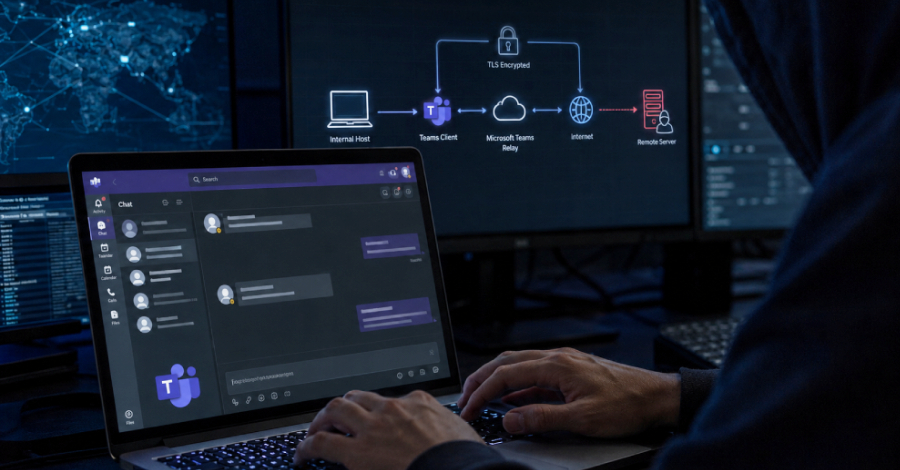
In a calculated evolution of ransomware tradecraft, threat actors affiliated with the DragonForce ransomware operation have been caught leveraging a previously undocumented remote access trojan — one specifically engineered to blend malicious communications into the noise of legitimate enterprise collaboration infrastructure. The technique represents a troubling leap in operational sophistication and a direct challenge to conventional network-based detection strategies.
A Backdoor Built for Concealment
Security researchers have identified a custom Go-based implant, designated Backdoor.Turn, deployed against at least one major U.S. services organization. What distinguishes this tool from conventional RATs is not simply its construction — Go-based malware has become increasingly common among sophisticated threat groups — but rather where it hides its tracks.
Rather than reaching out to attacker-controlled servers over exposed or flagged IP ranges, Backdoor.Turn routes its command-and-control traffic through Microsoft Teams relay infrastructure. In practice, this means that from a network monitoring perspective, the malicious traffic appears indistinguishable from routine Teams telemetry — a product used daily by millions of enterprise employees and trusted implicitly by most corporate firewalls.
By abusing trusted cloud relay infrastructure, DragonForce effectively turns an organization's own productivity stack into a covert communication channel — neutralizing signature-based detection at the network perimeter.
Why This Technique Is Particularly Dangerous
The exploitation of legitimate cloud services for C2 communications — a technique often referred to as living-off-the-cloud — has been growing in prevalence among both nation-state actors and financially motivated cybercriminal groups. By co-opting platforms like Microsoft Teams, attackers benefit from several built-in advantages:
This is not the first time a threat group has exploited Microsoft's ecosystem for covert operations, but the specific targeting of Teams relay servers — as opposed to SharePoint, OneDrive, or Outlook, which have been abused in prior campaigns — signals continued experimentation by DragonForce operators to find detection blind spots.
DragonForce's Expanding Operational Playbook
DragonForce has evolved considerably from its early ransomware-as-a-service roots. The group has demonstrated a willingness to invest in custom tooling rather than relying solely on commodity malware or publicly available exploit frameworks. The development of Backdoor.Turn — a purpose-built, language-specific implant with cloud-relay evasion capabilities — underscores a maturation in capability that security teams should not underestimate.
The targeting of a large U.S. services firm also fits a well-established pattern: high-revenue organizations with complex, interconnected environments where a ransomware deployment can cause maximum operational disruption and, consequently, maximum extortion leverage.
Detection Challenges for Enterprise Defenders
Traditional perimeter defenses are largely ineffective against this class of attack. Blocking Microsoft Teams traffic outright is operationally infeasible for most enterprises. Behavioral analysis, endpoint telemetry, and anomaly detection on process-level network activity become the most viable detection vectors.
Security teams should pay particular attention to unusual processes initiating connections to Teams relay endpoints — especially those that have no legitimate business reason to interact with Teams APIs. Go-compiled binaries appearing in non-standard directories, combined with Teams-related network activity, should be treated as high-confidence indicators of compromise.
What You Should Do
- Audit endpoint-to-cloud traffic at the process level — Identify which processes on your endpoints are making connections to Microsoft infrastructure, and flag anomalies that fall outside expected application behavior.
- Deploy EDR with behavioral analytics — Signature-based tools will not catch Backdoor.Turn. Endpoint detection and response platforms capable of process genealogy analysis are essential.
- Restrict Teams API access by application — Where possible, use Microsoft's conditional access and application control policies to limit which applications can interact with Teams services.
- Investigate Go-compiled binaries — Proactively hunt for unsigned or anomalous Go binaries appearing in user directories, temp folders, or scheduled task locations.
- Implement network segmentation — Limit lateral movement opportunities so that even a successful initial compromise cannot easily reach high-value assets prior to ransomware deployment.
- Test your detection stack against cloud-relay C2 scenarios — If your threat simulation exercises don't include living-off-the-cloud techniques, close that gap immediately.
The Broader Implication
The DragonForce Teams relay campaign is a clear signal that ransomware operators are no longer simply script-kiddies deploying off-the-shelf tools. They are investing in research, custom development, and evasion engineering at a pace that demands an equivalent investment from the organizations defending against them. The perimeter is no longer the frontier — the threat now lives inside your trusted infrastructure.


