
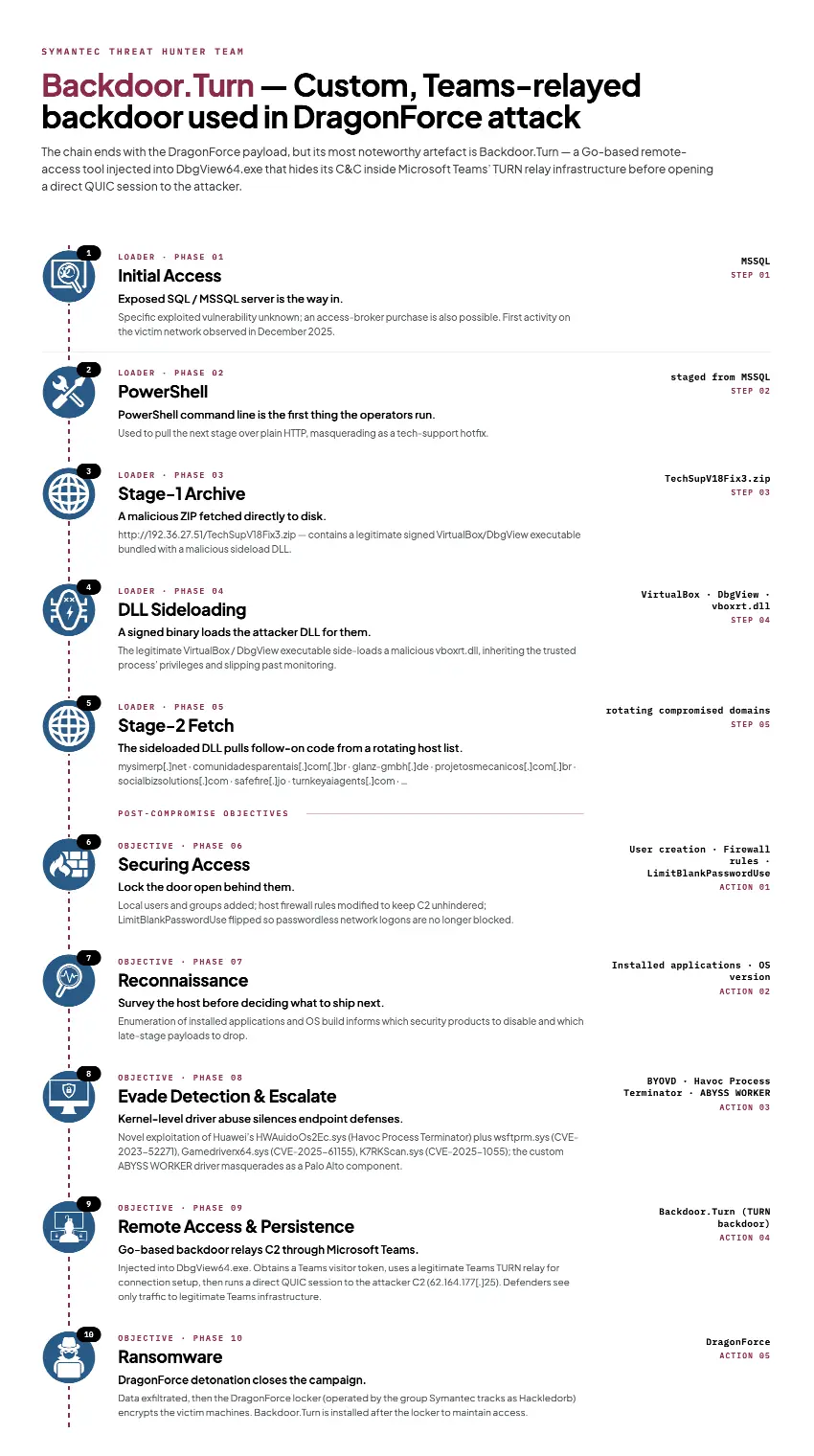
When security teams scan network traffic for signs of intrusion, they instinctively trust the familiar. Traffic flowing to and from Microsoft's servers rarely raises alarms — and that blind trust is precisely what a sophisticated ransomware group exploited to devastating effect against a major U.S. services organization. For as long as two months, attackers moved freely through the victim's environment while defenders watched what appeared to be entirely routine Microsoft Teams activity.
A Novel Technique That Rewrites the Threat Playbook
The group behind the operation, a ransomware cartel known as DragonForce, deployed a custom-built backdoor — designated Backdoor.Turn — that represents a genuine leap forward in attacker tradecraft. Rather than establishing direct connections to attacker-controlled infrastructure (a tell that endpoint and network detection tools are specifically designed to catch), the malware takes an altogether different approach.
Backdoor.Turn acquires an anonymous visitor token from Microsoft's identity services — the same Skype-backed infrastructure that underpins Teams — and leverages a legitimate Microsoft TURN relay to establish its connection. Over this trusted channel, it runs a QUIC protocol session back to the attacker's actual command-and-control server. From the perspective of any security tool watching the wire, the traffic is indistinguishable from a legitimate Teams call or collaboration session.
To defenders monitoring network activity, Backdoor.Turn produces no anomalous signal — because every packet it sends appears to originate from, and terminate at, Microsoft's own infrastructure.
This is the first confirmed instance of TURN relay infrastructure being weaponized in this manner in the wild. The conceptual groundwork for the technique traces back to research presented at a major security conference in 2025, which explored command-and-control communications deliberately engineered to resist network-side profiling. DragonForce's operators apparently studied that research and put it into production.
A Backdoor Built for Staying Power
Backdoor.Turn is written in Go and injected into a legitimate Windows debugging process to further conceal its presence. Once active, it provides operators with a comprehensive toolkit for sustained access and lateral movement:
Notably, the backdoor was deployed after the ransomware payload was executed — suggesting DragonForce either maintains persistent footholds for follow-on operations or sells that access to other threat actors operating within its cartel structure.
How the Attackers Got In — and Stayed Hidden
The initial intrusion vector appears to have been a vulnerability in an SQL or MSSQL server, though the precise flaw has not been confirmed. Access broker involvement is also considered a possibility. Once inside, the attackers deployed a layered evasion strategy that combined multiple advanced techniques.
A compressed archive containing a legitimate virtualization executable was paired with a malicious DLL engineered to sideload additional payloads from remote servers — a classic living-off-the-land maneuver that abuses trusted binaries to avoid detection. For disabling security tooling, the group employed Bring Your Own Vulnerable Driver (BYOVD) techniques against several signed drivers.
Most strikingly, one of the targeted drivers — a component associated with Huawei hardware — had not been publicly identified as exploitable at the time of the attack. Its vulnerable status was only documented by external researchers months after this intrusion had already occurred, meaning the attackers were working with knowledge that the broader security community did not yet possess.
The group also deployed a custom malicious driver disguised as a legitimate security vendor's driver — a step beyond traditional BYOVD, since the driver itself was entirely fabricated rather than a repurposed legitimate component.
DragonForce: A Cartel on the Rise
DragonForce has been operating since at least mid-2023, but the group has undergone a significant structural evolution. What began as a conventional ransomware-as-a-service operation has matured into a full cybercrime cartel model — recruiting affiliates, expanding its toolset, and clearly investing in bespoke offensive capabilities that most ransomware groups never develop.
The deployment of a purpose-built backdoor of this sophistication marks a meaningful escalation. Most ransomware operators rely on commodity tools and off-the-shelf frameworks precisely because building and maintaining custom malware is expensive and technically demanding. DragonForce has evidently crossed that threshold.
What You Should Do
This attack exposes a critical gap in many organizations' detection strategies: an over-reliance on traffic destination as a proxy for legitimacy. The following steps are now essential for any security team reassessing their defensive posture:
- Audit QUIC traffic patterns: QUIC's encrypted, UDP-based nature makes it attractive for covert channels. Consider whether your environment has visibility into anomalous QUIC session behavior, even when endpoints appear legitimate.
- Enforce strict driver allowlisting: BYOVD attacks depend on the ability to load vulnerable drivers. Implement Windows Defender Application Control (WDAC) policies and maintain an updated blocklist aligned with Microsoft's vulnerable driver blocklist.
- Harden MSSQL and SQL Server exposures: Database servers remain a frequent initial access vector. Ensure these systems are patched, not internet-exposed, and monitored for anomalous query patterns and outbound connections.
- Investigate post-ransomware persistence: A ransomware detonation should not be treated as the end of an incident. Assume secondary implants are present and conduct thorough forensic sweeps before restoring operations.
- Implement behavioral detection beyond signatures: Backdoor.Turn evades signature-based detection entirely. Investing in behavioral analytics that flag process injection, unusual credential access, and Active Directory enumeration is now non-negotiable.
- Monitor for DLL sideloading patterns: Flag instances where signed, legitimate executables load unexpected DLLs from non-standard paths — a consistent indicator across multiple attack chains.
DragonForce's operation against this U.S. firm is a reminder that the most dangerous threat actors are not standing still. They are studying conference research, developing novel infrastructure abuse techniques, and building capabilities that outpace the detection tools most organizations currently rely on. The gap between attacker sophistication and defender visibility has rarely been more consequential.


