
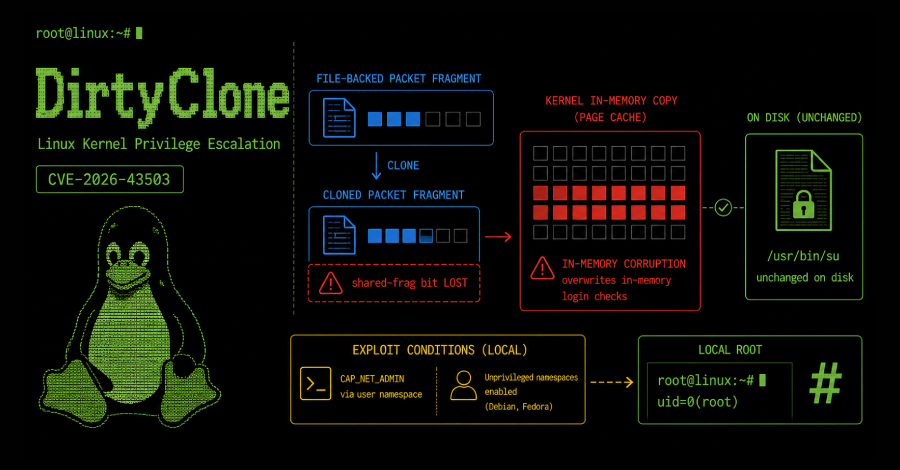
A dangerous new vulnerability in the Linux kernel is drawing urgent attention from security teams worldwide. Dubbed DirtyClone and tracked as CVE-2026-43503, this privilege escalation flaw carries a CVSS score of 8.8 and represents the latest entry in the increasingly concerning DirtyFrag vulnerability family. For any organization running Linux infrastructure — which, at enterprise scale, means nearly everyone — this flaw deserves immediate action.
What Is DirtyClone and Why Does It Matter?
At its core, DirtyClone exploits a subtle but devastating weakness in how the Linux kernel handles cloned network packets in relation to file-backed memory. A local user — someone already authenticated on a system, such as a compromised service account, a malicious insider, or an attacker who has achieved initial access — can leverage this flaw to corrupt memory structures and elevate their privileges all the way to root.
Root access on a Linux system is the highest level of privilege available. Once an attacker achieves it, they can read or exfiltrate any data on the system, install persistent backdoors, disable security controls, pivot laterally across a network, and effectively own the host entirely.
"Local privilege escalation vulnerabilities are often underestimated because they require prior access — but in modern threat environments, initial access is frequently the easiest part of the attack chain."
What elevates the urgency here is that a working exploit walkthrough has already been made public by JFrog Security Research. This is the first publicly demonstrated proof-of-concept for this specific DirtyFrag variant, meaning the barrier for exploitation has dropped significantly. Script-level threat actors no longer need to develop their own weaponized code — the technical roadmap is now available to anyone willing to look for it.
The DirtyFrag Family: A Growing Threat Lineage
DirtyClone does not exist in isolation. It belongs to a broader class of Linux kernel vulnerabilities that manipulate memory management and packet handling to achieve unauthorized privilege escalation. The DirtyFrag family has demonstrated a pattern of subtle, hard-to-detect flaws that require deep kernel expertise to both discover and patch effectively.
This lineage is significant for threat modeling purposes. Where one variant is found, others often follow. Security teams should treat the emergence of DirtyClone not as an isolated incident but as a signal to conduct broader audits of Linux kernel versions deployed across their environments.
Attack Surface and Exposure
Understanding who is at risk requires clarity on the attack prerequisites. DirtyClone requires local access to a vulnerable system — it is not directly remotely exploitable over a network without prior authentication. However, this distinction is less protective than it sounds in practice.
Modern enterprise environments routinely expose Linux systems to conditions where local access is achievable: containerized workloads with shared kernel surfaces, cloud instances accessible via compromised credentials, developer workstations, CI/CD pipeline runners, and internal servers accessible to a broad employee base all represent realistic exploitation scenarios. In each case, a threat actor who has cleared the initial access hurdle faces a clear, well-documented path to full system compromise.
Patch Availability and Remediation
A patch addressing CVE-2026-43503 has been integrated into the mainline Linux kernel. Downstream distributions — including enterprise-focused releases such as Red Hat Enterprise Linux, Ubuntu LTS, Debian, and SUSE — are expected to backport and release updated packages. Security teams should monitor their distribution's security advisory channels and apply updates as soon as vendor-validated patches become available.
For organizations that cannot patch immediately due to operational constraints, compensating controls should be considered:
What You Should Do
- Inventory your Linux kernel versions immediately. Identify all systems running vulnerable kernel versions across on-premises, cloud, and hybrid environments.
- Prioritize patching based on exposure. Internet-facing systems, shared infrastructure, and multi-tenant environments carry the highest risk and should be patched first.
- Do not wait for a breach to validate your detection coverage. Test whether your SIEM, EDR, or runtime security tools would alert on privilege escalation behavior consistent with DirtyClone exploitation.
- Brief your security operations team on the public proof-of-concept. Awareness that weaponized guidance exists changes the operational tempo for response.
- Review least-privilege configurations. The damage potential of any local privilege escalation flaw is directly proportional to how many accounts have unnecessary access to sensitive systems.
DirtyClone is a stark reminder that the Linux kernel — the foundation beneath cloud infrastructure, enterprise servers, embedded systems, and containers — remains an active and consequential attack surface. The combination of a high CVSS score, a public exploit walkthrough, and membership in an active vulnerability family makes this a threat that demands more than a line item on a patch queue. It demands urgency.


