
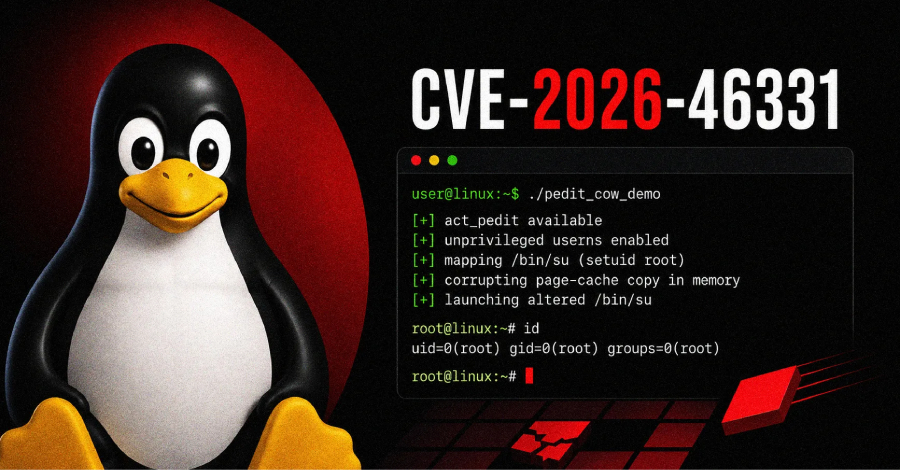
A newly disclosed vulnerability in the Linux kernel is sending system administrators scrambling — and for good reason. Dubbed "pedit COW" and tracked as CVE-2026-46331, the flaw represents a particularly dangerous class of local privilege escalation: one where an unprivileged user can quietly corrupt kernel memory and walk away with root-level control of an affected machine.
Inside the Vulnerability: What Makes pedit COW So Dangerous
The vulnerability resides in the Linux kernel's traffic-control subsystem — specifically within act_pedit, the packet-editing action component responsible for manipulating network packet data in-flight. Under certain conditions, the subsystem performs an out-of-bounds write that spills data into shared page-cache memory regions it was never intended to touch.
The "COW" in the nickname is a nod to the kernel's copy-on-write (COW) mechanism, a memory optimization that allows multiple processes to share read-only memory pages until a write operation forces a private copy. The exploit abuses this boundary — poisoning shared cached binaries before the kernel can isolate the write. In practical terms, an attacker can overwrite executable content that other processes — including privileged ones — are relying on.
An unprivileged local user exploiting this flaw does not need network access, social engineering, or complex toolchains. The attack surface is the kernel itself.
What elevates the urgency here is the speed of weaponization. A fully functional, publicly available exploit appeared within approximately 24 hours of the CVE being formally assigned on June 16. That near-immediate availability of proof-of-concept code compresses the patch window dramatically and raises the risk profile for any unpatched system exposed to local users — including shared hosting environments, containerized workloads with misconfigured isolation, and multi-tenant cloud infrastructure.
Who Is at Risk?
This is a local privilege escalation vulnerability, meaning an attacker must already have some degree of access to the target system — a shell account, a container escape, or an initial foothold via a separate exploit chain. That said, the threat model is broader than it might initially appear:
Red Hat has assigned the flaw a high severity rating, reflecting both the reliability of exploitation and the breadth of affected kernel versions across major Linux distributions.
Technical Exploitation Pathway
The attack chain works roughly as follows: a local attacker crafts a malicious network traffic-control configuration that triggers the out-of-bounds write in act_pedit. The corrupted write lands in a shared page-cache entry — often a mapped executable or shared library. Because multiple processes reference the same cached page, the attacker effectively poisons a binary that a privileged process will subsequently execute. From there, arbitrary code execution as root is achievable without any further privilege boundary crossing.
The elegance — and the danger — of this technique is its abuse of a performance feature. Page-cache sharing is a fundamental efficiency mechanism in the Linux kernel. Restricting it entirely is not feasible; the only real mitigation is patching the source of the errant write.
What You Should Do
- Apply kernel patches immediately. Major distributions including Red Hat Enterprise Linux, Ubuntu, Debian, and SUSE are actively releasing patched kernel packages. Treat this as an emergency patch cycle — do not wait for a scheduled maintenance window if your systems expose shell access to untrusted users.
- Audit local user access. Identify which systems have accounts accessible to users outside your direct control. Prioritize patching those environments first.
- Enforce mandatory access controls. Where patching is temporarily delayed, tightening SELinux, AppArmor, or seccomp profiles can reduce — though not eliminate — exploitation surface.
- Review container isolation posture. Ensure containers are not running with elevated capabilities or loosened seccomp policies that could facilitate kernel interaction leading to this exploit.
- Monitor for unusual privilege escalation activity. Deploy endpoint detection rules looking for unexpected root process spawning from low-privileged parent processes, particularly those tied to network subsystem interactions.
- Assess CI/CD and build pipeline risk. If your pipelines execute arbitrary or third-party code on shared Linux hosts, consider temporary isolation measures until patches are applied universally.
Key Takeaways
The combination of a high-severity local privilege escalation, a public working exploit, and widespread Linux kernel deployment makes CVE-2026-46331 one of the more operationally significant kernel flaws of the year.
Kernel-level vulnerabilities demand a different urgency calculus than application-layer flaws. When the exploit is already public, that calculus shifts further still. Security teams should treat pedit COW not as a vulnerability to schedule — but as a fire to put out. The systems most at risk are not necessarily internet-facing web servers; they are the internal Linux hosts, build machines, and multi-tenant environments that organizations often assume are implicitly safe because they are "behind the perimeter."
Patch first. Audit second. And resist the temptation to assume local access requirements make a root exploit anything less than critical.


