
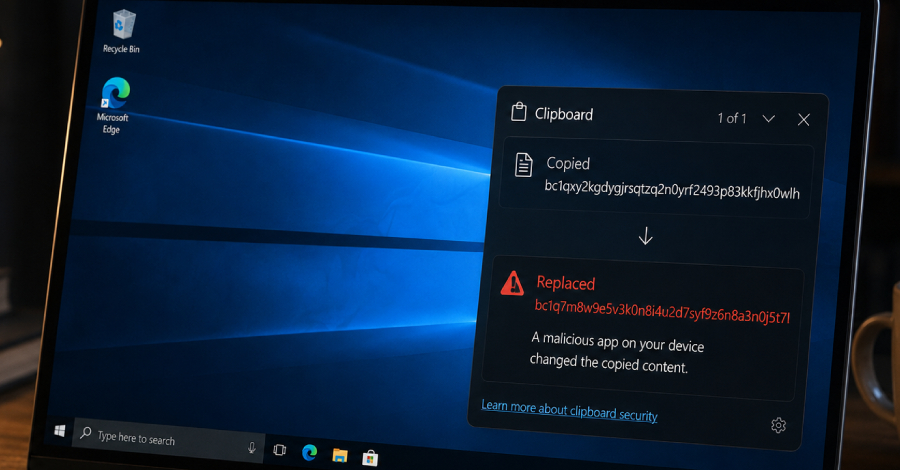
Cryptocurrency theft has never been more surgical. A newly detailed malware campaign targeting Windows systems demonstrates just how far threat actors are willing to go to ensure their operations remain hidden, resilient, and devastatingly effective. Since at least February 2026, a clipboard-hijacking operation has been quietly intercepting cryptocurrency transactions on infected machines — and the technical architecture behind it reveals a threat actor with serious operational discipline.
The Anatomy of a Modern Clipper Attack
At its core, a cryptocurrency clipper is deceptively simple: it monitors a victim's clipboard for wallet addresses, then silently substitutes the attacker's address the moment a user copies one. The victim pastes what they believe is their intended recipient's address, hits send, and the funds vanish into a wallet they'll never access. What makes this campaign notable isn't the concept — it's the execution.
According to Microsoft's Defender Security Research Team, this campaign wraps that familiar theft mechanism inside a far more sophisticated delivery and persistence framework. The malware propagates via USB drives using malicious LNK files — Windows shortcut files engineered to execute code the moment a curious user double-clicks what appears to be a legitimate folder or document. This worm-like behavior allows the malware to spread laterally through air-gapped or network-isolated environments, a technique historically associated with high-sophistication threat actors.
Windows Script Host, ActiveX, and the Tor Lifeline
Once installed, the clipper doesn't phone home through conventional channels that endpoint detection tools readily flag. Instead, it deploys a bundled Tor proxy directly on the compromised host, establishing communications with a hidden service command-and-control server — one that exists entirely within the anonymized Tor network.
The clipper relies on Windows Script Host and ActiveX-driven logic to launch a bundled Tor proxy and poll a hidden-service C2 server — a design that makes both takedown and attribution significantly more difficult.
This architectural choice carries significant implications. Hidden service C2 infrastructure means there is no conventional domain or IP address to block, no certificate to revoke, and no hosting provider to pressure. The operator's identity remains shielded behind layers of onion routing, and the C2 server can be updated, moved, or replicated without exposing any traditional indicators of compromise.
The use of Windows Script Host (WSH) and ActiveX as the execution engine is equally deliberate. These are legitimate, built-in Windows components — using them allows the malware to blend into normal system activity, reducing the likelihood of behavioral detection by security tools that look for unusual process trees or unsigned binary execution.
Why USB-Based Propagation Still Works
In an era of cloud storage and remote work, it might seem anachronistic to rely on USB drives for malware delivery. But the threat data tells a different story. Removable media remains a persistent vector, particularly in environments where internet access is restricted, where employees routinely share drives, or where legacy systems are common. Manufacturing facilities, financial back-offices, government agencies, and healthcare institutions are all environments where a well-crafted LNK file on a dropped or shared USB drive can bypass the most sophisticated network-layer defenses entirely.
LNK-based attacks are also notoriously difficult to defend against at the user level. The files are visually indistinguishable from legitimate shortcuts, and the embedded execution logic triggers automatically upon interaction — no macro approval dialog, no security warning that a trained user might recognize.
The Broader Cryptocurrency Theft Ecosystem
This campaign doesn't exist in isolation. Clipboard hijackers have become a staple of the criminal cryptocurrency ecosystem precisely because they require no server-side exploit, no account compromise, and no social engineering beyond the initial infection. Once running, they operate silently and indefinitely, intercepting transactions across Bitcoin, Ethereum, and dozens of altcoin networks by pattern-matching the distinctive alphanumeric structure of wallet addresses.
The integration of Tor-based C2 infrastructure signals that the operators behind this campaign are investing in longevity. They're not running a smash-and-grab operation — they're building infrastructure designed to survive takedown attempts and persist across months or years of operation.
What You Should Do
Key Takeaways
This campaign is a reminder that financial theft through malware doesn't require nation-state sophistication — it requires operational patience and smart infrastructure choices. By combining a time-tested theft mechanism with worm-capable USB delivery and anonymous Tor-based command infrastructure, these operators have built a campaign that is simultaneously low-profile and highly resilient.
For security teams, the lesson is clear: technical controls matter, but so does user awareness. In the world of cryptocurrency, a single unverified paste can mean irreversible financial loss. Layered defenses — from device controls and script host restrictions to behavioral monitoring and user education — remain the most reliable path to meaningful protection.


