
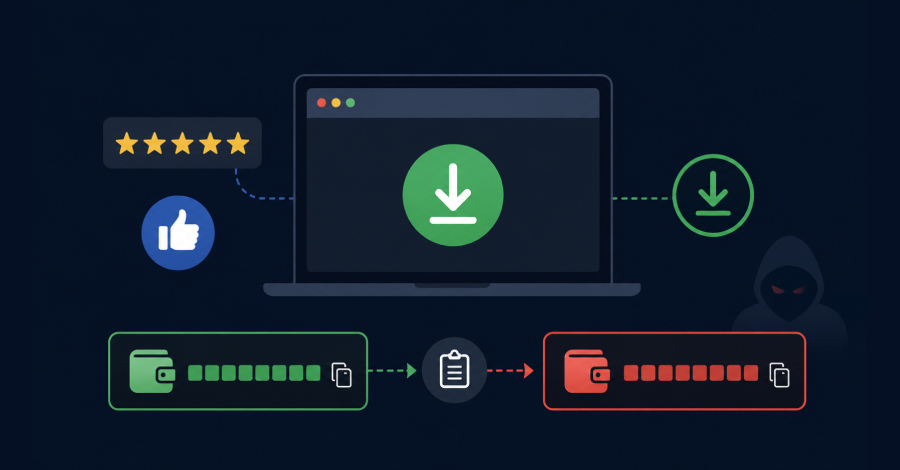
A newly uncovered threat campaign is rewriting the playbook on malware distribution — not by exploiting exotic zero-days, but by weaponizing the very platforms and trust signals that security professionals and everyday users rely on. At the center of this operation is a crypto clipper: a strain of malware engineered to silently intercept cryptocurrency transactions by swapping legitimate wallet addresses with those controlled by the attacker. What makes this campaign stand out, however, is the sophisticated social engineering infrastructure surrounding it.
A Web of Deception Across Trusted Platforms
The threat actor behind this campaign has constructed a remarkably broad distribution network designed to manufacture credibility at every touchpoint. Rather than relying on dark web forums or sketchy download portals, this group is operating in plain sight — embedding itself into ecosystems that users inherently trust.
The operation's infrastructure includes:
AI-Narrated Malware Tutorials: A New Low
Perhaps the most unsettling element of this campaign is the use of AI-generated narration in promotional videos. As synthetic voice technology becomes increasingly indistinguishable from human speech, threat actors are exploiting it to produce polished, convincing content at scale — without the overhead of hiring human actors or recording studios.
This development signals a broader trend: AI is no longer just a defensive asset in cybersecurity. Adversaries are integrating generative tools into their operational workflows to lower production costs, increase output volume, and lend an air of legitimacy to otherwise obvious scams.
The abuse of AI-generated content in malware campaigns represents a fundamental shift in the threat landscape — one where production quality is no longer a reliable indicator of trustworthiness.
Why Crypto Clippers Are Particularly Dangerous
Crypto clippers operate silently in the background, monitoring the clipboard for cryptocurrency wallet addresses. The moment a victim copies an address — typically to initiate a transfer — the malware swaps it with the attacker's wallet. By the time the victim realizes the funds have gone to the wrong destination, the transaction is irreversible.
These tools are especially effective because they exploit a behavioral habit most users have normalized: copying and pasting long wallet strings rather than manually typing them. Victims rarely double-check the pasted address against the original, making the attack nearly invisible until it's too late.
The VirusTotal Angle: Corrupting Threat Intelligence
The campaign's use of VirusTotal comments deserves particular attention from the security community. VirusTotal is widely regarded as a foundational tool for malware triage and threat intelligence. By planting misleading comments on file analyses — potentially claiming a sample is clean, a false positive, or even a legitimate security tool — attackers can sow confusion among analysts and delay remediation.
This tactic underscores a growing reality: threat actors are not just attacking end users, they are actively working to degrade the quality of threat intelligence itself.
What You Should Do
Organizations and individual users handling cryptocurrency transactions or evaluating software from online repositories should take immediate, practical steps to reduce exposure:
- Always verify wallet addresses character-by-character after pasting, especially for high-value transactions. Consider using QR codes where possible to eliminate clipboard manipulation vectors.
- Treat GitHub and SourceForge listings skeptically — examine contributor history, commit frequency, and community engagement before running any downloaded executable.
- Cross-reference VirusTotal results critically — do not weight user comments as authoritative. Rely on detection ratios and behavioral sandbox analysis instead.
- Invest in endpoint clipboard monitoring — enterprise security teams should deploy solutions capable of detecting anomalous clipboard activity, particularly address substitution patterns.
- Educate users about AI-generated content — professional production quality in a tutorial video or sponsored article is no longer a reliable trust signal. Train staff to apply the same skepticism to polished content as they would to obvious phishing attempts.
- Implement application allowlisting where feasible to prevent unauthorized executables from running, even if downloaded from seemingly reputable sources.
The Bigger Picture
This campaign is a case study in what modern social engineering looks like when adversaries invest in infrastructure. It doesn't rely on urgency or panic — it relies on manufactured legitimacy. By distributing across multiple trusted platforms simultaneously, the threat actor creates a feedback loop of false credibility that is genuinely difficult to untangle without dedicated threat intelligence resources.
For security teams, the lesson is clear: platform trust is not a substitute for technical verification. The presence of a GitHub repo, a YouTube channel, or a news article is not — and never was — a guarantee of safety. In an era where AI can generate convincing content on demand and comment sections can be seeded with disinformation, the burden of validation falls squarely on the practitioner.


