
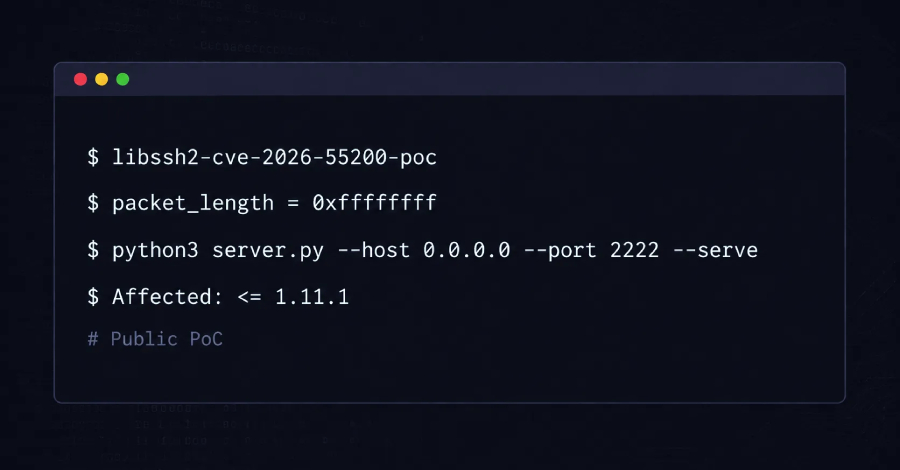
A critical vulnerability in one of the most widely deployed SSH client libraries has moved from theoretical risk to imminent threat. A working proof-of-concept exploit for CVE-2026-55200 is now publicly available, dramatically lowering the barrier for attackers to weaponize a flaw that carries a CVSS 4.0 score of 9.2 out of 10. Security teams should treat this as an active-threat scenario, not a routine patching exercise.
Understanding the Vulnerability
libssh2 is a lightweight, open-source library that enables SSH connectivity from the client side — it is embedded in countless applications, automation frameworks, development tools, and enterprise software products to handle secure shell communications. This distinction is critical: the attack surface here is not an exposed server, but rather any application or system that connects to an SSH server using this library.
CVE-2026-55200 is a memory corruption flaw triggered during the SSH handshake process. An attacker controlling a malicious or compromised SSH server can send specially crafted protocol responses to any connecting libssh2 client, causing memory corruption on that client system. Depending on the environment and how memory is laid out at the time of the connection, this corruption can escalate to arbitrary code execution — and it requires no authentication, no credentials, and no interaction from the end user.
Every release of libssh2 up to and including version 1.11.1 is confirmed vulnerable. If your software links against this library and has not been updated, it is exposed.
Why a Public PoC Changes Everything
When a critical vulnerability exists without a public proof-of-concept, exploitation typically remains within the reach of sophisticated, well-resourced threat actors — nation-state groups, advanced ransomware operators, and high-tier criminal organizations. The moment working exploit code enters the public domain, that calculus shifts entirely. Script-level actors and opportunistic attackers can now leverage the same capability.
The release of a functional PoC for CVE-2026-55200 means the window for calm, scheduled remediation has effectively closed. Organizations operating on standard monthly or quarterly patch cycles need to escalate this vulnerability to emergency priority. Any delay represents a measurable, quantifiable increase in organizational risk.
Assessing Your Exposure
The challenge with client-side library vulnerabilities is that they are rarely obvious. libssh2 does not announce itself. It lives quietly inside other software — scripting language extensions, file transfer utilities, infrastructure automation tools, CI/CD pipelines, embedded systems, and commercial enterprise applications. Identifying every instance across a complex environment requires deliberate effort.
Security and IT teams should prioritize the following areas of investigation:
The Threat Model: Malicious Infrastructure and Supply Chain Risk
This vulnerability is particularly dangerous in scenarios where outbound SSH connections cannot be fully trusted. Consider any situation where a client system connects to third-party infrastructure, cloud-hosted services, or repositories — if any of those endpoints are compromised or spoofed, the connecting client becomes the victim. Supply chain attacks, BGP hijacking, and DNS poisoning are all plausible vectors for steering vulnerable clients toward attacker-controlled servers.
Attackers do not need to compromise your environment directly. They need only to position a malicious server somewhere your systems will voluntarily connect to — and then wait.
What You Should Do
- Inventory immediately. Run a software composition analysis (SCA) scan across your environment to identify every application, container, and system linking against libssh2 version 1.11.1 or earlier.
- Patch without delay. Update libssh2 to the latest patched release as soon as it is available from the project maintainers. Do not wait for scheduled maintenance windows.
- Engage your vendors. Contact software vendors whose products may bundle libssh2 and ask explicitly about their patch timelines for CVE-2026-55200.
- Audit outbound SSH connections. Review and restrict which systems and applications are permitted to initiate SSH connections, and to which destinations. Apply strict allowlisting where operationally feasible.
- Monitor for exploitation indicators. Update your threat detection rules to flag anomalous behavior following SSH connection events, particularly unexpected process spawning or memory anomalies.
- Rebuild container images. Any container base image that includes libssh2 must be rebuilt from a patched base and redeployed.
The Broader Lesson
CVE-2026-55200 is a reminder that the most dangerous vulnerabilities are often the quietest ones — buried inside shared libraries that underpin thousands of applications, invisible until the moment they are exploited. Robust software composition analysis, continuous dependency monitoring, and a practiced emergency patching process are not optional capabilities. They are the organizational infrastructure that separates a manageable incident from a catastrophic breach.
The exploit code is out. The clock is running.


