
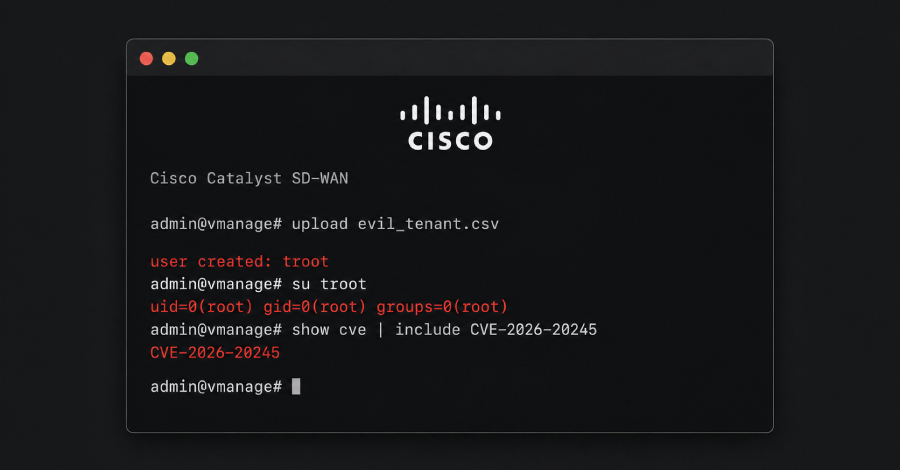
The window between vulnerability discovery and active exploitation is shrinking — and in some cases, it has already closed before defenders even know a flaw exists. A newly disclosed high-severity security vulnerability in Cisco Catalyst SD-WAN serves as a stark reminder that organizations relying solely on vendor patch cycles are playing a dangerous game of catch-up against adversaries who operate on their own timeline.
The Vulnerability at a Glance
The flaw, catalogued as CVE-2026-20245 with a CVSS score of 7.8, resides within Cisco's Catalyst SD-WAN platform — a widely deployed enterprise networking solution used to manage distributed wide-area networks. The vulnerability enables an authenticated, local attacker to execute arbitrary commands with elevated privileges, potentially granting full root-level access to an affected system.
While a CVSS score of 7.8 places this in the "high" severity tier rather than critical, the real-world impact should not be understated. Root access on a networking control plane is not a minor inconvenience — it is a complete operational compromise. An attacker with that level of access can intercept traffic, reconfigure routing policies, pivot laterally across enterprise segments, and establish persistent footholds that survive standard remediation efforts.
"The most dangerous vulnerabilities are not always the ones with the highest CVSS scores — they are the ones being actively exploited before defenders have a chance to respond."
Zero-Day Exploitation: The Silent Head Start
Threat intelligence analysis has revealed that an unknown actor was weaponizing this vulnerability in active intrusion campaigns at least two months before Cisco publicly disclosed its existence. This pre-disclosure exploitation window — sometimes referred to as a "silent exploitation period" — represents one of the most challenging threat scenarios modern security teams face.
During that two-month window, affected organizations had no patch available, no CVE to track, and no vendor advisory to act upon. Traditional vulnerability management programs, which prioritize patching based on published advisories and CVSS scores, would have offered no protection whatsoever. This is not an edge case or theoretical scenario — it is an increasingly common pattern in sophisticated intrusion campaigns.
Why SD-WAN Infrastructure Is a High-Value Target
Enterprise networking platforms like SD-WAN controllers occupy an extraordinarily privileged position within corporate infrastructure. Unlike endpoint compromises, which affect individual workstations or servers, a foothold within an SD-WAN management plane can provide visibility into — and control over — traffic flows across an entire organization's distributed network.
For threat actors conducting espionage, data exfiltration, or pre-positioning for destructive attacks, this makes SD-WAN infrastructure a priority target. The authenticated requirement for exploitation may appear to reduce risk on paper, but in practice, initial access brokers, phishing campaigns, and credential theft operations routinely provide that first foothold at scale.
The Limits of Reactive Security
This incident exposes a fundamental tension at the heart of enterprise security strategy: the patch-and-respond model cannot protect against threats that precede disclosure. Organizations with mature security programs are increasingly investing in detection-based controls — behavioral analytics, network traffic analysis, and privileged command monitoring — precisely because these capabilities can surface anomalous activity regardless of whether a CVE has been published.
Monitoring for unexpected privilege escalation attempts, unusual command execution patterns in networking infrastructure, and unauthorized configuration changes should be standard practice for any organization running enterprise-grade SD-WAN deployments. These telemetry sources provide the detection layer that static vulnerability management cannot.
What You Should Do
The Broader Lesson
CVE-2026-20245 is not merely a Cisco problem — it is a systems problem. The coordinated vulnerability disclosure model, for all its strengths, leaves an inherent gap between the moment a flaw is discovered and the moment defenders can act on it. Adversaries have recognized and systematically exploited this gap for years.
Security teams that internalize this reality — and build their programs around detection, response, and resilience rather than patching alone — are the ones best positioned to weather the next zero-day before it even has a name.


