
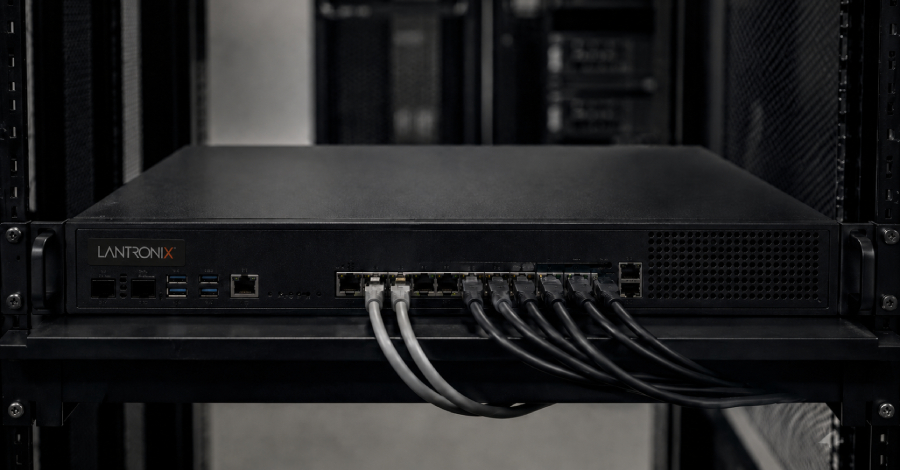
When the U.S. Cybersecurity and Infrastructure Security Agency issues an active exploitation warning, the cybersecurity community takes note. This week, that warning centers on a critical vulnerability in Lantronix EDS5000 Series devices — network-connected serial device servers widely deployed across enterprise and industrial environments. The severity is not theoretical. Attackers are already in the wild, and the clock is ticking.
A Near-Perfect Severity Score and Real-World Exploitation
The vulnerability, a code injection flaw, carries a CVSS score of 9.8 out of 10 — placing it firmly in the critical tier. Scores at this level typically indicate that exploitation requires little to no authentication, can be triggered remotely, and results in significant system compromise. In this case, successful exploitation could allow a threat actor to execute arbitrary code on affected devices, potentially gaining full administrative control over the hardware.
Lantronix EDS5000 Series devices function as bridges between legacy serial equipment and modern IP networks — a role that makes them integral to operational technology (OT) environments, manufacturing floors, healthcare infrastructure, and government networks. That ubiquity is precisely what makes this flaw so dangerous.
"A compromised device server doesn't just expose one system — it can serve as a pivot point into broader network segments that organizations assume are isolated."
CISA has directed all Federal Civilian Executive Branch agencies to apply available patches no later than June 26, 2026. That mandate carries legal weight under the agency's Known Exploited Vulnerabilities catalog directives, but the private sector should treat this timeline as a ceiling, not a target.
Why OT and Hybrid Network Environments Face Elevated Risk
Serial-to-Ethernet converters like the EDS5000 series occupy a peculiar and often poorly monitored position in enterprise architectures. They were designed to modernize legacy infrastructure, but in doing so, they introduced network-accessible attack surfaces to equipment that was never designed with remote threats in mind.
Several factors compound the risk in these deployments:
The Exploitation Landscape: What Attackers Gain
Remote code execution on a device server can open multiple avenues for attackers. Depending on the network architecture, a compromised EDS5000 unit could be leveraged to intercept or manipulate serial communications, serve as a persistent foothold for lateral movement, facilitate data exfiltration from connected systems, or act as a launching point for attacks on adjacent OT or IT infrastructure.
The nature of code injection vulnerabilities — particularly those scoring at the top of the severity scale — means exploitation can often be automated. Threat actors don't need bespoke tooling; once a reliable exploit becomes available, it can be folded into existing attack frameworks and deployed at scale.
What You Should Do
Whether you operate a federal agency or a private enterprise, the response framework here is clear and urgent. The following steps should be treated as immediate priorities:
- Inventory your environment: Identify all Lantronix EDS5000 Series devices on your network. Asset visibility is the prerequisite for everything that follows.
- Apply patches without delay: Obtain and install the vendor-supplied fix as soon as possible. Do not wait for a scheduled maintenance window if the exposure is active.
- Isolate affected devices: If immediate patching is not feasible, place affected devices behind network segmentation controls and restrict access to trusted hosts only.
- Monitor for indicators of compromise: Review logs for unusual authentication attempts, unexpected outbound connections, or anomalous command execution on or near affected devices.
- Audit network trust relationships: Evaluate what systems can communicate with your serial device servers and tighten access controls to enforce least-privilege networking.
- Engage your OT security team: If your organization operates industrial or operational technology environments, loop in OT-specific security personnel who understand the operational constraints of patching in those contexts.
A Broader Signal for Industrial and Hybrid Network Security
This incident is a reminder that the attack surface organizations must defend extends well beyond endpoints, servers, and cloud workloads. Network-connected serial infrastructure, often overlooked during security reviews, represents a meaningful and increasingly targeted category of risk.
CISA's active exploitation warning should serve as a forcing function — not just for organizations running EDS5000 devices, but for any security team that has not recently audited its inventory of embedded network devices, industrial controllers, and legacy hardware with IP connectivity. The adversary does not distinguish between IT and OT when opportunity presents itself.
Patch now. Segment aggressively. Monitor continuously. The window for a quiet remediation is already closing.


