
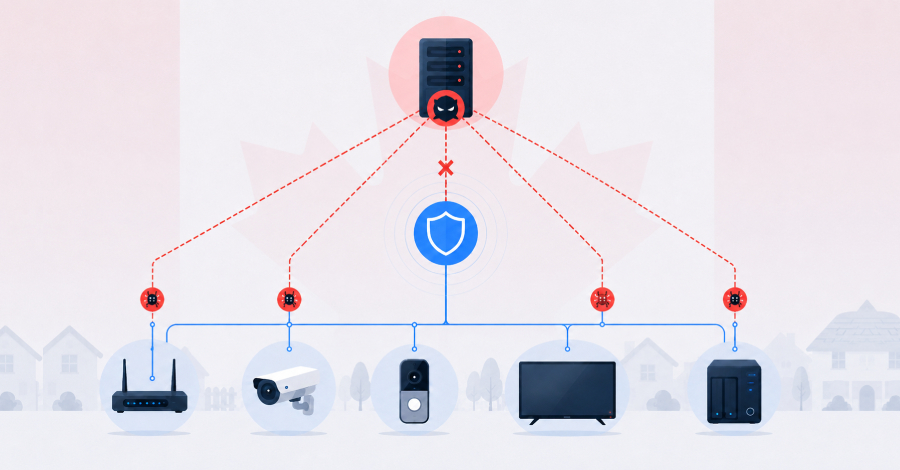
In a landmark exercise of domestic cyber authority, Canada's premier intelligence agency has crossed a significant threshold in active threat mitigation — reaching directly into compromised devices on Canadian soil to dismantle two foreign-controlled botnets. The move represents a pivotal evolution in how Western democracies are willing to confront infrastructure threats that originate abroad but metastasize at home.
A New Chapter in Intelligence-Led Cyber Defense
The Canadian Security Intelligence Service (CSIS) successfully obtained a judicial warrant — the first of its kind under existing Canadian law — authorizing its operatives to actively modify and neutralize devices infected by two separate botnet operations. The Federal Court's ruling, made partially public in mid-June, reveals a legal framework quietly expanding to meet an increasingly aggressive global threat environment.
What makes this action historically significant is not just the technical operation itself, but the legal scaffolding supporting it. CSIS employed its so-called "threat reduction" warrant powers, provisions that have existed on paper for years but had never previously been applied in this manner. The court's authorization permitted intelligence officers to alter the configuration of infected machines — including enterprise servers, consumer-grade routers, and Internet of Things devices — effectively severing their connection to foreign command-and-control infrastructure.
"This is what proactive cyber defense looks like in a constitutional democracy — intelligence agencies acting not just as observers, but as active participants in neutralizing threats, under judicial oversight."
The Anatomy of the Threat
Botnets represent one of cybersecurity's most persistent and insidious challenges. Unlike targeted intrusions that strike a single organization, botnets quietly enslave thousands — sometimes millions — of ordinary devices, turning home routers, IP cameras, and unpatched servers into unwitting soldiers in campaigns ranging from credential theft to large-scale distributed denial-of-service attacks.
The two networks targeted by CSIS were foreign-operated, meaning the masterminds directing them resided outside Canadian jurisdiction. This creates a classic enforcement gap: Canadian law cannot easily reach threat actors sheltering in adversarial or non-cooperative nations, but the infected devices enabling their operations sit squarely on domestic networks. By targeting the infrastructure rather than the operators, CSIS found a legally defensible and operationally effective solution.
Why Routers and IoT Devices Are the Weak Link
The device types involved — home routers and IoT equipment — are among the most chronically under-secured categories in modern networking. Consumers rarely update firmware. Default credentials often go unchanged for years. Manufacturers frequently abandon support for older models long before those devices leave service in the field. The result is a sprawling attack surface that sophisticated adversaries have learned to exploit systematically.
Foreign intelligence services and criminal groups alike have made a cottage industry of compromising these edge devices, using them as anonymizing relays, launching pads for further intrusions, or raw computational power for coordinated attacks. The fact that CSIS identified and acted against two such networks underscores just how pervasive this threat has become on Canadian networks.
The Legal Precedent and Its Implications
The release of the Federal Court's ruling — even in redacted, public-facing form — signals an intentional effort at transparency from both the judiciary and the intelligence community. That transparency matters. Active cyber operations by domestic spy agencies, even those sanctioned by courts, carry inherent risks of overreach. The fact that this action required judicial authorization, rather than being conducted unilaterally, provides a model other democracies might look to as they grapple with the same dilemma.
Intelligence agencies in allied nations are watching closely. The Five Eyes partnership — comprising Canada, the United States, the United Kingdom, Australia, and New Zealand — has collectively struggled to develop legal frameworks agile enough to permit timely, authorized action against fast-moving cyber threats. Canada's approach here may well inform policy discussions across the alliance.
What You Should Do
The Broader Signal
Canada's action is a message — to adversaries, to allies, and to the private sector. Governments are no longer content to simply observe and report on cyber threats flourishing within their borders. With proper legal authority and judicial oversight, active neutralization is now on the table. For security professionals, this should accelerate conversations about public-private coordination: when government agencies take action against botnet infrastructure, organizations need visibility into those operations to understand the full threat landscape affecting their environments.
The era of passive cyber defense is giving way to something more assertive. The question for every organization is whether their own defenses are keeping pace.


