
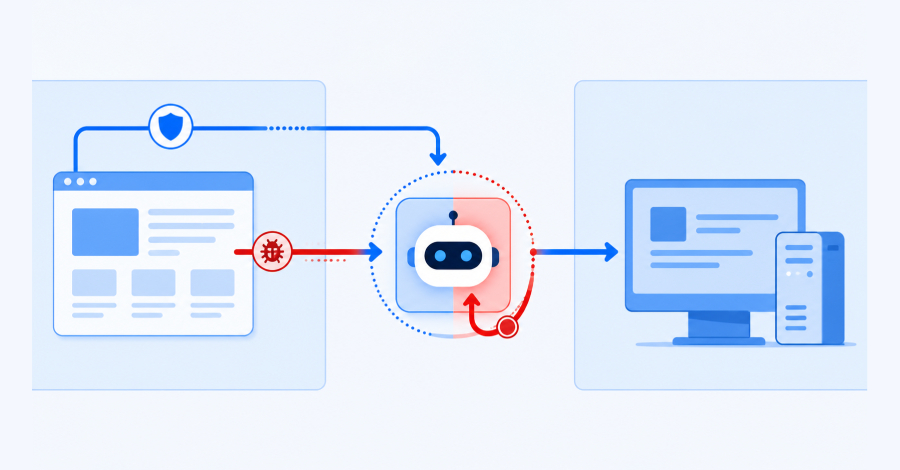
The promise of AI agents — software systems that autonomously browse the web, execute tasks, and interact with local resources on your behalf — has captured the imagination of enterprises and developers alike. But a newly detailed exploit chain from Microsoft researchers serves as a stark reminder that the more capable an autonomous system becomes, the more devastating its compromise can be.
The attack, dubbed AutoJack, represents a genuinely new class of threat. It transforms an AI browsing agent from a productivity asset into an unwitting delivery mechanism for remote code execution — all triggered by navigating to a single attacker-controlled web page.
How AutoJack Works: A Chain With No Weak Links
At its core, AutoJack exploits the architectural trust relationship between an AI agent operating in a browser context and the privileged local services running on the same host machine. The attack unfolds with alarming efficiency.
An attacker crafts a malicious web page embedding JavaScript specifically designed to probe and interact with locally exposed services — components that the AI agent's runtime environment has legitimate access to by design. When the agent is directed to load this page, through a phishing link, a poisoned search result, or even a prompt injection embedded in a seemingly benign document, the malicious script executes within a trusted context.
From there, the JavaScript reaches across to a privileged local service on the same machine and instructs it to spawn a process on the host operating system. The result is full remote code execution — without any credential prompt, authentication challenge, or additional user interaction required beyond the initial moment the agent loads the page.
The attack transforms the AI agent's very capability — its ability to autonomously take action — into the attack surface itself. The more trusted and empowered the agent, the greater the blast radius.
Why This Is Different From Conventional Web Attacks
Traditional browser-based attacks require overcoming significant barriers: convincing a human user to click, defeating browser sandboxing, exploiting memory corruption vulnerabilities, or chaining multiple flaws together. AutoJack sidesteps much of this by leveraging something far more pernicious — the intended functionality of an AI agent.
AI browsing agents are explicitly built to take action. They are designed to interact with web content, execute instructions they encounter, and communicate with local systems to fulfill tasks. AutoJack simply weaponizes these features. The agent does exactly what it was built to do — it just happens to be doing it for an adversary.
This positions AutoJack within a broader and growing family of prompt injection and indirect instruction hijacking attacks that security researchers have been warning about since large language model-powered agents entered mainstream use. What makes AutoJack particularly severe is its ability to break out of the browser context entirely and achieve host-level code execution.
The Privileged Local Service Problem
A critical enabler of this attack is the presence of local services that AI agent runtimes expose or interact with on the host machine. These services — often listening on loopback interfaces or communicating through inter-process mechanisms — are granted elevated trust because they are assumed to be operating in a controlled, local environment.
That assumption collapses the moment attacker-controlled web content can speak to them. The browser's same-origin policy and other standard web security mechanisms were not designed with the AI agent architecture in mind, creating gaps that AutoJack exploits effectively.
Who Is at Risk?
What You Should Do
AutoJack is a research disclosure, not a confirmed in-the-wild campaign — but the window between proof-of-concept and exploitation is shrinking across every threat category. Security teams should act now rather than wait for the first breach report.
- Audit AI agent permissions immediately. Identify every local service, API endpoint, or inter-process communication channel that your AI agent runtime can access. Apply the principle of least privilege aggressively — agents should only communicate with the services they absolutely require.
- Implement strict URL allowlisting. Where operationally feasible, restrict which external web domains AI agents are permitted to browse. Treat unsanctioned web content as untrusted input that could carry adversarial instructions.
- Harden local service authentication. Local services should not assume that any request arriving from localhost is inherently trustworthy. Implement token-based authentication and validate the identity of callers even for loopback communications.
- Deploy prompt injection detection. Evaluate emerging tooling designed to detect adversarial content embedded in web pages or documents that AI agents process. This is an evolving field, but early implementation builds institutional knowledge.
- Sandbox agent execution environments. Where possible, run AI agents in isolated containers or virtual machines with no direct access to host-level services. Network segmentation and process isolation reduce the blast radius of a successful AutoJack-style exploit.
- Establish an AI-specific threat model. Conventional application security threat models were not built for agentic systems. Engage your security architecture team in a dedicated review of AI agent deployments with AutoJack's attack pattern explicitly included.
The Broader Signal
AutoJack is unlikely to be the last exploit chain of its kind. As organizations race to deploy AI agents capable of increasingly autonomous action, attackers will continue probing the seams between web content, agent runtimes, and host operating systems. The research community is doing its part by surfacing these risks before they are weaponized at scale.
The question for every security leader is whether their organization's AI deployment velocity has outpaced its security architecture. In the case of AutoJack, a single web page is the entire attack surface. That should be a clarifying fact for anyone still treating AI agent security as a future concern.


