
Most botnets announce themselves through disruption — crippling DDoS floods, ransomware encryption notices, or a sudden spike in electricity bills from unauthorized cryptocurrency mining. A newly identified malware family called AryStinger operates on an entirely different principle: silence. Its goal isn't immediate destruction. It's persistent, distributed intelligence gathering — and it has quietly recruited over 4,300 devices to do the work.
Old Hardware, New Threat
The campaign came to light on March 12, 2026, when threat detection systems identified a single IP address actively exploiting two vulnerabilities — one disclosed in 2013, the other in 2016 — to distribute a Linux binary that registered zero detections on major antivirus platforms at the time of discovery. The targets were routers built on Realtek's RTL819X chipsets, hardware that was commercially dominant roughly a decade ago and has received no manufacturer firmware support since.
This is the quiet crisis hiding in plain sight across the internet: millions of consumer and small-business routers that reached end-of-life years ago, still plugged in, still connected, and utterly undefended against vulnerabilities that were publicly documented when the Obama administration was entering its second term. AryStinger's operators didn't need novel zero-days. They needed patience and a target-rich environment — and both were readily available.
Architecture of a Covert Reconnaissance Network
What makes AryStinger operationally significant isn't any single technical capability — it's the architecture. Each compromised router functions as what researchers call an Executor: a node that receives assigned scanning tasks from a command-and-control server, executes them in parallel with other nodes across the botnet, and returns results, all while shielding the actual operator behind a relay layer that obscures their true origin.
The distributed task model is deliberately efficient. A massive reconnaissance objective — such as brute-forcing every possible subdomain under a country-code top-level domain — gets sliced into thousands of smaller chunks. Each Executor handles only its assigned portion. No single node carries a detectable workload. The aggregate result is a high-speed, globally distributed scanning engine that any individual device appears too weak to be running.
The attacker can split a massive scanning task into multiple small chunks and distribute them to different Executors for parallel execution — efficiently completing early footprinting activities and providing strong assurance for the success rate of subsequent intrusion operations.
Researchers confirmed this by monitoring an infected test device receive a subdomain brute-force assignment offset to a position roughly 12% into the full scanning space for length-7 subdomains under a specific domain. The entire fleet collectively covers the complete space, with each node contributing only its slice.
Two Builds, Expanding Targets
AryStinger comes in two distinct variants, each tailored to its target platform.
The RTL819X Build
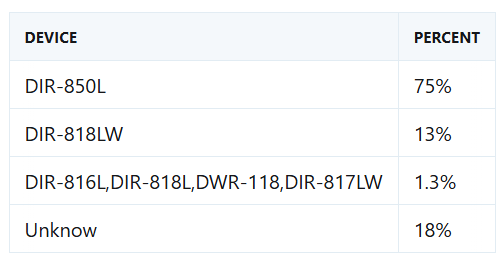
Written in C to accommodate the limited resources of aging router hardware, this version prioritizes mass DNS scanning and traffic tunneling. It communicates with its command-and-control infrastructure over HTTP using Protobuf-encoded messages obfuscated with XOR encryption. Persistence is established by downloading a legitimate SSH daemon — Dropbear — and running it on a non-standard port, leaving a functional backdoor that survives reboots. Geographically, the current infection base is concentrated in South Korea, China, Sweden, Malaysia, and Singapore, with D-Link's DIR-850L accounting for approximately three-quarters of identified devices.
The Go Build — Targeting NAS Devices
A second, considerably more capable variant emerged in late April, written in Go and targeting network-attached storage devices through a code injection vulnerability in a major NAS vendor's malware removal utility. That flaw was demonstrated at a prominent security research competition in late 2025 and patched in November of that year. AryStinger's operators were actively exploiting it within five months of the patch — a timeline that falls well within the patch-deployment window for many organizations.
This build integrates a full reconnaissance toolkit: internal network scanning, subdomain enumeration, web service discovery, and TLS fingerprinting. Its most powerful feature is a scripting execution capability that allows the operator to push raw source code — in Go, Java, or Python — directly to infected devices for real-time execution. No pre-compiled binary required, no architecture-specific targeting needed. The operator simply issues code and the device runs it.
The tradeoff is that source code written to disk and interpreter processes appearing in system logs create detectable artifacts — a rare defensive advantage that diligent log monitoring could surface.
The Strategic Intent
AryStinger's design makes its purpose clear: this is pre-intrusion infrastructure. The capability set — port scanning, service identification, subdomain enumeration, TLS fingerprinting — maps directly onto the reconnaissance phase of a targeted attack campaign. Whoever is operating this network isn't building a tool for opportunistic crime. They're building the intelligence collection layer that precedes deliberate, high-value intrusions.
The use of compromised routers as the delivery mechanism for that reconnaissance is tactically sound. Traffic originating from residential and small-business IP addresses attracts far less scrutiny than traffic from known data center ranges. The distributed architecture means no single scanning source is loud enough to trigger automated blocking. And because the underlying devices are abandoned by their manufacturers, there is no patch forthcoming that will close the door.
What You Should Do
AryStinger is a reminder that sophisticated threat actors don't always need sophisticated tools — they need unsophisticated targets. Decade-old routers with decade-old unpatched vulnerabilities are, at this point, a strategic resource for adversaries. The question organizations must answer is whether those devices are still on their networks.


