
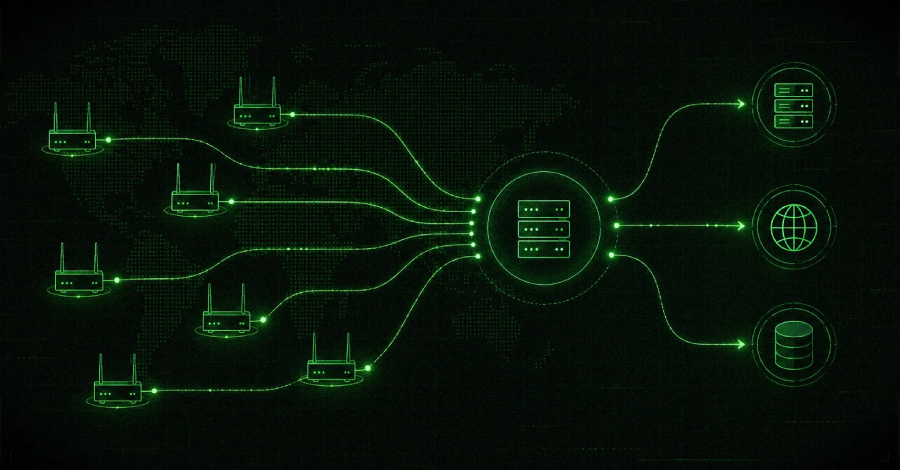
Most organizations worry about the attack itself — the breach, the ransomware, the data exfiltration. Far fewer think seriously about what happens in the hours, days, or weeks beforehand, when adversaries are quietly mapping networks, testing credentials, and routing malicious traffic through infrastructure that nobody is watching. That oversight is precisely the gap a newly identified malware family is designed to exploit.
Meet AryStinger: The Reconnaissance Botnet Nobody Saw Coming
Security researchers have identified a sophisticated malware strain, dubbed AryStinger, that is systematically compromising legacy home and small-office routers to construct what amounts to a distributed reconnaissance and proxy network. At least 4,300 devices have been confirmed infected, and that number continues to climb.
What separates AryStinger from the crowded field of router-targeting malware is its operational purpose. The overwhelming majority of router botnets are assembled for brute-force DDoS campaigns — high-volume, noisy attacks that burn through compromised nodes quickly. AryStinger is built for something far more surgical and, consequently, far more dangerous.
AryStinger exists for the stage of an attack that comes before the break-in — the reconnaissance phase, where patience and anonymity matter more than firepower.
By routing pre-attack traffic through thousands of residential and small-business IP addresses, threat actors using this infrastructure can conduct credential stuffing, port scanning, target profiling, and network enumeration while appearing to originate from innocuous consumer endpoints scattered across multiple geographies. Traditional IP-reputation blocking and geofencing become nearly useless against this kind of distributed noise.
Why Legacy Routers Remain the Perfect Attack Surface
The exploitation of aging router hardware is not a new tactic, but it remains stubbornly effective for several compounding reasons:
AryStinger's operators appear to have identified this sweet spot deliberately. A network of thousands of always-on, invisible, geographically distributed nodes provides reconnaissance capabilities that would otherwise require significant investment in commercial proxy services or VPN infrastructure — and those commercial services leave trails. Compromised routers do not.
The Broader Strategic Threat
Understanding AryStinger requires stepping back from the device-level technical details and appreciating the operational logic it enables. Reconnaissance is the foundational phase of virtually every sophisticated intrusion. Attackers use it to identify exposed services, validate target architecture, test authentication systems for weakness, and establish the intelligence baseline needed to craft convincing spear-phishing campaigns or precision exploits.
When that reconnaissance traffic arrives from tens of thousands of clean residential IP addresses, defenders face a signal-to-noise problem that existing tooling handles poorly. Automated blocking triggers false positives. Human analysts cannot manually triage at that volume. The attacker, meanwhile, moves at their own pace, unhurried and undetected.
This architecture also creates significant attribution complexity. Law enforcement and threat intelligence teams working to identify the actors behind a campaign find themselves staring at a fog of compromised consumer hardware rather than infrastructure that can be tied to a specific threat group, hosting provider, or geography.
What You Should Do
Whether you manage enterprise security or simply own a home router that connects to a corporate VPN, AryStinger's rise carries clear implications for action:
- Audit your router inventory: Identify any devices running end-of-life firmware and prioritize replacement. If a manufacturer is no longer issuing patches, the device should be considered compromised-in-waiting.
- Change default credentials immediately: Every router in your environment — at home, in branch offices, and in labs — should have a strong, unique administrative password. This single step eliminates a substantial portion of AryStinger's likely infection vector.
- Segment and monitor edge devices: Where possible, place routers and other network edge devices in isolated segments with outbound traffic monitoring. Anomalous outbound connections to unusual IP ranges are a primary indicator of proxy malware activity.
- Enable remote management restrictions: Disable remote administration interfaces unless strictly required, and restrict access to known IP ranges. Exposed management panels are a primary target for automated exploitation tools.
- Incorporate threat intelligence on residential proxy abuse: Security teams should update detection logic to flag unusual patterns consistent with residential proxy traffic — particularly during authentication and pre-attack reconnaissance phases.
- Consider firmware integrity monitoring: For critical infrastructure routers, periodic validation of firmware integrity can detect unauthorized modifications characteristic of persistent router malware.
The Quiet Threat Hiding in Plain Sight
AryStinger is a reminder that the most strategically dangerous threats are not always the loudest ones. A botnet designed for reconnaissance rather than destruction can operate for extended periods without triggering the alarms organizations have spent years calibrating. The infected routers powering this network are, to almost every monitoring system in existence, completely unremarkable.
That invisibility is the point. And with 4,300 confirmed nodes — and counting — AryStinger has already built a reconnaissance capability that demands the industry's full attention.


