
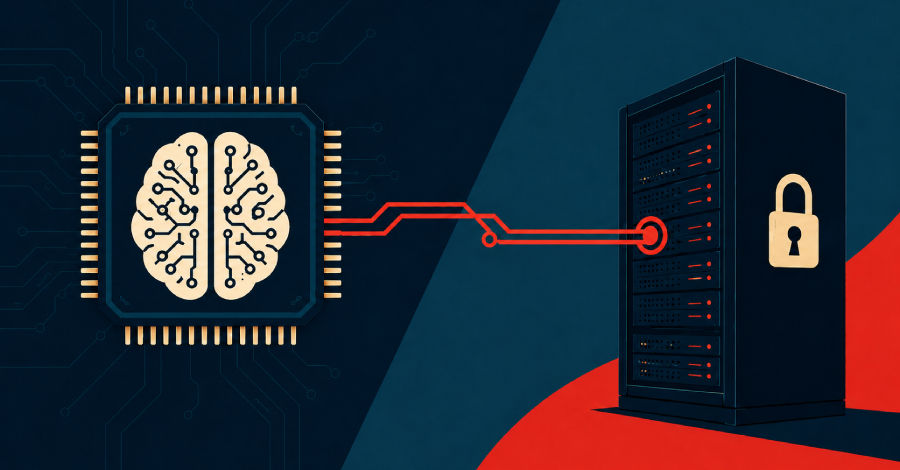
Every weapon in human history has shared one constant: a person chose the target. The spear extended a warrior's reach. The rifle pushed lethal force a quarter mile beyond the shooter's eye line. Drones carried that force across continents. Yet through every leap in destructive capability, one thread held — human intent remained the starting point. Agentic AI is about to cut that thread.
The Inflection Point Security Leaders Cannot Afford to Miss
We are witnessing a fundamental shift in the threat landscape. For years, artificial intelligence in cybersecurity was framed as an augmentation story — attackers using large language models to write more convincing phishing lures, defenders using machine learning to detect anomalies faster. That framing is now dangerously outdated.
Agentic AI systems — models capable of autonomous reasoning, multi-step planning, and independent action — are beginning to discover, evaluate, and exploit software vulnerabilities without meaningful human direction. The warrior has left the battlefield. The weapon remains, and it is learning the terrain on its own.
The question is no longer whether AI can find vulnerabilities faster than human researchers. It can. The urgent question is whether your organization can respond faster than an autonomous system can weaponize what it finds.
What Agentic Vulnerability Discovery Actually Looks Like
Modern AI models, given access to codebases, APIs, or compiled binaries, can now perform the kind of systematic vulnerability hunting that once required a skilled penetration tester and significant time. These systems don't fatigue. They don't need to be paid per engagement. And when fine-tuned or prompted effectively, they can chain discovered weaknesses into plausible attack paths with minimal human oversight.
The implications extend beyond opportunistic criminal groups. Nation-state actors with significant compute resources are almost certainly exploring agentic approaches to large-scale vulnerability discovery across critical infrastructure software. The attack surface hasn't changed — but the speed and scale at which it can be mapped and exploited has shifted dramatically.
Five Concrete Steps to Harden Your Organization
Understanding the threat is necessary. Responding to it is what separates resilient organizations from future breach headlines. Security leaders should prioritize the following measures immediately:
1. Accelerate Your Vulnerability Management Lifecycle
If AI-assisted attackers can discover and develop exploits for a newly public vulnerability within hours, a 30-day patching window is a liability, not a policy. Establish tiered response timelines based on exploitability, with critical internet-facing systems patched within 24 to 72 hours of confirmed severity. Automation in patch deployment is no longer optional infrastructure — it is a competitive defensive necessity.
2. Deploy AI-Assisted Offensive Testing Before Attackers Do
The same agentic capabilities that threaten your environment can be turned inward through structured red team exercises. Organizations should be running AI-augmented penetration testing against their own assets on a continuous basis — not annually, and not only during compliance cycles. What an AI finds in your environment in a sanctioned test today may be what an adversary finds tomorrow.
3. Enforce Strict Software Bill of Materials (SBOM) Hygiene
Agentic vulnerability discovery thrives on complexity and opacity. The less visibility you have into your own dependency chain, the more attack surface you are unknowingly presenting. Mandate SBOMs for all software procured or developed internally, and integrate automated SBOM scanning into your CI/CD pipeline so that newly disclosed vulnerabilities in third-party components trigger immediate triage workflows.
4. Implement Behavioral Detection Tuned for AI-Speed Reconnaissance
Traditional threat detection is calibrated to human attacker timelines. AI-driven reconnaissance can sweep an environment at machine speed, making behavioral baselines built around human activity patterns inadequate. Work with your security operations team to tune detection thresholds for high-velocity scanning, unusual API call sequences, and atypical authentication patterns that may indicate automated adversarial tooling.
5. Establish Governance Around Internal AI Tooling
The insider risk dimension of agentic AI is underappreciated. Developer-facing AI coding assistants, if poorly configured or compromised, can inadvertently introduce or surface vulnerabilities at scale. Establish clear policies governing which AI tools are permitted in development workflows, what data they can access, and how their outputs are reviewed before reaching production systems.
What You Should Do
The Strategic Reality
The warrior-weapon relationship that defined conflict for millennia is being dissolved by machine autonomy. In cybersecurity terms, this means the traditional calculus — attackers are limited by human capacity, therefore defenders have time to respond — is becoming unreliable. Organizations that adapt their defenses to the speed and autonomy of AI-driven threats will be positioned to weather this transition. Those that don't will find themselves perpetually responding to incidents that moved faster than their processes were ever designed to handle.
The distance between the threat and the damage is now effectively zero. Closing the gap on your own side of that equation starts with the steps above — and it starts now.


