
The number sounds like a misprint. It is not. Twenty-four billion stolen credentials — usernames, email addresses, plaintext passwords, and the URLs they were designed to unlock — were sitting in an openly accessible database until researchers quietly flagged it earlier this month. When the team triple-verified the record count, the figure held. What they had stumbled upon was not simply a data dump. It was a meticulously maintained arsenal.
Inside the Database: What 8.3 Terabytes of Stolen Identity Looks Like
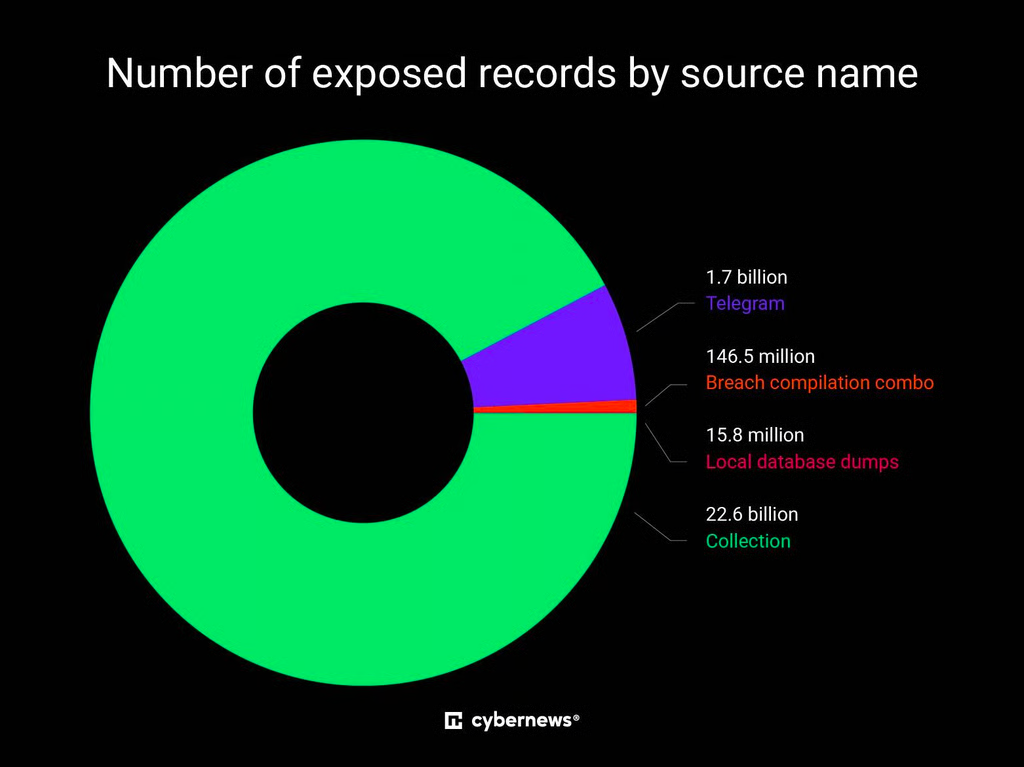
The exposed cluster was built on Elasticsearch and contained records drawn from 36 distinct sources. Each credential entry was stored individually, paired with the corresponding service or URL it was meant to compromise — a formatting choice that speaks to operational intent rather than casual hoarding. The sheer organizational discipline suggests whoever assembled this dataset had a clear purpose: industrialized account takeover.
The breakdown of sources is illuminating:
The Detail That Changes Everything: This Collection Was Being Actively Maintained
What elevates this incident beyond a typical data exposure is a small but alarming discovery buried within the dataset. Researchers found approximately 17,000 records containing vulnerability identifiers paired with GitHub repository links, more than 5,200 logs of news articles covering recent data breaches, and nearly 2,900 entries documenting social media discussions about cybersecurity incidents. One article referenced in the dataset was published as recently as February 2026.
This was not a static archive. Someone was reading the security news, cataloguing new breach disclosures, and systematically updating their credential stockpile to incorporate the latest leaked data.
The operational picture this paints is of a threat actor — or a criminal organization — running what amounts to a continuous credential intelligence program. New breaches occur. New infostealer campaigns harvest fresh passwords. New Telegram channels trade the output. And somewhere, a database gets updated.
The Infostealer Pipeline Driving the Crisis
The dominant source category for this exposure was infostealer malware logs. Infostealers — a category of credential-harvesting malware distributed through phishing campaigns, malicious software bundles, and compromised websites — have exploded in prevalence over the past three years. Families such as RedLine, Raccoon, and Lumma operate as subscription services in the criminal underground, generating millions of fresh credential sets weekly and funneling them directly into Telegram channels and dark web forums.
This pipeline is self-reinforcing. Infostealers harvest credentials. Credentials are traded on Telegram. Aggregators compile Telegram output into massive databases. Those databases fuel targeted account takeover attacks, business email compromise schemes, and credential-stuffing campaigns at industrial scale. The 24 billion record exposure represents one visible node in that ecosystem — and almost certainly not the only one of its size.
What Remains Unknown — and Why It Matters
Researchers were unable to determine the database owner's identity, the precise age distribution of the records, the total number of unique individuals affected, or the full contents of the "collections" category before the database was taken offline. The removal of the database from public access is a positive development, but it is not a remediation. Any party who accessed or copied the data before discovery retains a fully functional credential weapon.
What You Should Do
The practical risk calculus here is straightforward. Stolen credentials are only dangerous when they work. They work when users reuse passwords across multiple services and when accounts lack multi-factor authentication. Addressing both factors is non-negotiable:
- Enable multi-factor authentication immediately on every account that supports it — particularly email, financial services, and any platform that stores sensitive personal or organizational data. MFA renders stolen passwords functionally useless in the vast majority of attack scenarios.
- Audit password reuse across your accounts. If the same password protects your work email and your streaming service, a breach of either compromises both. Use a reputable password manager to generate and store unique credentials for every service.
- Monitor for credential exposure using breach notification services. Knowing when your email appears in a fresh dataset allows you to rotate credentials before attackers act on them.
- For security teams: Treat infostealer log monitoring as a core threat intelligence function, not an edge case. Dark web and Telegram monitoring for organizational domains and employee credentials should be an active, ongoing practice — not a reactive one.
- Organizations should audit third-party data exposure. Infostealers harvest credentials from every application running on a compromised endpoint, including corporate SaaS platforms. Assume that infostealer infections among your user base have already occurred and validate accordingly.
The database is offline. The credentials it contained are not. In the time between its creation and its discovery, the data almost certainly moved — copied, traded, and operationalized across multiple threat actors. That is the nature of credential markets. The only meaningful defense is making those credentials worthless before an attacker gets the chance to use them.


