
In a significant escalation of its cyber deterrence posture, the United States government has placed a $10 million bounty on members of two Russian intelligence-linked threat groups caught systematically compromising the encrypted messaging accounts of senior officials, defense personnel, and investigative journalists. The move signals not only the severity of the ongoing campaign but also a broader recognition that secure messaging platforms have become primary battlegrounds in modern espionage operations.
A Sophisticated Campaign Hiding in Plain Sight
What makes this operation particularly alarming is what it does not do. The adversaries behind these intrusions did not break Signal's encryption. They did not exploit a zero-day vulnerability in WhatsApp's codebase. Instead, they weaponized trust — exploiting legitimate platform features and human psychology to gain persistent, covert access to some of the most sensitive digital communications in existence.
The two groups, now publicly designated as UNC5792 and UNC4221, are assessed to operate under the direction of Russia's Federal Security Service, with personnel believed to include FSB Border Guard officers and individuals supporting Russian military intelligence objectives. Their operational playbook is methodical and deceptively low-tech on its surface.
How the Attacks Work
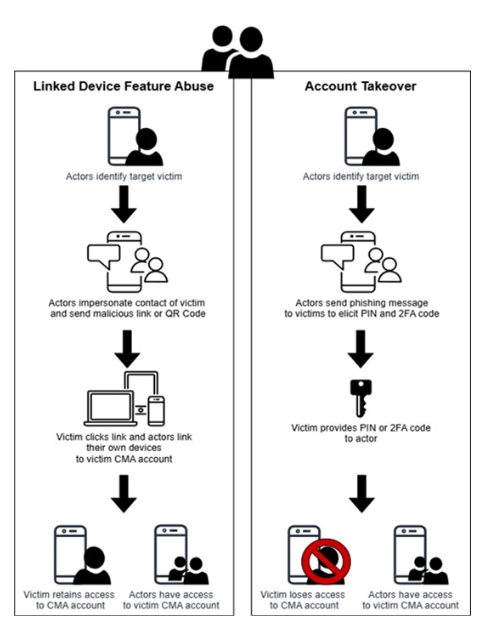
Rather than attacking the apps themselves, the groups exploit the device-linking functionality built into secure messaging platforms. Victims are lured through targeted phishing campaigns — often masquerading as official support communications — and manipulated into either approving a secondary device link on their account or, in the campaign's most recent evolution, surrendering their Signal Backup Recovery Keys.
This tactical shift is significant. Recovery keys unlock not just future messages but the entire historical archive of an account's conversations. A compromised recovery key effectively hands an adversary a complete retrospective window into months or years of private communications — contacts, group memberships, sensitive discussions — with no indication to the victim that anything is wrong.
The operators didn't need to break the encryption. They convinced users to hand over the keys themselves — a masterclass in social engineering that bypasses billions of dollars in platform security investment.
In some documented instances, the groups went further, modifying legitimate Signal group invitation pages to redirect targets to attacker-controlled infrastructure. The scale is not trivial — authorities estimate that thousands of messaging accounts have already been affected across this campaign.
Who Is Being Targeted
The target profile compiled by U.S. authorities reads like a directory of geopolitically sensitive individuals. The campaign has been directed at:
The breadth of this target set reveals an intelligence collection operation of considerable ambition — one designed not just to intercept individual communications but to map influence networks, identify sources, and potentially compromise entire information ecosystems surrounding Western policy on Russia and Ukraine.
Escalating Government Response
Federal agencies including the FBI and CISA have now updated earlier advisories to formally name these groups and expand the scope of known tactics. The public designation of UNC5792 and UNC4221 — with explicit links to FSB personnel — represents a deliberate shift toward naming and shaming, a strategy that has produced mixed but meaningful results in deterring state-sponsored cyber activity in the past.
The $10 million reward is being offered through the Rewards for Justice program and covers information that could identify group members, reveal their organizational structure, expose supporting contractors and infrastructure, or uncover the financial networks — including cryptocurrency wallets and funding channels — that sustain these operations. The breadth of the request suggests authorities have significant intelligence gaps they are hoping to fill through human sources.
What You Should Do
Whether you are a government employee, policy professional, journalist, or researcher operating in sensitive geopolitical spaces, this campaign demands immediate attention to your messaging hygiene. The following steps are strongly recommended:
- Audit linked devices immediately. Open Signal and WhatsApp settings and review every linked device. Remove any you do not recognize or no longer use.
- Treat your Recovery Key as a top-tier secret. Signal Backup Recovery Keys should never be shared, entered on unverified pages, or transmitted digitally. Legitimate support channels will never request them.
- Scrutinize group invitations. Be deeply suspicious of any unexpected Signal group invite, especially those arriving via SMS or third-party links rather than in-app from known contacts.
- Enable registration lock features. Signal's Registration Lock adds a PIN requirement before your account can be re-registered on a new device, providing a critical additional layer of protection.
- Apply security training beyond email phishing. Many organizations train employees to spot malicious emails but neglect messaging app threats. This campaign proves that gap is now actively exploited.
- Report suspicious outreach. If you receive unusual support messages, device-linking requests, or group invites from unknown parties, report them to your security team and relevant authorities.
The Bigger Picture
This campaign is a reminder that encryption alone is not a security strategy. End-to-end encryption protects data in transit — but it cannot protect against a user who is deceived into granting access voluntarily. As adversaries grow increasingly sophisticated in their social engineering capabilities, the human element remains the most exploitable vulnerability in any security architecture.
For organizations operating in high-risk environments, the message from this episode is unambiguous: secure messaging platforms require the same disciplined security culture applied to any other critical communication channel. The threat is real, the targets are broad, and the window for complacency has closed.


